Yunnan and Guizhou in 13 Days: Waterfalls, Old Towns, and the Tibetan Edge
China's southwest at traveling pace: cool-summer Guiyang for the Huangguoshu curtain and Ming-era stone lanes, then the Yunnan line — Kunming's eternal spring and gulls, Dali's lakeside old town under the Cangshan range, Lijiang's canal maze below a 5,500-meter snow peak, and the train up to Shangri-La's Tibetan monasteries at 3,300 meters. Every leg runs on rail, every day carries a booking rule that matters — Jade Dragon's cableway releases just 7 days out — plus a tropical swap: trade the Tibetan edge for Xishuangbanna's rainforest and the China-Laos Railway.
Route: Guiyang Kunming Dali Lijiang Shangri-La
The southwest is where China’s travelers stop ticking off sights and start traveling again. Guizhou and Yunnan stack experiences the rest of the country can’t: a waterfall you can walk behind, a salt lake that mirrors the sky, old towns where the local culture — Bai, Naxi, Tibetan, Dai — is the attraction, not the backdrop. This route strings them together by rail at a pace that works: three days in cool-summer Guiyang and the stone villages around it, then the Yunnan line climbing from Kunming’s eternal spring through Dali’s lakeside ease and Lijiang’s canal maze to Shangri-La, where prayer wheels the size of buildings need five people to turn. Altitude rises the whole way — that’s the design, and the reason the itinerary ends high, not starts there. City guides for Guiyang, Kunming, Dali, Lijiang, and Shangri-La go deeper on every stop.
Day 1: Arrive in Guiyang
Land, set up your apps at the airport (essential apps guide), and ease in. Guiyang’s pleasure is low-altitude and low-stakes: wander Jiaxiu Pavilion’s riverfront as the lights come on, then eat your way through a sour-soup fish dinner — the city’s signature — and an early night. Tomorrow is the biggest single day of the trip.
Practical tip: Jiaxiu Pavilion’s interior is free but needs a timed reservation via the “One Code Travel Guizhou” (一码游贵州) mini-program, and closes Mondays — the illuminated exterior at night is the better show anyway.
Day 2: Huangguoshu Waterfall
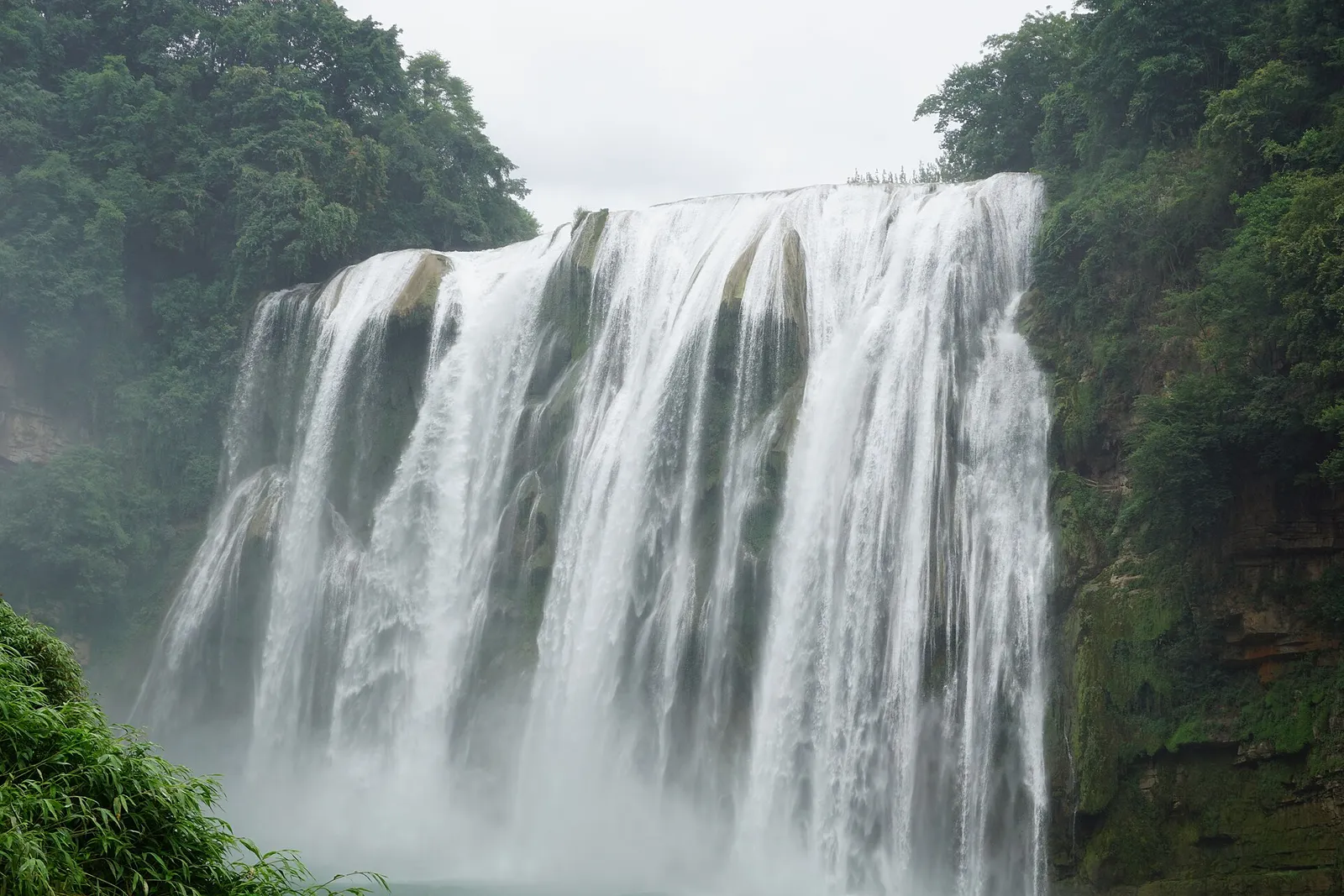
The full day out west: a high-speed hop to Anshun West (about 30 minutes), a shuttle bus to the falls, then the “Water-Curtain Cave” — a walkway that runs behind the falling water itself, the largest waterfall in Asia doing its thing a meter from your shoulder. Finish at Doupotang, the gentler cascade every Chinese childhood knows from a classic TV Journey to the West.
Practical tip: Tickets cost ¥160 in peak season (March-November; ¥150 off-season) covering all three areas, and the internal shuttle (¥50) is effectively mandatory — book one to 15 days ahead on the official “Anlutong” (安旅通) mini-program in WeChat or Alipay with your passport. Go early: tour coaches land by 10:30.
Day 3: Qianling’s Macaques and Qingyan’s Stone Lanes
Morning at Qianling Mountain Park, the city forest where wild macaques hold the paths and a Buddhist temple hums uphill — half zoo, half pilgrimage, entirelyGuiyang. Afternoon in Qingyan Ancient Town, a Ming-era garrison of stone walls and lanes an hour south; climb the wall section for the roofscape, then graze the rose-sugar snacks the town is known for.
Practical tip: Qianling has been free since 2024 but requires a timed reservation via its official WeChat account — your hotel front desk can book it if the app balks at foreign passports. Qingyan’s lanes are free; the small-sights combo runs about ¥60.
Day 4: The Rail to Kunming, Green Lake at Dusk
Morning train to Kunming (2.5-3.5 hours across the border ridge into Yunnan). Arrive to the country’s gentlest big city at 1,900 meters — the “Spring City,” where the weather barely argues all year. Walk Green Lake Park’s bridges at golden hour, and if it’s November-March, stand inside a blizzard of Siberian gulls that winter here.
Practical tip: Trains run most hours from Guiyang North/East to Kunming South; book the late morning so Day 5 stays whole. Second class floats roughly ¥143-255 depending on train. Near Green Lake, Yuantong Temple — the city’s oldest — costs a token ¥6.
Day 5: The Stone Forest
Day trip southeast to the Stone Forest, a UNESCO-listed karst maze where limestone pinnacles crowd together like a petrified city — 270 million years in the making, walkable in two hours, busiest in the middle of the day. Back in Kunming by late afternoon: the flower-and-bird market, then a crossing-the-bridge noodle ritual for dinner.
Practical tip: Entry is ¥130 (flat, year-round) with the passport used for booking; the electric carts add ¥25 and save the outer loops. Take the high-speed train to Shilin West (20-30 minutes) plus the connecting bus — and don’t confuse it with the slow-line “Shilin” station that lands you nowhere near the gate.
Day 6: The Rail to Dali, Old Town Evening
A two-hour ride northwest to Dali, where the Cangshan range rears 3,000-plus meters straight off the lake shore. Check into the old town, walk the wall-top at the South Gate, and let the evening take over — Bai textiles, song squares, the Foreigner Street legacy of the backpacker 1990s gone pleasantly domestic.
Practical tip: Kunming-Dali trains run all day; second class runs about ¥109-155 (most seats near ¥145). Stay inside or near the old town, not the lakeside “new town” of Xiaguan, unless lake sunrises outrank atmosphere.
Day 7: Erhai’s West Shore and the Three Pagodas
The classic Dali day: morning market grazing in Xizhou village — baba flatbread, fresh cheese, Bai courtyards — an e-bike or bicycle up the lakeshore through Zhoucheng’s indigo tie-dye workshops, then the Three Pagodas at golden hour, 1,200 years old beneath the Cangshan wall.
Practical tip: The Three Pagodas entry runs about ¥75 (flat price; the grounds close around 18:30, later in summer) — book online with your passport or at the gate outside holidays. E-bike rentals run roughly ¥60-150 a day: agree on the rate, insist on the helmet, and keep the west shore (46 kilometers round trip) as the sane loop.
Day 8: Cangshan or a Deliberate Slow Day
Pick one. Option A: ride a chairlift partway up Cangshan and walk the Jade Belt Path, a contour trail strung at 2,600 meters with the whole lake below. Option B: nothing — a teahouse morning, a market lunch, the lake breeze. Thirteen days have slack built in; this is where it lives.
Practical tip: Mountain entry is around ¥30-35 with three separate cableways (from about ¥60 return at the budget end to ¥240-300 for the high gondola toward 3,900 meters — weather-dependent). The middle Gantong option (~¥80-115 return) is the value pick for the Jade Belt Path.
Day 9: The Rail to Lijiang, Canal Lanes at Dusk
North again by rail (1.5-2.5 hours) to Lijiang, where the UNESCO-listed old town braids canals through Naxi-style timber courtyards below Jade Dragon Snow Mountain. Dusk is the hour: lanterns on the water, the hilltop Lion Pavilion view, and dinner in a courtyard where the menu still mostly serves the family’s own recipes.
Practical tip: The old town is free to wander, but the ¥50 ancient-town maintenance fee (valid a year) still officially exists and gets checked when you buy certain sights — including the Black Dragon Pond park, where the classic snow-mountain-over-pond photo happens (free with the fee receipt; best before the wind rises).
Day 10: Jade Dragon Snow Mountain
The big mountain day. The cableway lifts you from meadow to 4,506 meters, and a boardwalk climbs to the 4,680-meter marker under the glacier — thin air, thick sun, and the sound the mountain makes at that height is wind and nothing else. Blue Moon Valley’s turquoise pools soften the landing back down.
Practical tip: The trip’s tightest booking: park entry ¥100 plus the Glacier Park cableway ¥140 return, released 7 days ahead at 20:00 on the official Lijiang Tourism Group mini-program and capped daily in season — set the alarm, and fall back to a Trip.com order (pricier, passport-ready) if the mini-program rejects your foreign ID. Carry a warm layer and go easy at the top; oxygen cans rent on-site (safety guide).
Day 11: Baisha, Shuhe, and the Slow Naxi Morning
A day at village speed. Baisha, the old capital up the valley, keeps the Naxi murals and the quietest lanes; Shuhe, the “third old town,” splits the difference between heritage and cafe culture. Afternoon: pack, and taste your way through a final night in the Dayan lanes.
Practical tip: Baisha is free (the mural hall about ¥20, no photos inside); buses or a 30-minute bike ride cover it from the old town. This is also the swap slot: hikers trade the villages for the Tiger Leaping Gorge high trail — entry ¥65 from the Lijiang side — but only with a spare day; the gorge deserves better than a squeeze.
Day 12: The Train to Shangri-La
The Li-Xiang railway, opened 2023, threads 119 kilometers of gorge country to the Tibetan plateau in about 80 minutes — one of the world’s more scenic new rail lines. Arrive at 3,300 meters, and act like it: slow afternoon, butter tea in Dukezong’s whitewashed lanes, then the giant prayer wheel above town, which takes a crowd pulling together to turn.
Practical tip: About eight trains a day; second class runs roughly ¥56-70. Don’t plan anything athletic today — Dukezong and the Guishan park prayer wheel are free, close, and altitude-appropriate. Nights run cold even in summer; the town’s hotels rent oxygen if the headache insists.
Day 13: Songzanlin Monastery and the Flight Home
Morning at Songzanlin, the 300-year-old “Little Potala” — the largest Tibetan monastery in Yunnan, its roofs stacked up the hillside across a sacred lake, monks in the galleries and butter lamps everywhere. Afternoon: fly out from Diqing Shangri-La airport (five kilometers from town, about an hour to Kunming) or take the afternoon train back toward Lijiang.
Practical tip: Songzanlin entry runs roughly ¥55-115 depending on whether the shuttle-and-package tier applies — check at the visitor center; hours run about 8:00-18:00, last entry 16:00. Photography inside halls is banned; walk clockwise, hats off. Kunming flights run daily, but book the seat before you lock the Shangri-La nights.
The Tropical Swap: Xishuangbanna Instead of Shangri-La
Not a fan of altitude? Trade Days 12-13 for China’s tropical edge. From Kunming, the China-Laos Railway slides south to Jinghong in about 3-3.5 hours (second class roughly ¥150-220, about 29 trains a day) into a lowland world of Dai temples, rainforest, and a night market that peaks after dark around the golden stupa of Gaozhuang. The tropical botanical garden (¥80, plus ¥50 for the electric carts) is one of China’s finest; Wild Elephant Valley (¥65) offers an honest lottery — most visitors see no wild elephants, and the best odds are dawn or dusk boardwalks in the dry season, November-April. Manting Park (¥40) makes the easy evening. Fly home from Jinghong’s airport or rail back to Kunming; Xishuangbanna’s guide has the full picture.
Practical Notes
Intercity transport
| Leg | Mode | Time | Second-class fare (approx.) |
|---|---|---|---|
| Guiyang → Kunming South | G/D train | 2.5-3.5 hours | ¥143-255 |
| Kunming → Dali | C/D train | about 2 hours | ¥109-155 (most near ¥145) |
| Dali → Lijiang | C train | 1.5-2.5 hours | ¥48-80 |
| Lijiang → Shangri-La | D train | 1-1.5 hours | ¥56-70 |
| (Swap) Kunming → Xishuangbanna | D train, China-Laos Railway | 3-3.5 hours | ¥150-220 |
Four rail legs, zero flights inside the core route. Trains book 15 days out on 12306 (train guide); the Shangri-La legs are the ones worth booking early around holidays. Fares as of September 2026, floating pricing.
Budget estimate (per person, excluding international flights)
- Backpacker: US$750-1,000 — guesthouses, rice-noodle meals, buses and second-class seats, the budget cableway (~US$60-80/day)
- Mid-range: US$1,300-1,750 — courtyard hotels and boutique guesthouses, mixed dining, all tickets and cableways, day tours at Huangguoshu and Stone Forest (~US$100-135/day)
- Comfort: US$2,300-3,200 — the southwest’s upscale lodges, private drivers between villages, business-class seats (~US$175-245/day)
Yunnan’s sightseeing is cheap by national standards — most tickets are flat, year-round prices — so lodging and the two big cableways move the needle most. See our budget guide for the daily math.
Booking calendar (the part that makes or breaks it)
- 7 days ahead, 20:00 Beijing time: Jade Dragon Snow Mountain cableway on the official mini-program — the trip’s scarcest ticket
- 15 days out: trains, especially Lijiang-Shangri-La around holidays
- 1-15 days ahead: Huangguoshu on the Anlutong mini-program; Qianling Park’s free timed slots
- Rolling: Three Pagodas, Stone Forest, Songzanlin (walk-up fine outside holidays)
- Best months: May-October for the whole route; November-April if you take the Banna swap (best-time-to-visit guide). Home setup: 12306, Alipay, Didi, Amap, a translate app (essential apps guide)
Sources & verification (11)
- https://www.trip.com/travel-guide/attraction/zhenning/huangguoshu-waterfall-79814/
- https://www.chinadiscovery.com/guizhou/ansun/huangguoshu-waterfall.html
- https://www.guizhou.gov.cn/home/rdgz/202312/t20231228_83414656.html
- https://www.travelchinaguide.com/attraction/guizhou/guiyang/qingyan-ancient-town.htm
- http://shilingeopark.com/public/park/en-US/detail-446-28861.html
- https://www.chinahighlights.com/china-trains/kunming-dali-train.htm
- https://chinatripedia.com/three-pagodas-of-chongsheng-temple-ticket-opening-hours-location-and-highlights/
- https://chinafortravelers.com/cities/yunnan/
- https://us.trip.com/trains/china/route/lijiang-to-shangri-la/
- https://chinatripedia.com/pudacuo-national-park-shangri-la-ticket-opening-hours-location-and-highlights/
- https://us.trip.com/trains/china/route/kunming-to-xishuangbanna/