Kunming, the capital of Yunnan in China's far southwest, trades big-city spectacle for something rarer: weather you can plan around. Sitting at about 1,900 meters on a plateau ringed by hills, it stays mild through the year, which shapes everything — the lakeside strolls, the flower stalls, the outdoor life in its parks. Most visitors meet it as the gateway to Yunnan, catching high-speed trains to Dali and Lijiang or a bus to the UNESCO-listed Stone Forest, and that is exactly the right way to use it. Stay a few days and the city grows on you: red-billed gulls wheeling over Green Lake Park in winter, incense drifting through a 1,200-year-old temple, bowls of crossing-the-bridge noodles assembled tableside. It suits slow travelers, food-lovers, and anyone easing into China before the region's bigger names.
Top sights at a glance
No. 1
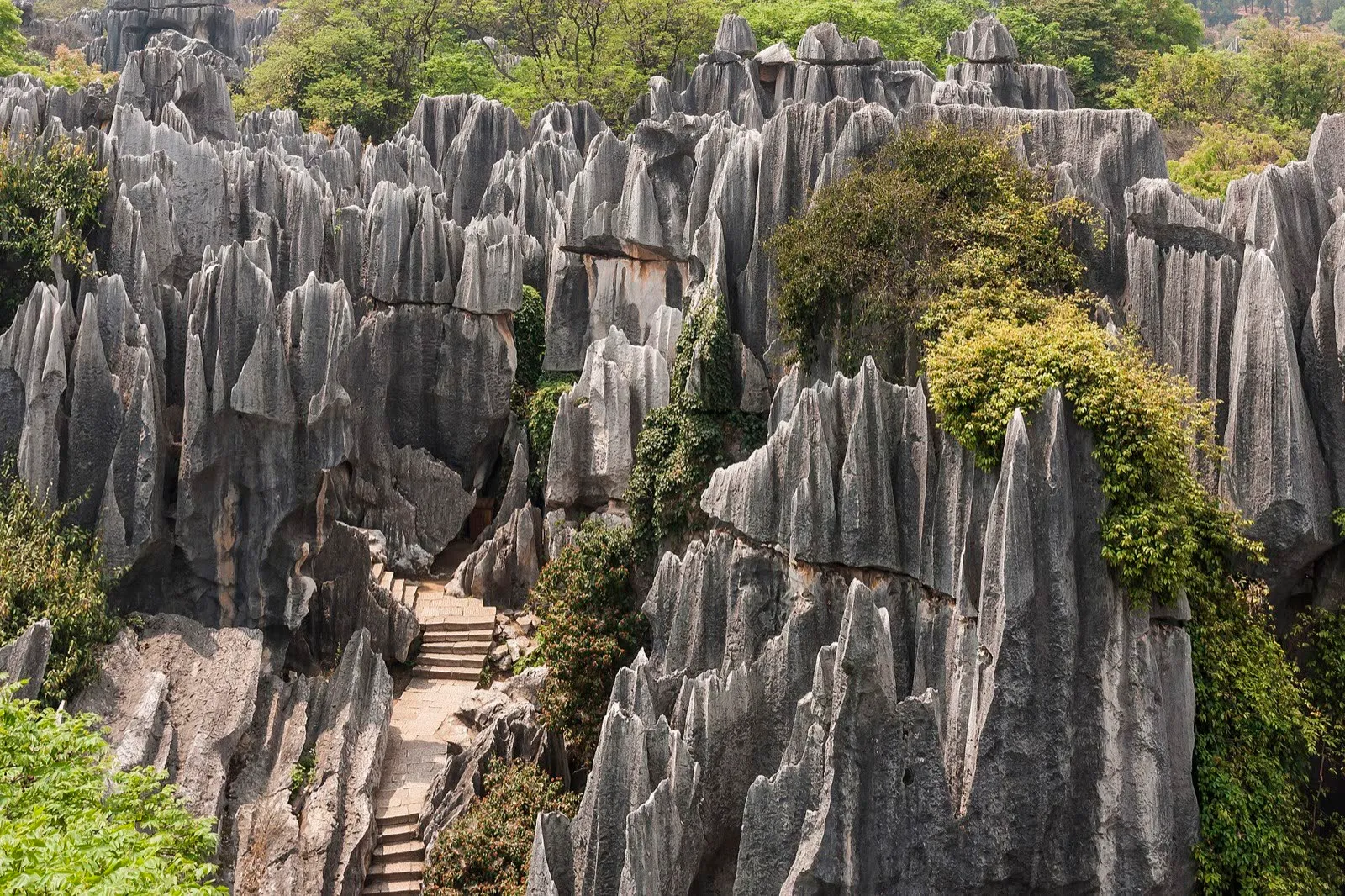
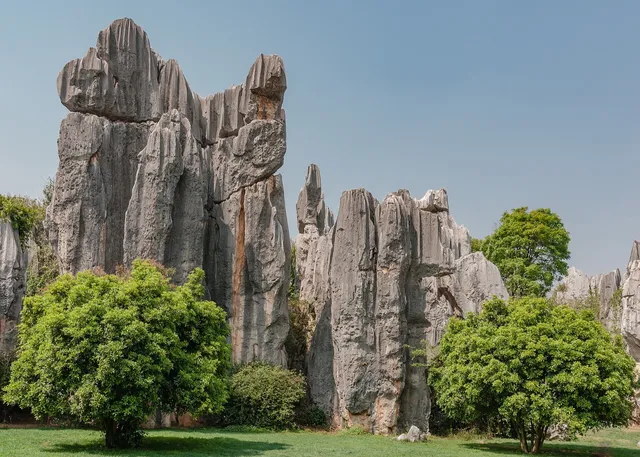
The Stone Forest
An hour and a half southeast of the city, limestone pillars the height of apartment buildings crowd together in a gray forest sculpted by rain over some 270 million years. This is China's most famous karst landscape, inscribed by UNESCO in 2007 as part of the South China Karst World Heritage site. Paved walkways thread the densest clusters, the Sani people's Ashima legend haunts the rock walls, and a good karst museum rounds out the geology.
Good to know · Entry runs about ¥130, open roughly 7:30 AM–6:00 PM with last admission around 5:30 PM (as of September 2026). High-speed trains from Kunming South station reach Shilin West in under 40 minutes; shuttle buses and taxis cover the final few kilometers. Arrive at opening to stay ahead of tour groups.
No. 2
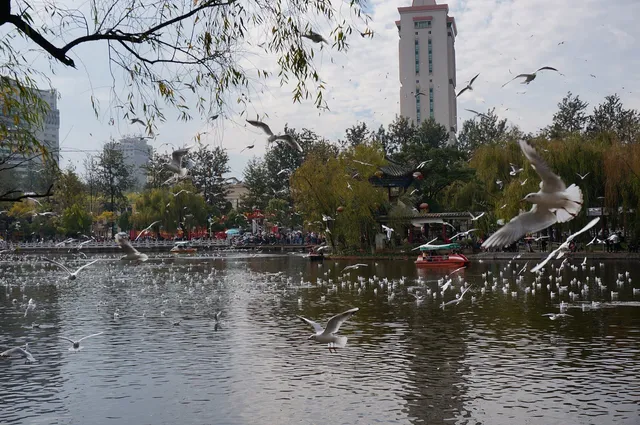
Green Lake Park
Two mirror-still ponds linked by lotus-draped causeways, Green Lake (Cuihu) is Kunming's living room — free, central, and busiest at dawn, when pensioners practice sword forms and folk choirs gather under the willows. From November to March the park's real celebrities arrive: thousands of red-billed gulls that fly down from Siberia each winter, taking bread from strangers' fingertips. Cafes and the leafy lanes around Yunnan University sit right at its edge.
Good to know · The park is free and open all day; the gulls are most active mid-morning and late afternoon in November–March. Combine it with Yuantong Temple, a 20-minute walk east, and the cafe streets near the university's main gate.
No. 3
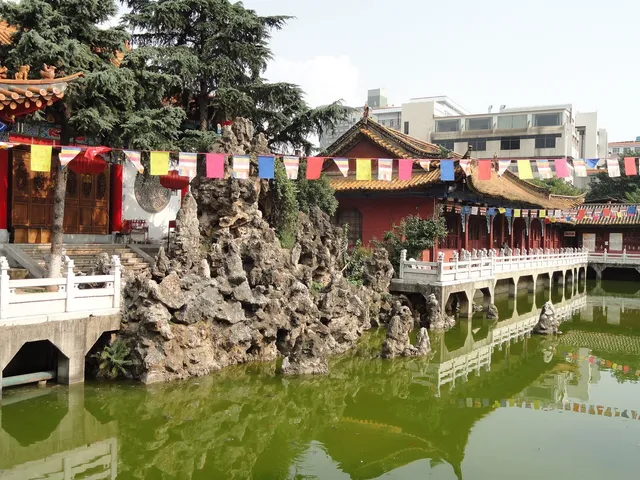
Yuantong Temple
Kunming's oldest and largest Buddhist temple has held this ground for more than 1,200 years, dating to the Nanzhao kingdom of the Tang era. Its design is unusual: the halls sink into a hollow around a pond where carp and turtles cruise beneath a small central pavilion, and the Guanyin Hall sits against the cliff at the rear. Incense, chanting, and enormous banyan shade make it a genuinely working monastery, not a museum.
Good to know · Entry costs just ¥6 (as of September 2026); the temple opens early in the morning and closes by early evening. It sits on Yuantong Street between Green Lake Park and Kunming Zoo, an easy walk from the park's east side — go in the morning for the atmosphere.
No. 4
Dianchi Lake & Haigeng Dam
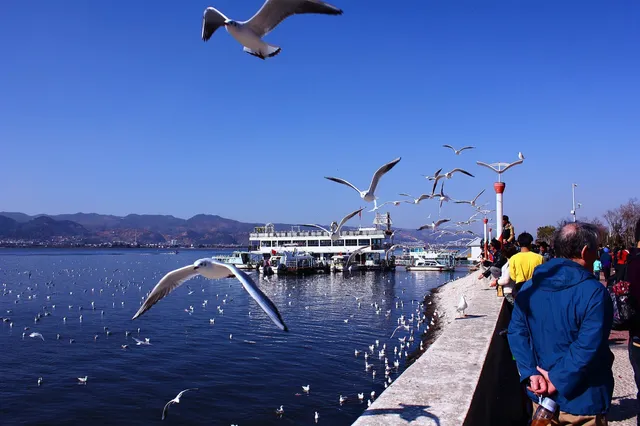
Yunnan's largest lake spreads like an inland sea along Kunming's southern edge, backed by the Western Hills' long 'sleeping beauty' silhouette. The Haigeng Dam, a 3-kilometer causeway between lake and city, is the place to feel the scale: kite-surfers offshore, willows along the water, and in winter a blizzard of red-billed gulls riding the wind at arm's length. It is the single most popular free viewpoint in the city.
Good to know · The dam is free and open around the clock; gull season runs November–March, with birds most active around 8–10 AM and again before sunset (as of September 2026). It is roughly 30–40 minutes from downtown by taxi or DiDi, with buses and metro lines serving the lakefront area — check current stops locally.
No. 5
The Flower & Bird Market
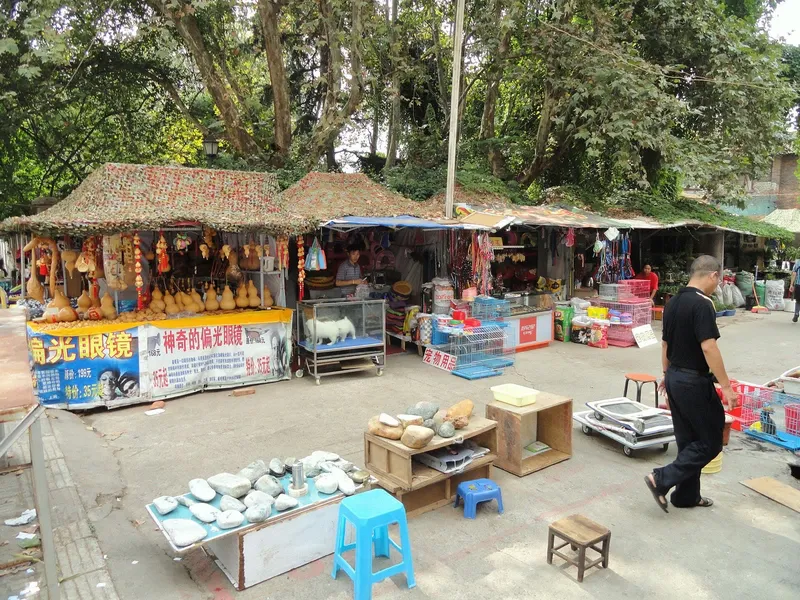
On Jingxing Street in the restored Kunming Old Street quarter, one of the city's oldest markets still trades in the beautiful and the bizarre: songbirds in bamboo cages, chirring crickets in clay pots, koi and orchids, jade bangles, copper teapots, and antiques of uncertain age. It is part shopping street, part living museum of Yunnan's obsessions, and one of the few places in town where bargaining is part of the fun.
Good to know · Stalls generally trade from mid-morning to late afternoon, and weekends bring the fullest scene (as of September 2026). Pair it with the surrounding Old Street lanes and the nearby Jinma Biji archways, then finish with a meal in the old quarter.
Yunnan’s capital is the rare Chinese city that promises weather instead of wonders — and delivers. Sitting on a plateau at about 1,900 meters (6,200 feet), Kunming calls itself the Spring City, and the nickname holds up: while Shanghai sweats and Harbin freezes, Kunming stays in cardigan territory. Do not come expecting a Shanghai skyline or a Beijing monument count. Come for the soft pleasures — gulls wheeling over a downtown lake, incense in a 1,200-year-old temple, flowers sold by the armful, noodles assembled like a chemistry experiment — and come because nearly every road into Yunnan runs through here. The Stone Forest, a UNESCO World Heritage karst wonder, makes an easy day trip, and high-speed trains put Dali two hours away. Kunming is the ideal place to decompress after a long flight, get your payment apps sorted, and learn how China travels before heading deeper into the country’s most varied province.
A Bit of History
Civilization here is older than the city’s fame. Two millennia ago the Dian Kingdom flourished around Lake Dianchi, leaving bronze drums, cowrie containers, and figurines so finely cast that museums worldwide display them — the best collection, fittingly, is in the Yunnan Provincial Museum. Han dynasty armies absorbed the kingdom around 109 BC, and the region lived on as a highland crossroads on the trade routes linking China to Tibet, Myanmar, and Southeast Asia — the network later romanticized as the Tea Horse Road, along which tea and horses moved for a thousand years.
Kunming’s modern era began with an unusual foreign import. In 1910 a French-built railway linked the city to Haiphong in Vietnam — an engineering epic through gorges and tunnels — and suddenly this remote plateau capital had a direct line to the outside world, complete with European hotels, consulates, and an enduring cafe habit; the meter-gauge locomotives of that era are preserved at the railway museum by Kunming North station. That cosmopolitan streak proved decisive in the Second World War. When Japan blockaded China’s coast, the Burma Road was pushed through from Kunming into Myanmar, and the American Volunteer Group — the Flying Tigers — flew their shark-mouthed P-40s out of the city’s airfields, with residents lining routes to watch them. Meanwhile three of China’s top universities, fleeing occupation, merged into the National Southwestern Associated University and taught a generation of future Nobel laureates, physicists, and poets in spare campus huts here from 1938 to 1946; the modest museum on the old site is one of the city’s most moving stops.
After 1949 the city grew into an industrial and administrative center, and in recent decades into something more deliberate: the launchpad for Yunnan tourism. Today’s Kunming is polished and unhurried, an airport hub with a metro, an ever-expanding skyline around the lake, and a self-image built on climate rather than conquest. Museumgoers can trace every chapter above in a single afternoon. The gulls that began wintering here in 1985 have become the city’s emblem — proof, residents like to say, that even the birds know a good thing when they find it.
Culture & Daily Life
Yunnan is China’s most ethnically diverse province, and the capital is where all of it mixes: Yi, Hui, Bai, Sani, and dozens of other communities live and trade here, visible in the markets, the restaurants, and the provincial museum’s superb ethnic-costume halls. The city has none of the megacity energy of Chengdu or Chongqing; it feels provincial in the best sense. Life organizes around parks and lakefronts — dawn tai chi, folk opera circles, mahjong under banyans, and in winter, the civic ritual of feeding the gulls, which locals have done with genuine tenderness since the birds first arrived in 1985.
Flowers are the other obsession. Yunnan supplies a large share of China’s cut flowers, and Kunming’s Dounan market ranks among the biggest flower markets in Asia; roses here are sold by the kilogram like potatoes, and corner florists do brisk evening business with commuters. Food culture runs deep and casual — this is a city of noodle breakfasts, afternoon tea, and late rice-noodle suppers.
Teahouses anchor the rhythm of the day. Kunming’s old teahouse culture — bowls of pu’er refilled endlessly, chess players, radio operas — survives alongside a newer wave of specialty-coffee roasters pouring Yunnan-grown beans, and the two sit comfortably blocks apart, sometimes on the same street. Weekends bring the flower and antique markets their fullest, and the lakeside promenades turn into a parade of families, photographers, and wedding parties renting traditional Yunnan dress for portraits.
One practical note shapes daily travel: Kunming sits high, so the sun is strong even when the air is cool, and nights can drop ten degrees from midday. Locals carry layers and sunscreen as a matter of course; travelers should too. English is less widespread than in coastal cities, but the tourist machinery — bilingual signage at major sights, easy payment apps, forgiving transport — works smoothly.
Nature & Day Trips
Kunming’s natural asset is the lake-and-mountain pairing on its doorstep. Lake Dianchi laps the city’s southern edge, and the Western Hills rise straight from its western shore; a half-day climb through pine forest reaches the Dragon Gate, a network of grottoes and ledges carved into the cliff face with the whole lake spread below. A cableway connects the hills to the lakeside, making an easy loop.
Farther afield, Fuxian Lake, about an hour south toward Yuxi, is the local secret: a vast, startlingly clear lake with swimmable-looking water and a slower rhythm than Dianchi. Photographers chase the Dongchuan Red Land, a 3-hour drive north where iron-rich soil stripes the hillsides in crimson and gold — best as an overnight. Jiaozi Snow Mountain, closer still, lifts a chairlift into genuine alpine country when you need a cool-weather fix. And when the weather misbehaves, the provincial museum’s bronzes and ethnic exhibits are a first-rate rainy-day fallback.
Within the city itself, Green Lake Park and the lakeside strips do most of the work. The honest advice: treat Kunming’s outdoors as a warm-up act, spend one full day on the Stone Forest, and save your biggest nature days for Dali, Lijiang, and the national parks beyond.
Food & Drink
Yunnan cooking is one of China’s great regional cuisines, and Kunming is the place to learn it. The signature dish is crossing-the-bridge rice noodles (guoqiao mixian). The legend — a Qing-era scholar’s wife from Mengzi who carried hot soup across a bridge to her studying husband and discovered a layer of oil keeps broth scalding — explains the ritual on your table: a bowl of boiling broth, a tray of raw quail egg, ham slices, tofu, vegetables, and noodles, all cooked by you, in order, at the table. Simple bowls cost a few dollars; banquet versions turn it into theater.
Beyond the noodles: er kuai, chewy rice cakes stir-fried or grilled at street stalls; Xuanwei ham, Yunnan’s answer to prosciutto; steamed-pot chicken, simmered in a lidded clay pot with no added water; and, in season from roughly June to October, wild mushrooms, when markets fill with chanterelles, porcini-like boletes, and prized matsutake. Eat mushrooms in restaurants rather than self-catering — even locals treat them with respect.
Do not skip the flower pastries (xianhua bing), flaky rounds stuffed with rose-petal sugar, best warm from the oven, or the province’s other beverage trades: pu’er tea served gongfu-style in any teahouse, and a fast-growing Yunnan coffee scene that has made lattes from local beans a point of pride. Because Yunnan borders Southeast Asia, Dai, Burmese, and Lao flavors also thread through the city — lemon-grass grilled fish, coconut curries, and tropical fruit salads that would not be out of place in Chiang Mai. Night markets and the food streets around the old quarter keep cooking until late.
Prices run gently — street breakfasts are pocket change, a generous noodle lunch costs little more, and a very good multi-dish restaurant dinner rarely approaches what Beijing or Shanghai would charge for far less. Order by pointing at neighboring tables; it works.
Top Sights
Give the Stone Forest a full day, the rest of the city half-days stitched around meals and parks. Book major tickets a day ahead with your passport via official mini-programs or Trip.com, paying with Alipay or WeChat Pay.
The Stone Forest
Some 270 million years ago this ground lay under a tropical sea; the limestone it left behind has since dissolved into a forest of gray pillars, some several stories tall, crowded so tight the paths feel like corridors. The main Shilin scenic area, about 78 kilometers southeast of Kunming, is the headline site of the South China Karst World Heritage listing inscribed in 2007, and it earns the designation — particularly in early light, when the pinnacles throw long shadows and the tour buses are still in the city. Local Sani (Yi) people weave the area’s legends, most famously Ashima, a maiden said to have turned to stone; her silhouette is the park’s signature formation. An on-site karst museum makes the geology legible, and the quieter Naigu Stone Forest nearby offers the same formations with a fraction of the crowds. Entry runs about ¥130, open roughly 7:30 AM–6:00 PM with last admission around 5:30 PM (as of September 2026) — buy via the official channels or Trip.com with your passport, and aim for the first hours of the day.
Green Lake Park
Every Chinese city keeps a favorite park, and Kunming’s is unbeatable for setting: two linked ponds laced with willow causeways and lotus, framed by the weathered gates of Yunnan University and the cafe lanes of Wenlin Street. Come at dawn to share the flagstone paths with sword dancers and sparrow-whistlers, or come in gull season and simply stand still with a bag of bread crumbs — from November to March the red-billed gulls that fly down from Siberia each winter swirl so thickly over the water that the sky seems to flicker. The tradition dates to 1985, when the birds first wintered here, and Kunming has adopted them as its mascot. The park is free and open all day. Teahouses and coffee roasters ring the water; the temple of Yuantong lies a 20-minute walk east, and the university’s old campus — with its links to the wartime university story — is worth an unhurried hour.
Yuantong Temple
Kunming’s oldest Buddhist foundation has occupied this pocket beneath Yuantong Hill for over 1,200 years, and its setting remains one of the most atmospheric in any Chinese city. Unusually, the temple descends: you enter at the top of a sunken courtyard that funnels down to a pond spanned by an octagonal pavilion, carp and turtles crowded beneath its eaves, halls rising in tiers to a Guanyin figure set against the living cliff. Founded in the era of the Nanzhao kingdom during the Tang dynasty, it remains a working monastery — expect chanting, thick incense, and lines of devotees, especially on Buddhist holidays. Entry is a token ¥6 (as of September 2026), open from early morning until early evening. Come before 9 AM to share the courtyard with worshippers rather than tour groups, then walk west to Green Lake Park for a park-bench debrief.
Dianchi Lake & Haigeng Dam
Yunnan’s largest lake is so wide it reads as sea, with the Western Hills drawing a long “sleeping beauty” profile along the far shore. The Haigeng Dam, a 3-kilometer lakeside causeway, is the classic vantage: joggers and kite-flyers on the path, sailboards offshore, and in winter a cyclone of gulls close enough to feel the wingbeats. Honesty note: Dianchi fought decades of algae problems from old industrial pollution, and the water still will not pass for tropical — the pleasure here is the scale, the mountains, the wind, and the birds, not a swim. The dam is free and open around the clock; gull season runs November–March, with the birds most active around 8–10 AM and in the hour before sunset (as of September 2026). Feeding is tolerated and vendors sell proper feed — skip the bread. Allow half a day, ideally ending with sunset behind the hills.
The Flower & Bird Market
Kunming’s old heart keeps one of China’s most engaging markets on Jingxing Street, in the restored Kunming Old Street quarter. The wares run from the charming to the eccentric: songbirds in handmade cages, crickets chirring in clay gourds (kept, famously, for their song), tanks of koi, orchids and succulents, jade and silver bangles, brass teapots, Mao-era knickknacks, and antiques of conveniently flexible provenance. You are not required to buy anything — the browsing is the show, and the surrounding Old Street lanes reward an unhurried loop with snacks and colonial-era facades. Stalls trade from mid-morning to late afternoon, with weekends fullest (as of September 2026). Bargaining is expected for jade and antiques; agree on prices politely and smile. Finish nearby at the twin Jinma Biji archways, the city’s old south-gate landmark, glowing nicely after dark.
Getting There & Around
Kunming Changshui International Airport is one of China’s busiest hubs and the main aerial gateway to Yunnan, with dense domestic connections from every major Chinese city and a handful of international routes; it sits roughly 30 kilometers from downtown, about 45 minutes by airport bus, metro, or DiDi. Long-haul travelers will almost certainly connect through Chengdu, Chongqing, Guangzhou, or Shanghai.
By rail, the city is Yunnan’s high-speed hub. Kunming South station, linked to the metro, dispatches trains to Dali in about two hours (fastest around 1 hour 55 minutes, with dozens of departures daily) and to Lijiang in roughly 3 to 3.5 hours — second-class fares run about ¥265–318 on the Lijiang route (as of September 2026). Trains to Shilin West for the Stone Forest take well under an hour. Book on the official 12306 app or Trip.com with your passport; arrive early for security.
Inside the city, the metro covers the core and airport, DiDi is fast and cheap, and taxis are metered. Pack for altitude: strong sun at 1,900 meters, cool evenings, and dry air — sunscreen and a layer, year-round.
Where to Stay
Three bases cover most trips. The Green Lake area, around the park and Wenlin Street, is the traveler’s choice: leafy, cafe-dotted, walkable to Green Lake Park, Yuantong Temple, and the university, with the widest range of guesthouses and boutique hostels. The city center around Nanping and the Jinma Biji archways suits first-timers who want metro connections, shopping, and the Old Street quarter at the doorstep — pick a room off the main drags for quiet. The Haigeng lakeside strip, south toward Dianchi, trades centrality for space and lake air; it makes sense for families and for gull season, when dawn on the dam is the day’s headline act.
Whatever the base, book stone-silent rooms away from elevator shafts and main roads — Kunming is quieter than most Chinese cities but not silent. Two nights covers the city; add a third if the Stone Forest and a slow morning by the lake both make the cut.
Sources & verification (12)
- http://shilingeopark.com/public/park/zh-CHS/detail-421-30074.html
- https://whc.unesco.org/en/list/1248/
- https://en.wikipedia.org/wiki/Stone_Forest
- https://www.yunnanexploration.com/attractions/kunming-stone-forest
- https://en.wikipedia.org/wiki/Green_Lake_(Kunming)
- https://www.gokunming.com/en/blog/item/4560/from-siberia-with-love-the-yearly-seagull-winter-migration-to-kunming
- https://www.gokunming.com/en/listings/item/208/yuantong-temple
- https://www.yunnanexploration.com/attractions/dianchi-lake-bird-watching-in-kunming
- https://www.yunnanexploration.com/attractions/jingxing-flowers-and-birds-market-in-kunming
- https://en.wikipedia.org/wiki/Crossing-the-bridge_noodles
- https://www.trip.com/trains/china/route/kunming-to-dali/
- https://us.trip.com/trains/china/route/kunming-to-lijiang