Three Weeks in China: The Deep-Dive Route
China in one long, honest sweep: imperial Beijing, the Ming banking town of Pingyao, Xi'an and its Terracotta Army, a Silk Road detour to Dunhuang's Mogao Grottoes, panda-and-hotpot Chengdu, then the Himalayan foothills of Lijiang and Dali before a Shanghai finish. Planes and high-speed trains are mixed for the fastest realistic routing — including the Xi'an-Dunhuang leg everyone gets wrong. Twenty-one days, nine hotels, real altitude, and the country's scarcest ticket (Mogao's Class A) all flagged, with a mid-range budget of US$110-150 per day.
Route: Beijing Pingyao Xi'an Dunhuang Chengdu Lijiang Dali Shanghai
Twenty-one days is enough to see China as a country rather than a highlight reel, and this route connects the three Chinas most first-timers never see together: the imperial north, the Silk Road northwest, and the mountain southwest, before surfacing in Shanghai for a cosmopolitan finish. Be honest about the pace — nine hotels, early trains, two stretches at altitude. The 30-day visa-free entry most Western passports now carry makes the timing comfortable rather than tight, and the mix of planes and high-speed rail keeps every travel day under half a day. City guides for Beijing, Xi’an, Chengdu, and Shanghai go deeper; Pingyao, Dunhuang, Lijiang, and Dali guides are coming to this site soon.
Day 1: Arrive in Beijing
Ease in. Airport express or Didi downtown, then a slow afternoon around Qianmen’s restored shopping street and the hutong lanes behind it, where courtyard homes, snack carts, and card-playing grandmothers set the tone. Dinner is the only commitment — make it Peking duck, reserved ahead if you want a famous name. If jet lag wins at 8 p.m., let it.
Practical tip: Sort the tech at the airport, where English help desks exist: eSIM live, Alipay charging your foreign card, 12306 logged in (payments and connectivity guides walk through it). This trip books everything through those apps.
Day 2: Tiananmen Square and the Forbidden City
Reserve the square in advance (free, mandatory), then walk north through the gate into the Forbidden City for three to four hours along the central axis — Meridian Gate to the throne halls to the imperial garden — exiting north into Jingshan Park. Climb the hill for the classic panorama of golden roofs, then a long dinner; tomorrow is the trip’s first big physical day.
Practical tip: Tickets are ¥60 peak season, released 7 days ahead at 20:00 Beijing time on the official site, and gone within hours in season. Closed Mondays — if Day 2 falls on one, swap with Day 3 before booking anything else.
Day 3: The Great Wall at Mutianyu
Full day at Mutianyu: the Dongzhimen shuttle out, cable car up to the restored watchtowers, and the ridge walk east toward Tower 20, where the crowds thin and the wall rides the mountains alone. Toboggan down — a minute of pure joy — then village lunch and back in the city by late afternoon for a hotpot recovery meal.
Practical tip: The stack is ¥40 entrance + ¥15 shuttle + ¥140 round-trip cable car. Book 1-2 days ahead on official channels and start early; tour coaches land by 11 a.m. and the serenity ends with them.
Day 4: Temple of Heaven, Hutongs, and an Early Night
Morning at the Temple of Heaven, where the park around the masterpiece hall doubles as Beijing’s open-air gym — tai chi, choirs, shuttlecock. Buy the ¥34 peak-season combo ticket; the park ticket alone skips the halls. Afternoon drifting the Drum Tower and Shichahai hutongs, evening packing, and an early night before the trip’s rhythm begins.
Practical tip: Confirm the Day 5 train tonight: Beijing West to Pingyao Gucheng runs about 4 hours (¥213-321 second class) with only a handful of departures daily — the fastest one sells out first.
Day 5: High-Speed Rail to Pingyao, Walls at Dusk
A four-hour ride west across Shanxi’s loess plateau delivers you to Pingyao Ancient City station, then a 15-minute ride to one of China’s great survivals: a complete Ming-dynasty walled town, six centuries of courtyards, temples, and banks intact inside 6 km of ramparts. Walk the walls at dusk when the tour groups have gone, then sleep in a converted courtyard inn — this is the night the trip changes gear.
Practical tip: The old town is free to enter; the ¥125 pass covers 22 sights and stays valid three days, so spread the spending of your legs — nothing inside needs sprinting.
Day 6: Pingyao’s Banks, Temples, and Courtyards
A full day inside the walls at walking pace: Rishengchang, China’s first draft bank and the ancestor of modern remittance; the county yamen where Qing magistrates held court; temple courtyards, underground vaults, and the city wall itself, rented bicycle optional. Evening is for a courtyard dinner under lanterns — or the acclaimed “Again Pingyao” immersive drama, if tickets align with your night.
Practical tip: The pass admits each sight once within its 3-day validity. Plan geographically — south gate first, vaults before lunch — and note most sights close by early evening.
Day 7: Train to Xi’an, the Muslim Quarter at Dusk
Pingyao to Xi’an takes only 2.5-3 hours (from about ¥125), so the morning is still yours: one last wall walk, a courtyard breakfast, then the ride south into Shaanxi. Arrive mid-afternoon, settle near the Bell Tower, and spend the evening grazing the Muslim Quarter — roujiamo, lamb skewers, persimmon cakes — the eastern end of the old Silk Road doing what it has always done.
Practical tip: The metro from Xi’an North to the walled city (Line 2) takes 20-30 minutes and shuts down around 23:00. Stay inside or near the walls — it is the difference between a city and a base camp.
Day 8: The Terracotta Warriors and the City Wall by Bike
Morning at the Terracotta Warriors, 40 km east: stand where Pit 1’s life-size army stares back, an honest jaw-dropper even after all the photographs. Take the included shuttle out to Lishan Garden’s quiet mound, then back in town by late afternoon for the ride most cities would charge a fortune for: bicycles on top of the 13.7 km Ming City Wall at sunset.
Practical tip: Warrior tickets (¥120 through ticket) open up to 7 days ahead on the museum’s official WeChat channels and sell out around Chinese holidays — book the moment your Xi’an dates are fixed.
Day 9: Tang Xi’an in the Morning, Fly to Dunhuang at Dusk
Morning at the Big Wild Goose Pagoda square or the Shaanxi History Museum (free, but reserve ahead) — Tang-dynasty Xi’an was the world’s cosmopolis, and this is its last great witness. Then the day’s real move: a 2-2.5 hour flight west across the Hexi Corridor to Dunhuang, landing in time for the night market’s grilled lamb under the poplar trees.
Practical tip: Fly, do not train: the rail route means 10-11 hours with a transfer near Lanzhou, or a 22-hour overnight K train. Book 3-6 weeks out; peak-season fares run ¥800-1,500, and early birds see half that.
Day 10: The Mogao Grottoes, Then the Singing Dunes
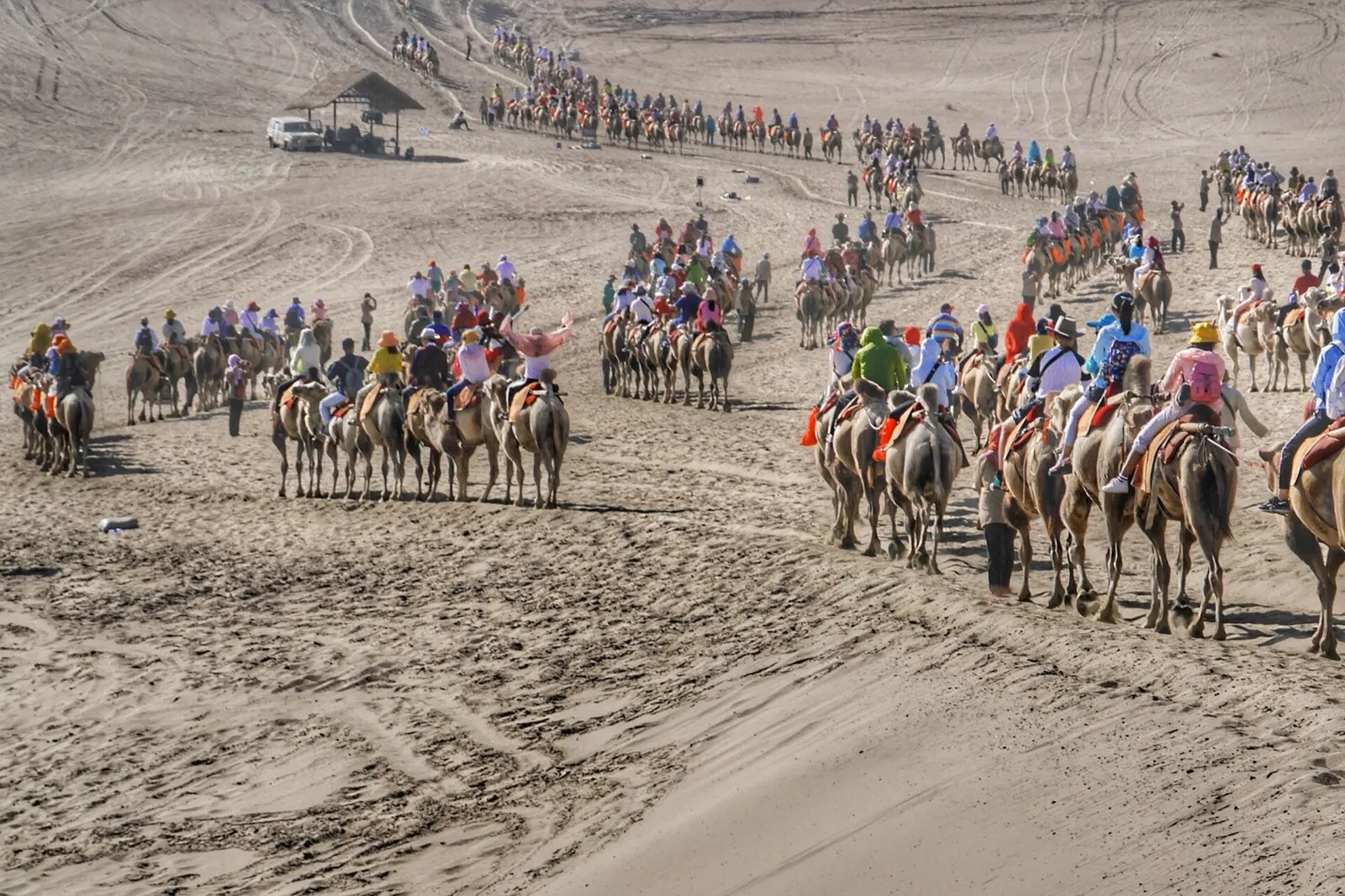
Morning at the Mogao Grottoes: two films at the digital center, then a guide-led rotation through eight of the 735 cave temples — a millennium of Buddhist art preserved by desert air. Late afternoon at Mingsha Shan, climbing the singing dunes above crescent-shaped Crescent Lake until the light goes gold, sandals optional and barefoot better.
Practical tip: The Class A ticket (¥238) is this trip’s scarcest item — released up to 30 days ahead on the official reservation site, real-name with your passport, gone early in season. The ¥100 Class B (4 caves) is the fallback. No photos inside the caves.
Day 11: Desert Day at Your Own Speed
A deliberate breath. Options within an hour of town: Yumen Pass’s ancient frontier beacon, the Yangguan ruins, or the Western Thousand-Buddha Cave as a quiet Mogao encore. Afternoon for the Dunhuang Museum’s Silk Road galleries and the Shazhou night market — apricot-pear tea, grilled flatbread, souvenirs that cost less than they look. Pack tonight; tomorrow moves south.
Practical tip: Desert excursions cover real distances. A half-day car with a driver, arranged via your hotel, costs less than it sounds and beats renting a self-drive car in a foreign script.
Day 12: Fly to Chengdu, Teahouse Afternoon
A 2.5-hour flight drops you from desert into basin — Chengdu’s plane-tree greenery is almost disorienting after Dunhuang’s sand. Check in, then do Chengdu right from hour one: People’s Park teahouse, bamboo chairs, jasmine tea, ear-cleaning if you dare, and Sichuan hotpot for dinner. Order the half-spicy pot and thank us later.
Practical tip: The Dunhuang-Chengdu flight does not run every day — check days of operation before you fix your Dunhuang dates, and build the week around it rather than hoping.
Day 13: Pandas at Opening, Old Chengdu Afternoon
Gates at opening for the panda base, while the mountain air is cool and the bears are vertical: eating, tumbling, falling off platforms. Two to three hours there, then back to town for Wenshu Monastery’s vegetarian lunch service or Jinli’s snack street, and an optional face-changing opera in the evening. Second hotpot optional but probable.
Practical tip: Tickets are ¥55, real-name, released up to 7 days ahead on the official mini-program — book the morning slot the night you land in Chengdu at the latest. The ¥30 internal shuttle saves real walking.
Day 14: Slow Chengdu Morning, Fly to Lijiang
One last Chengdu morning — Kuanzhai Alley’s lanes, a dan dan noodle breakfast, a second teahouse because that is what Chengdu is for. Then a 1.5-hour flight south to Lijiang, landing beneath the Jade Dragon Snow Massif. Evening in the old town’s cobbled lanes as the lanterns come on over the canals and the Naxi courtyards start cooking.
Practical tip: Lijiang sits at 2,400 meters. Take the evening easy, skip alcohol tonight, and let altitude acclimatize you before tomorrow’s big mountain day.
Day 15: Jade Dragon Snow Mountain
The big one: a cable car to the Glacier Park platform at 4,506 meters, the massif hanging overhead and spruce meadows on the descent. If altitude or queues win, the gentler Spruce Meadow cableway and the old town make a fine consolation prize. Evening in quieter Baisha or Shuhe — Naxi courtyard food, murals, and an early night at altitude.
Practical tip: Entry is ¥100 + ¥20 eco-shuttle, with the Glacier cableway at ¥120 extra — booked on the “Lijiang Tourism Group” official mini-program up to 7 days ahead. Cableway slots sell out daily; bring a warm layer, it is winter up there year-round.
Day 16: Morning Lijiang, Train to Dali
A last Lijiang morning — Mu Palace’s courtyard halls or Black Dragon Pond’s mirror-still view back to the mountain — then a 2-hour train south to Dali, skirting Erhai Lake’s shore as the karst gives way to horse-drawn-carriage country. Evening in Dali’s old town: marble gates, teahouse atmosphere, and the lake glowing west of the walls.
Practical tip: Lijiang’s ¥50 old-town maintenance fee has been collected inconsistently in recent years — sometimes bundled into mountain tickets, sometimes not collected at all. Budget for it once and expect to pay it with the Jade Dragon ticket.
Day 17: Erhai Lake and the Dali Countryside
Dali’s magic is the ring around the lake: cycle or hire a car along Erhai’s eastern shore, where fishing villages, wetlands, and the Cangshan mountains trade postcard duty all morning. The Three Pagodas below the mountains are the classic stop; Xizhou’s Bai-architecture lanes and baba flatbread make the lunch. Sunset from the old town’s south gate ends it.
Practical tip: Pick one half of the lake — east shore for views, Xizhou for culture — rather than attempting the full loop. Hire e-bikes only if you are a confident rider; the traffic is real.
Day 18: Fly to Shanghai, the Bund at Night
The long goodbye to the mountains: Dali to Shanghai runs 3.5-4 hours when the direct flight operates, otherwise connect through Kunming (a 2-hour train plus a 3-hour flight). Either way you land by evening — enough time to walk the Bund as Pudong’s skyline switches on across the river, which is the correct last image of the day.
Practical tip: Direct Dali-Shanghai flights are limited and seasonal. Book the whole routing as one itinerary so a missed connection is the airline’s problem, not yours.
Day 19: Yu Garden and Pudong’s Skyline
A proper Shanghai sightseeing day: Yu Garden and the bazaar lanes at opening (¥40 peak season), the old town’s backstreets while they still belong to residents, then Pudong at golden hour from an observation deck, and the ¥2 ferry back across the Huangpu — the best skyline-per-yuan deal in the country. Dinner wherever the queue is made of locals.
Practical tip: Yu Garden closes Mondays, with last entry at 16:00 — the final calendar check on this route before you book it.
Day 20: The Built-In Buffer Day
By now you will understand why this day exists. Use it for what the trip owes you: the French Concession’s plane-tree streets and 1930s villas, Zhujiajiao’s canals if you want one last water town, tailoring and shopping, or a hotel breakfast and absolutely nothing. If a delay, closure, or storm cost you time anywhere on the route, this is where the debt gets paid.
Practical tip: Do not book anything non-refundable for today. The buffer only works if it stays empty.
Day 21: Departure
Metro Line 2 from the center to either airport, 60-90 minutes to spare, a final xiaolongbao if the flight allows. Three weeks ago you landed knowing three or four Chinese brand names; you leave having crossed the country east to west and back, from sea level to a 4,506-meter platform, by rail and by four flights — and you will be answering questions about it at dinner parties for years.
Practical tip: Keep receipts if you shopped — VAT refunds happen at the airport, before checked bags drop.
Practical Notes
Intercity transport
| Leg | Mode | Time | Fare (approx.) |
|---|---|---|---|
| Beijing → Pingyao | G train, Beijing West to Pingyao Gucheng | ~4 hours | ¥213-321 (US$30-45) |
| Pingyao → Xi’an | G/D train, Pingyao Gucheng to Xi’an North | 2.5-3 hours | from ¥125 (US$18) |
| Xi’an → Dunhuang | Flight (recommended) | 2-2.5 hours | ¥400-1,500 (US$56-210) |
| Dunhuang → Chengdu | Flight | ~2.5 hours | ~US$90-150 |
| Chengdu → Lijiang | Flight | ~1.5 hours | ~US$60-120 |
| Lijiang → Dali | Train | ~2 hours | from ¥50 (US$7) |
| Dali → Shanghai | Flight (direct or via Kunming) | 3.5-4+ hours | ~US$110-200 |
Four trains, four flights. Trains release 15 days out on 12306 (train guide); flights 3-6 weeks ahead. Fares as of September 2026 and seasonal — the Dunhuang legs swing the most.
Budget estimate (per person, excluding international flights)
- Backpacker: US$1,800-2,300 — guesthouses, street food, rail-heavy options (~US$85-110/day)
- Mid-range: US$2,400-3,200 — 3-4-star hotels and courtyard inns (~US$60-90/night), mixed dining (~US$25-40), heavy ticket days (Mogao ¥238, cableways ~US$20-35/day), intercity legs ~US$450-600 total (~US$110-150/day all-in)
- Comfort: US$4,500-6,000 — boutique courtyard hotels, business-class rail, private drivers for desert and lake days
Eight intercity legs average US$25-30 per day across the trip — the honest price of covering this much geography. Breakdowns live in our budget guide.
Booking calendar
- 30 days ahead: Mogao Class A via the official reservation site, passport real-name required
- 7 days ahead: Forbidden City (20:00 release), panda base, Jade Dragon cableway, Terracotta Warriors
- 15 days out: all trains; 3-6 weeks out: all four flights
- At 2,400-4,506 meters: slow arrival days, hydrate, no alcohol on Day 14
- Apps at home: 12306, Alipay, Didi, Amap, a translate app (essential apps guide)