The Silk Road Overland: Xining to Urumqi in 12 Days
The northwest done as one overland line: acclimatize at 2,200 meters in Xining, day-trip to Qinghai Lake and the Chaka salt mirror, then ride the Hexi Corridor — the rainbow-striped Danxia earth of Zhangye and the fort at Jiayuguan where the Great Wall dies — to Dunhuang's Mogao Caves and singing dunes, finishing in Urumqi for Tianshan's glacial lake, Turpan's ruined cities, and the Grand Bazaar. Built around the booking clocks that govern it: Mogao's 30-day release first, then the trains, with Xinjiang's late sunrises and heavier security rhythm explained.
Route: Xining Zhangye Dunhuang Urumqi
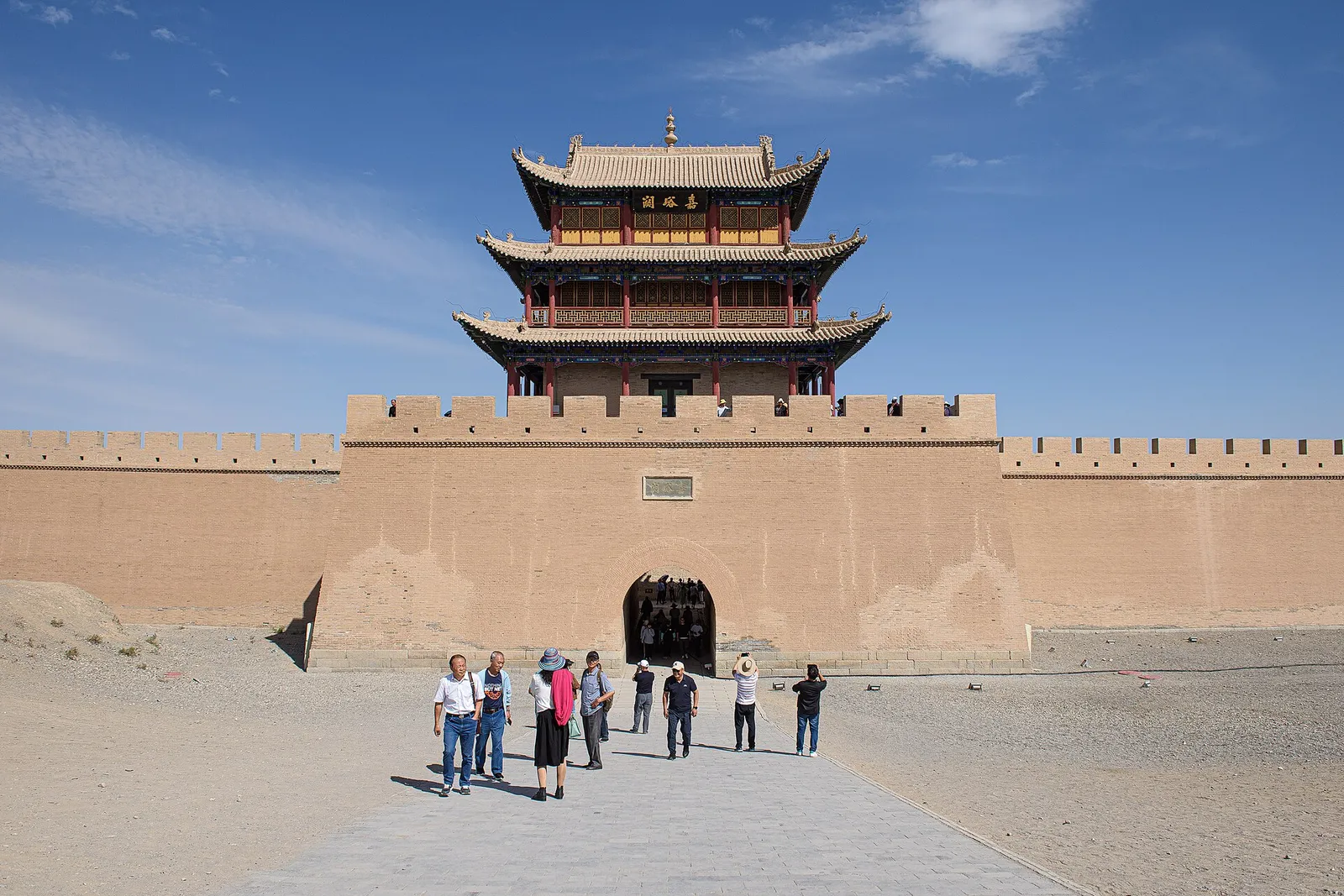
The Silk Road is the rare China route where the traveling is the destination. West of Xi’an the high-speed lines thin out, the cities space themselves along the Hexi Corridor like campsites, and every train window holds something an empire once fought to keep: oasis towns, fortress gates, cliff walls of painted Buddhas. This route runs the corridor end to end — starting where the Qinghai-Tibet Railway starts, in Xining, so you acclimatize at altitude before the deserts, and finishing in Urumqi, Asia’s farthest city from any sea. Two days of it are not sights at all but landscapes from trains and car windows: rapeseed gold around China’s largest lake, then rainbow-striped rock that looks Photoshopped and isn’t. City guides for Xining, Zhangye, Dunhuang, and Urumqi go deeper on every stop.
Day 1: Arrive in Xining, 2,275 Meters Up
Land at Caojiabao airport or roll in from the east, check in near the Moorish-style Dongguan quarter, and do very little on purpose. Your body has real work today: Xining sits at 2,275 meters, and the honest way to handle the plateau is slowly — walk the mosque district as the light goes soft, eat hand-pulled noodles and yogurt with a skin of yellow crystallized sugar, sleep early.
Practical tip: Set up your digital kit at arrival, not at altitude: eSIM live (connectivity guide), Alipay charging your foreign card (payments guide), 12306 logged in — this route books every intercity seat through that one app (train guide). Skip alcohol and hard sightseeing for 24 hours.
Day 2: Kumbum Monastery and the Old Quarter
Morning at Kumbum (Ta’er) Monastery, 25-odd kilometers southwest — the birthplace monastery of Tsongkhapa, where butter sculptures, murals, and raised-silk embroidery are the celebrated “three wonders” and pilgrims prostrate along the flagstones. Back in town by mid-afternoon: the Dongguan Great Mosque area, the night-market stalls around Mochan Street, another early night.
Practical tip: Tickets run ¥70 in peak season (about ¥40 off-season), open roughly 7:30-18:00; the outer grounds are free and atmospheric if you’d rather spend nothing. Photography inside the halls is strictly forbidden — a rule enforced, not suggested. Dress so shoulders and knees are covered; it is an active monastery, not a museum.
Day 3: Qinghai Lake — or the Chaka Salt Mirror
A full day at China’s largest inland lake, about 3,200 meters up on the plateau. Most visitors aim for the gated Erlangjian shore or the quieter village lanes around it, where yaks graze to the waterline and, in July, rapeseed fields burn yellow to the horizon. If your legs and lungs have adjusted, this is also the day to keep going to Chaka Salt Lake, where the brine floor turns into a mirror of the sky on calm mornings.
Practical tip: Erlangjian entry has been listed anywhere from about ¥90 to ¥190 depending on the transport package; village lanes and public shoreline give cheaper views legally. Chaka’s own entry is ¥60 with a ¥50 scenic train and ¥10 boot covers if you want to walk the bed. Distances are big (2-4 hours each way), so a small-group day tour or hired car beats public buses — book the Chaka tourist train (one morning departure) only if you plan to stay over.
Day 4: The Train to Zhangye, Giant Buddha by Dusk
Travel day, and a beautiful one: the line climbs out of the plateau and drops into the Hexi Corridor, the 1,000-kilometer trench between the Qilian and Beishan ranges that every Silk Road caravan funneled through. D trains do Xining to Zhangye West in about two hours. Check in, then walk to the Giant Buddha Temple, a Ming-era compound built around China’s largest indoor reclining Buddha — 34.5 meters of clay and timber, face lit best in late light.
Practical tip: Trains run roughly hourly through the day — book a late-morning departure and keep the morning slack. The Giant Buddha Temple costs ¥40, opens about 8:00-18:00, and sits walkable from the Drum Tower in the old center; photography rules are enforced at the door, so check before raising the camera.
Day 5: Rainbow Mountains at Sunset
A slow morning in town — the Drum Tower anchors the grid, and scaffolding on it lately means admiring from the corner is the free option. Then the headline: the Zhangye Danxia landform, where 24 million years of sediment banded into striped rainbow hills. Enter from the west gate in the afternoon, ride the shuttle between viewing platforms, and let the light do the work — the bands ignite near sunset.
Practical tip: Entry plus the mandatory shuttle runs ¥108 (¥70 + ¥38), open to 20:00 May-October — sunset (around 19:30-20:00 in summer) is the slot worth having, and platforms 4 and 1 hold the classic views. A public bus from Zhangye West station (¥15, first run 07:45) covers the 30-odd kilometers if you’d rather not charter. Bring real sun protection; there is zero shade.
Day 6: Jiayuguan Fort, Then the Night Train West
Morning D train up the corridor to Jiayuguan (the fastest run about 1 hour 11 minutes, trains most hours). At its fort, the Ming Great Wall ends: the Jiayuguan pass was built in 1372 as the empire’s last gate, and the restored complex — walls, watchtowers, the Overhanging Wall section climbing the cliff — reads like a diagram of frontier logic. Late afternoon, the train continues to Dunhuang, arriving by around 21:30.
Practical tip: The through ticket is ¥110 in season (¥90 off-season) and covers the fort, the Overhanging Wall, and the First Beacon Tower over three days; the shuttle between sites adds ¥10-20. Storage at Jiayuguan South station takes luggage if you don’t want to haul packs through the fort. Time the connection carefully: only about seven trains a day run on to Dunhuang — book both legs on 12306 before you leave home.
Day 7: The Mogao Grottoes
The reason this trip exists. Start at the digital cinema for two orientation films, then the shuttle into the cliff face, where a guide unlocks eight caves — some with murals a thousand years old and still wet-looking. The art spans a millennium of Buddhism moving east: Indian-born iconography melting into Tang-dynasty elegance, then the colors of the Silk Road’s later empires.
Practical tip: This is China’s least flexible ticket: the standard Class A ticket (¥238) — films, transport, and eight caves — is real-name, date-specific, released up to 30 days ahead on the official Mogao booking site or mini-program with your passport, and summer slots sell out weeks early. Book this first, before trains and hotels, and build the rest of the trip around whatever date you get. Photography inside the caves is banned.
Day 8: Singing Dunes, Crescent Lake, Night Market
Sleep in, then hit the Mingsha dunes at your leisure — the ticket’s best trick is validity: entry (¥110 in season) works for three days, so come now for the camel caravans and the crescent-shaped spring at the dunes’ foot, and return another evening for sunset if the mood takes. In town, the Dunhuang Museum’s replica caves and Library Cave exhibit make smart pre-reading, and Shazhou Night Market handles dinner — lamb skewers, apricot-peeled water, cold noodles.
Practical tip: Camel rides run about ¥100 round trip; the dune climb to the sunrise platform is free with entry but demanding in sand — go before 9 a.m. or after 5 p.m. in warm months. The museum is free with your passport but closed Mondays — swap with Day 7 or 9 if it falls wrong.
Day 9: The West Line — or a Slow Exit West
A pick-one day. Option A: the west-line day trip to Yumen Pass and the yardang “Ghost City” of Dunhuang National Geopark, three hours each way through emptiness that earns the word. Option B: a slow morning and the short flight to Urumqi (about two hours when it runs), landing with energy for the Grand Bazaar’s lantern-lit dusk.
Practical tip: The west line costs about ¥120 in park entry plus shuttles, usually as a bundled day tour — worth it for geology fans, skippable if caves satisfied you. For the flight: schedules to Urumqi thin or pause in winter, so confirm before committing to the routing; the overland alternative is a train to Liuyuan, then the high-speed connection west, adding half a day.
Day 10: Urumqi — Grand Bazaar and the Museum
Your body clock, not just the sightseeing, needs managing in Xinjiang: everything official runs on Beijing time while the sun runs two hours behind, so a 10 a.m. start is genuinely early. Spend the day on the city’s two headline indoor sights — the Xinjiang Regional Museum (the 4,000-year-old “Loulan Beauty” mummy and Silk Road grave goods) and the International Grand Bazaar, a mosque-adjacent sprawl of dried fruit, carpets, and lamb.
Practical tip: The museum is free with your passport but closed Mondays (swap days if needed), with timed entry caps — arrive early. The bazaar is free to enter; the tower costs ¥50. Expect more security checks than eastern China — at stations, malls, and sights — so carry your passport at all times and build in a few extra minutes everywhere (safety guide).
Day 11: Heavenly Lake of Tianshan
A full-day excursion north of the city to Tianchi, the glacial lake strung at 1,900-odd meters under the 5,400-meter Bogda peak — pine forest, boardwalks, and (postcard alert) Kazakh eagle-hunter photo offers you can politely decline. Afternoon back in the city, or stretch the lake day with a yurt-side milk tea.
Practical tip: Expect ¥95 entry plus a compulsory ¥90 park shuttle in season, with the site opening roughly 9:00-19:30; it sits 90 minutes to two hours each way, so a day tour or chartered car is the low-friction option. Nights are cold even in summer at the lake — pack a layer.
Day 12: Turpan’s Ruined Cities, Then Out
A final loop into the Turpan Depression, China’s lowest and hottest ground: the D train from Urumqi does it in about an hour, delivering you to the Jiaohe ruins — a 2,300-year-old city carved whole from a plateau — and the karez wells that made a desert habitable. Back to Urumqi for your evening flight, or stay over and fly out next morning.
Practical tip: Jiaohe entry is ¥40, the karez museum about ¥30, and midday heat in summer is brutal — do Jiaohe at opening and be indoors by 13:00. Turpan is also where the security-check rhythm peaks; keep the passport handy and allow buffer time for the return train.
Practical Notes
Intercity transport
| Leg | Mode | Time | Second-class fare (approx.) |
|---|---|---|---|
| Xining → Zhangye West | D train | 1.5-2 hours | ¥60-160, varies by train |
| Zhangye West → Jiayuguan South | D train | 1-1.5 hours | from about ¥50 |
| Jiayuguan → Dunhuang | D/T train | 2.5-3.5 hours | varies by train |
| Dunhuang → Urumqi | Flight (recommended) | about 2 hours | US$60-120; schedules thin in winter |
| Urumqi → Turpan North | D train | about 1 hour | about ¥40 |
Four intercity moves, three of them by rail booked 15 days out on 12306 (train guide). The Mogao booking (Day 7) is the fixed point: reserve it 30 days out and lay the trains around it. Fares float and several legs only publish USD ranges to foreign cards — treat numbers as mid-2026 estimates and confirm on 12306.
Budget estimate (per person, excluding international flights)
- Backpacker: US$650-900 — hostels and budget chains, street food, trains and buses, skipping the west-line tour (~US$55-75/day)
- Mid-range: US$1,200-1,600 — 3-4-star hotels, mixed dining, day tours at Qinghai Lake and Tianchi, all tickets and shuttles (~US$100-135/day)
- Comfort: US$2,200-3,000 — upscale hotels, private car and driver for the corridor legs, front-row Mogao slots
The northwest is one of China’s cheaper regions once you’re moving; day tours and the internal flight account for most of the mid-range spread. See our budget guide for the daily math.
Booking calendar (the part that makes or breaks it)
- 30 days ahead: Mogao Class A tickets on the official site — do this before anything else
- 15 days out: all train legs on 12306; the Jiayuguan-to-Dunhuang evening seats are the scarcest
- Rolling: Kumbum and Danxia (walk-up fine outside holidays), Tianchi day tours (1-2 days), Turpan trains (2-3 days)
- Home setup: 12306, Alipay, Didi, Amap, a translate app (essential apps guide) — and check our best-time-to-visit guide before fixing months: May-June and September-October are the corridor’s sweet spots
Sources & verification (11)
- https://www.dha.ac.cn/skxl/mgk.htm
- https://www.mgk.org.cn/
- https://www.travelchinaguide.com/attraction/gansu/dunhuang/mogao_grottoes/
- https://www.travelchinaguide.com/attraction/gansu/zhangye/danxia-landform-geopark.htm
- https://www.travelchinaguide.com/china_great_wall/scene/gansu/jiayuguan.htm
- https://www.travelchinaguide.com/attraction/qinghai/xining/qinghai_lake.htm
- https://www.trip.com/trains/china/route/xining-to-zhangye/
- https://www.trip.com/trains/china/route/zhangye-to-jiayuguan/
- https://www.trip.com/trains/china/route/jiayuguan-to-dunhuang/
- https://www.travelchinaguide.com/china-trains/urumqi-schedule.htm
- https://www.chinahighlights.com/xinjiang/plan-a-trip.htm