Eating in China: Vegetarian, Allergies, Halal and Street Food Survival
Chinese food is one of the world's great cuisines, and dietary restrictions are more manageable than you fear — if you know where the traps are. This guide explains why 'vegetarian' dishes can arrive cooked in pork lard or meat broth, why Buddhist temple restaurants are the most reliable meat-free kitchens in the country, and exactly how to phrase allergies in Chinese so kitchens actually hear them. It covers the green qingzhen sign that unlocks halal food nationwide, the tap-water rule that never bends, how to judge a street-food stall in ten seconds, spice levels decoded from mild to brutal, and how to order when the menu has no pictures and no English. Advice reflects restaurant realities as of September 2026.
The short version
- Buddhist vegetarian restaurants (素食/斋菜) are the only reliably meat-free kitchens — ordinary restaurants cook 'vegetable' dishes in pork lard or meat stock
- Write allergies in Chinese: 我对花生过敏 (I'm allergic to peanuts) works far better than 'peanut' in English — carry it as a phone card or paper slip
- Halal food is easy: look for the green 清真 (qingzhen) sign — Lanzhou beef-noodle shops with it exist in virtually every city
- Never drink tap water in China; bottled or boiled water only. Tap water is fine for brushing teeth
- Order hot pot 微辣 (wēi là, mild) or a half-and-half pot — 'mild' in Sichuan is spicier than most visitors expect
Few countries reward eating adventurously like China, and few cuisines are more negotiable once you can make yourself understood. Every major dietary restriction — vegetarian, halal, allergies — has a working system here, centuries old in some cases. The catch: the systems don’t map neatly onto Western words. “Vegetarian” on a Chinese menu does not mean what it means at home, an English “no peanuts” may not survive the trip from table to kitchen, and the safe street-food stall looks different from what your instincts suggest. Restaurant realities as of September 2026.
Eating Vegetarian: The Broth and Lard Problem
Here is the trap in one sentence: in ordinary Chinese kitchens, a dish can be 100% vegetables and still not be vegetarian. Stir-frying starts with fat, and the default fat across much of China is pork lard (猪油). Soups and braises are built on chicken or pork bone stock (高汤). Sauces routinely contain oyster sauce (蚝油). Noodles billed as beef-free may ride in beef broth. None of this shows on the plate, and saying “I’m vegetarian” (我吃素, wǒ chī sù) often gets you a dish minus the visible meat — with the lard and broth intact.
Two workarounds change everything:
- Buddhist vegetarian restaurants. Look for the characters 素食 (sùshí, vegetarian food) or 斋菜 (zhāicài, Buddhist temple cuisine) on the sign. These kitchens operate under Buddhist dietary rules that exclude meat, seafood, and usually eggs and dairy, so they are the single most reliable meat-free bet in the country — major temples in cities like Shanghai and Chengdu have run excellent ones for decades. Expect “mock meat” dishes named “vegetarian chicken” (素鸡) or “vegetarian duck” (素鸭): at genuine Buddhist restaurants these are wheat gluten, tofu, and mushroom, fully plant-based. (Don’t extend that assumption to ordinary restaurants, where the 素 label covers nothing but the ingredients list.)
- The precise phrase list. In regular restaurants, skip “vegetarian” and negate the specific threats: 不用猪油 (bú yòng zhūyóu, no lard), 不放肉汤/高汤 (no meat or bone broth), 不放蚝油 (no oyster sauce). Pair this with 我吃素 and a translation app (see essential apps), and cooks will usually cooperate — the concepts exist, they are simply not what “vegetarian” triggers.
Vegans face all of the above plus eggs and dairy appearing unannounced in breads and buns; temple restaurants again are your anchor. If your trip centers on Sichuan, our Chengdu guide covers the city’s outstanding temple-cuisine scene.
Food Allergies: Make the Kitchen Understand
Food-allergy awareness in Chinese kitchens is improving but cannot be assumed, especially outside big cities. The reliable tool is written Chinese, shown at the point of ordering. The core sentence is 我对___过敏 (wǒ duì ___ guòmǐn) — “I am allergic to ___.” The fill-ins you are most likely to need:
| English | Chinese | Pinyin |
|---|---|---|
| Peanuts | 花生 | huāshēng |
| Seafood / shellfish | 海鲜 | hǎixiān |
| Gluten (wheat) | 麸质 | fūzhì |
| Eggs | 鸡蛋 | jīdàn |
| Dairy / milk | 奶制品 / 牛奶 | nǎizhìpǐn / niúnǎi |
| Soy | 大豆 | dàdòu |
| Sesame | 芝麻 | zhīma |
Prepare a card before you fly — a large-character phone note works; professional services (Equal Eats and similar) sell reviewed Simplified-Chinese cards for a few dollars. Add the severity, not just the allergen: 严重过敏 (yánzhòng guòmǐn, severe allergy) and, if it applies, 不能吃一点点 (cannot eat even a trace). Kitchens respond far differently to “allergy” than to “preference,” and showing severity gets the chef’s attention rather than the waiter’s shrug.
Two China-specific notes. First, peanut oil (花生油) is a default cooking oil across much of China; most allergists consider refined peanut oil low-risk for peanut allergy, but if yours includes it, add 不用花生油 (no peanut oil) to your card and favor boiled and steamed dishes. Second, gluten is genuinely hard: soy sauce almost universally contains wheat, and wheat noodles and dumpling wrappers are structural to the cuisine. Celiac travelers should stick to rice-based dishes (米粉 noodles, plain rice, steamed dishes) and manage expectations — “gluten-free” as a concept often doesn’t translate. For severe allergies generally, see the emergency-planning advice in our safety and health guide: carry your auto-injectors, know how to call 120, and identify hospitals near your hotels.
Halal Food: Follow the Green Qingzhen Sign
Halal is the easiest restriction to honor in China, because it has been institutionalized for over a millennium. Look for 清真 (qīngzhēn, “pure and true”) — typically a green signboard, often with Arabic script alongside — marking Muslim-run restaurants and butcher shops in every province. The 清真 sign is a meaningful community certification, not a marketing sticker, and travelers widely use it as their primary filter.
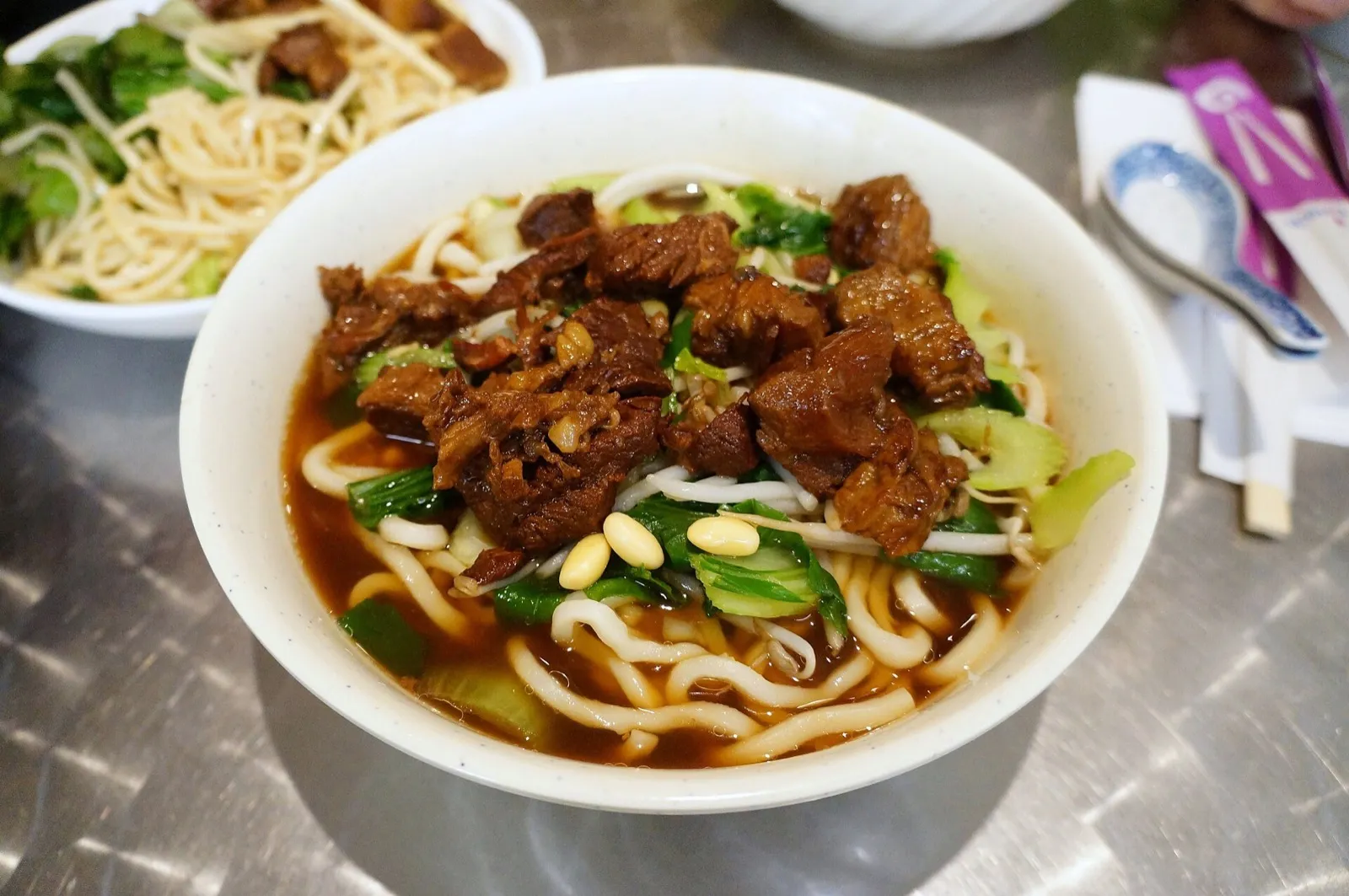
The single most dependable nationwide option is the Lanzhou beef-noodle shop (兰州拉面 / 兰州牛肉面): hand-pulled noodles in clear beef broth, a dish created by Hui Muslim cooks and traditionally halal end to end. Shops carrying the green sign are found in virtually every city in China, cost a few dollars a bowl, and feed you in five minutes. Cities with deep halal traditions — Lanzhou above all, plus Xi’an with its Muslim Quarter — offer the widest range, from lamb skewers to qingzhen hotpot. One habit to keep: in areas with few Muslims, a restaurant displaying 清真 deserves a quick glance at whether alcohol is on the menu, since enforcement is looser in some places; in Muslim-majority districts the sign is rock-solid.
Water and Street Food: The Safety Basics
Water: Bottled, Boiled or Nothing
The rule that never bends: do not drink Chinese tap water. Municipal water is treated, but aging pipes and rooftop tanks can re-contaminate it between plant and tap, so it is not considered potable anywhere in the country without boiling. Every hotel provides the alternatives — bottled water (under ¥3 a bottle at any convenience store) and kettles or hot-water dispensers, since boiled water is a Chinese institution. Tap water is fine for brushing teeth and showering; the queasy-stomach crowd uses bottled for tooth-brushing anyway.
Ice deserves one sentence of judgment: chains, hotels, and busy modern shops use purified ice and are fine; at small street stalls that cannot be verified, so skip it there.
Street Food: How to Pick a Good Stall
Street food is one of China’s great experiences, and the safety logic is simple: heat and turnover kill bacteria; stillness breeds it. A stall is a good bet when you spot these green flags within ten seconds:
- A line of locals — high turnover means nothing sits around, and regulars are the best food-safety audit that exists
- Food cooked to order in front of you at high heat — woks, griddles, boiling broths, skewer grills
- Fresh, light-colored frying oil — dark, opaque, smoking oil means it has been recycled past reason
- A stall whose one or two dishes are its whole identity
Walk away from: pre-cooked food sitting lukewarm in trays, anything cold sitting exposed (including pre-peeled cut fruit), unrefrigerated raw seafood, and stalls with nowhere to cook things fresh. Most stalls have no menu at all — just a look at what’s in the pans and a raised-fingers “two, please.”
Ordering Without a Common Language
Menus in tourist districts increasingly have English; elsewhere, assume none. The reliable sequence:
- Point-and-order. Picture menus are common at noodle shops — scan the wall photos, point. It works and nobody minds.
- Look it up on Dianping (大众点评) first. China’s Yelp-analogue lists nearly every restaurant with user-uploaded photos of actual dishes. Find the restaurant, screenshot three photos, show them to the waiter — the single most effective trick for food-focused travelers. It runs inside the Chinese app ecosystem covered in our essential apps guide.
- Camera translation. Point your phone’s camera at a Chinese menu for instant translation. Apple’s built-in Live Text and Chinese apps (Baidu Translate, Youdao) work without a VPN; Google Lens needs one — see our internet guide.
- Say 套餐 (tàocān, set meal) when overwhelmed — it bundles a main, rice or noodles, and often a drink at a fixed price.
And when all systems fail: walk to the table next door, point at what they’re eating, hold up two fingers. It works extra well in China.
Handling the Heat: Spice Levels
Chinese spice is a scale, printed on menus in Sichuan, Hunan, and most hotpot restaurants. Learn four terms:
| Chinese | Pinyin | Meaning | What it really means |
|---|---|---|---|
| 不辣 | bù là | Not spicy | Safe harbor |
| 微辣 | wēi là | Mild | The correct first order almost everywhere |
| 中辣 | zhōng là | Medium | Often hotter than “hot” back home |
| 特辣 | tè là | Extra spicy | You are being dared |
The critical calibration: in spice-first regions, even 微辣 is genuinely spicy for untrained palates — Sichuan “mild” is not Ohio mild. Order 微辣 your first time, and know the numbing buzz that comes with it is Sichuan peppercorn (花椒, huājiāo), a separate sensation from chili heat. For hotpot, order the yuanyang pot (鸳鸯锅) — a divided pot with spicy broth on one side and mild on the other — the standard move for mixed groups, especially in Chengdu, the format’s spiritual home. Milk or sweet soy milk beats water for relief; capsaicin is oil-soluble, which is why beer helps less than you’d hope.
Common Mistakes
- Trusting the word “vegetarian.” A dish without meat is not a vegetarian dish in most Chinese kitchens. Negate the ingredients or find a Buddhist restaurant.
- Saying allergies in English and hoping. “Peanut” said aloud is a coin flip in a busy kitchen. Written Chinese at the point of order is the only reliable channel — prepare the card before you land, not during anaphylaxis-adjacent improvisation.
- Forgetting that soy sauce contains wheat. Celiac travelers who avoid obvious noodles but eat stir-fries in soy-sauce-based kitchens are still exposed. Rice dishes are the safe lane.
- Drinking tap water “just this once.” Stick to bottled, boiled, or properly sealed drinks. Free teahouse refills are fine; a jug of room-temperature water at a rural stall is not.
- Avoiding street food entirely or eating at the wrong stalls. Both are mistakes. The line of locals is your quality control — join it.
- Ordering 中辣 to prove something on day one. Start at 微辣 and calibrate upward. There is no shame in the yuanyang pot; there is only regret at 特辣.
- Eating only in the hotel neighborhood. Dianping exists in every city; the best-rated place within a 15-minute walk will beat the hotel restaurant at a third of the price.
Sources & verification (10)
- https://thesinologue.com/guides/halal-vegetarian-vegan-food-in-china
- https://gochinafreely.com/food-and-drink/china-vegetarian-hidden-pork-broth-guide
- https://chinasurvivalkit.com/blog/vegan-vegetarian-survival-guide-china
- https://www.lyriktrip.com/guides/halal-food-china
- https://chinavisitguide.com/food/halal-china
- https://www.chansworld.com/inspirations/stories/muslim-friendly-food-guide-to-china
- https://www.yunnanexploration.com/lanzhou-hand-pulled-noodles-with-beef.html
- https://canidrinkthetapwater.com/countries/china
- https://www.chinaexpeditiontours.com/blog/can-i-drink-tap-water-in-china
- https://www.chinasimply.com/posts/china-street-food-ordering/