Domestic Flights in China: When to Fly, Airport Traps, and Survival
China's high-speed rail wins most intercity contests, but for long hauls — Chengdu to Kashgar territory, Tibet, the islands — flying is the only sane option. This guide maps the real decision: when a plane beats a train beyond the 1,500 km mark, and the trap that catches first-timers in cities with two airports. Beijing, Shanghai, and Chengdu each split traffic across two fields, and Xiamen is mid-transition to its new Xiang'an airport around the end of 2026 — booking the wrong one costs a day. It also covers booking channels, passport check-in, the security rules that actually trip visitors (power banks with the CCC mark, 100 ml liquids, no lighters), what happens when flights go late, and how budget carrier baggage math works. Rules and airport status are as of September 2026 — recheck near your travel date.
The short version
- Fly when the journey is long or the train is slow: beyond roughly 1,500 km, into Tibet or Xinjiang, or to islands like Hainan — under 1,000 km the train usually wins
- Big cities have two airports with different airlines: China Eastern/Southern fly from Beijing Daxing, most Star Alliance carriers from Capital; Shanghai splits Hongqiao (domestic) and Pudong (long-haul); Chengdu splits Shuangliu and Tianfu
- Xiamen is switching to the new Xiang'an International Airport around the end of 2026 — as of September 2026 all flights still use Gaoqi, so check your ticket airport close to travel
- Power banks must be carry-on, 100Wh or less (max two), with the CCC mark printed — and you may not charge devices with them onboard; lighters and matches are banned outright
- Book on Trip.com for English support and foreign cards, or use airline apps once you're confident; check in closes about 45 minutes before domestic departure, so arrive two hours early
Domestic flying in China is cheap, frequent, and — once you know the two-airport trick — painless. For most first-timer itineraries the high-speed rail is the better show, but the country is enormous: no train is beating a two-and-a-half-hour flight to Lhasa, and the scenery loses its charm around hour five. This guide tells you when to pick the plane, which airport your ticket actually means, how to clear check-in and security with a foreign passport, and what to do when the departure board turns red. Statuses and rules below are as of September 2026; airport transitions are live news, so recheck before booking.
Plane or Train? The Honest Math
The rail-vs-plane decision resolves into three questions.
Distance. Under 1,000 km, the train almost always wins — city-center stations, no baggage roulette, and 300-350 km/h cruising (see our trains guide). Between 1,000 and 1,500 km it’s a coin flip: Beijing–Shanghai by rail takes 4.5 hours against a two-hour flight that costs you three more in airport logistics. Beyond roughly 1,500 km, or seven hours of rail, the plane usually wins — Chengdu, Kunming, and Guilin from Beijing or Shanghai are flight territory.
Geography. Some destinations barely have trains: Tibet and far western Xinjiang sit beyond 2,000 km with flights of three to five hours; Hainan island is train-ferry territory and far faster by air; the mountain cities of Yunnan and Gansu’s west stretch rail times past the fun threshold. If a flight takes under three hours and the train takes over six, stop comparing.
Paperwork. Lhasa is a special case: foreign passport holders need a Tibet Travel Permit arranged through a licensed operator before flying, and airlines check the original permit at boarding — book the permit well before the flight, and see our Tibet permit guide for the process.
The Hub-Airport Puzzle: Two Airports, One City
The most expensive mistake in Chinese domestic aviation is going to the wrong airport in the right city. Three megacities split their traffic, and Xiamen is actively switching.
Beijing: Capital (PEK) vs Daxing (PKX)
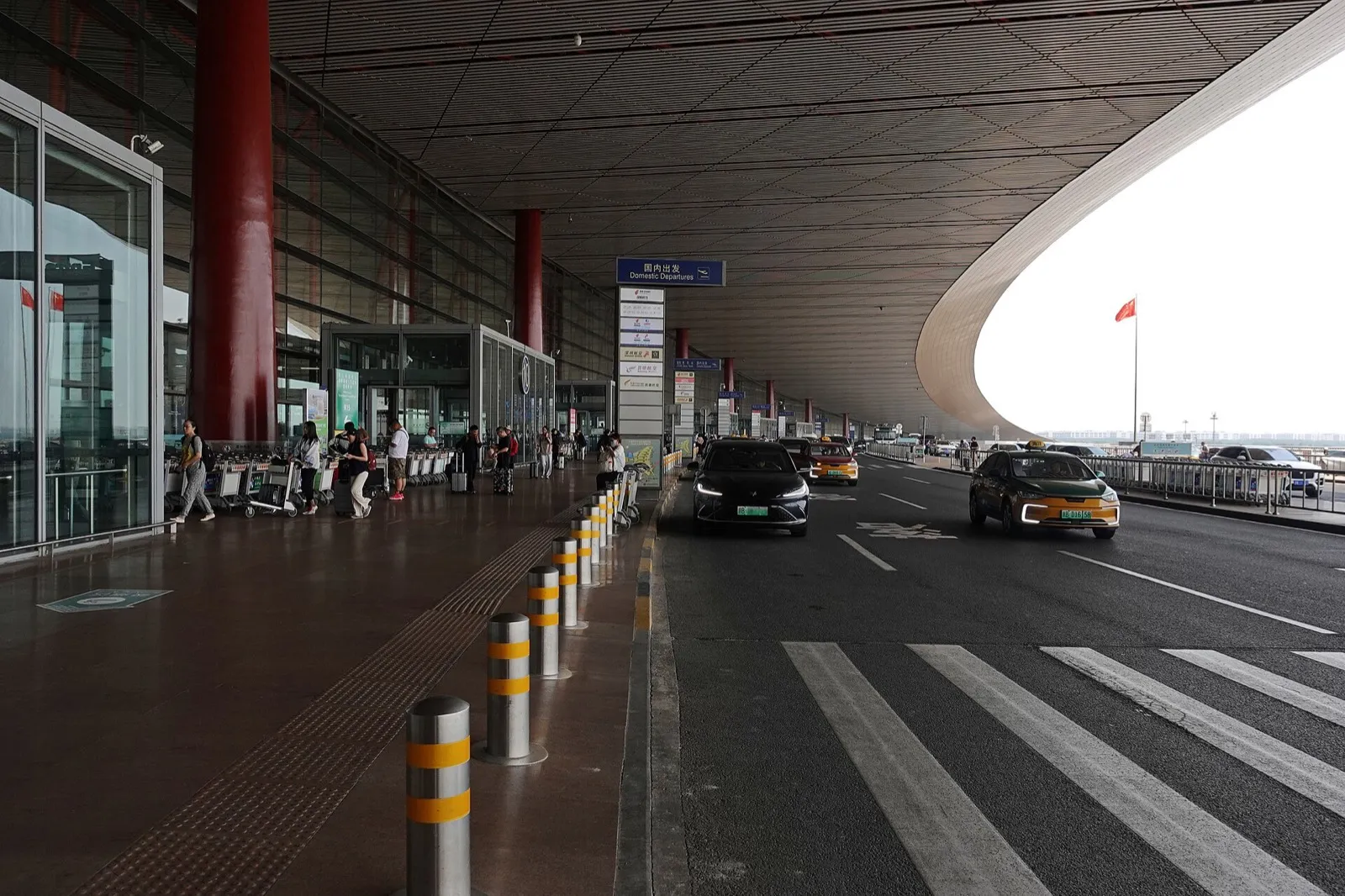
Beijing Capital, the old workhorse, was handling over 100 million passengers a year against a designed capacity of 83 million — so the city opened Daxing in 2019, about 50 km south of Tian’anmen. The split runs largely along alliance lines: China Eastern, China Southern, and Xiamen Air moved to Daxing along with their SkyTeam partners, while most Star Alliance and other full-service carriers stayed at Capital. Practically: check the airport code on your ticket, not the city name. Daxing connects by the Daxing Airport Express metro line and a handful of fast intercity trains (about 21 minutes to Beijing West); Capital sits northeast of town on its own express line. Cross-town between the two airports is roughly 90 km — do not schedule it into a connection.
Shanghai: Hongqiao (SHA) vs Pudong (PVG)
Shanghai’s split is cleaner: Hongqiao, about 20 km west of the center, is the domestic workhorse (plus regional international routes to Hong Kong, Macau, Taipei, Seoul, and Tokyo) and shares a complex with Hongqiao railway station — rail-to-air transfers in one building. Metro Lines 2 and 10 serve it. Pudong, about 45 km east, handles most of the city’s international flights and a large domestic network of its own; the magnetic levitation train covers the 30 km to Longyang Road in eight minutes at 431 km/h (about ¥50 one-way), where Metro Line 2 takes over. Flying Shanghai–Beijing or Shanghai–Guangzhou? That’s Hongqiao, almost certainly.
Chengdu: Shuangliu (CTU) vs Tianfu (TFU)
Chengdu opened Tianfu in June 2021, about 50 km southeast of downtown, and moved all international flights there; domestic traffic divides between the two fields, with Shuangliu remaining the closer, older option. Metro Line 18 runs express to Tianfu in about 35 minutes (¥10), and Line 19 links the two airports — useful if a flight-and-train itinerary lands you at the wrong one.
Xiamen: Gaoqi (XMN) out, Xiang’an (XMN) in — the live transition
Watch this one if your itinerary touches Fujian in late 2026. Xiamen Gaoqi — famously hemmed in by the city, the world’s busiest single-runway airport with over 29 million passengers in 2025 — is scheduled to close to civil flights when the far larger Xiang’an International Airport opens around the end of 2026. As of September 2026, every flight still uses Gaoqi, ten minutes from downtown; after the switch, flights move some 25 km east to Xiang’an. Airlines expect some disruption during the cutover, and schedules are being adjusted in real time — so if you’re flying into Xiamen (or on from it) near the transition, confirm which airport your ticket names the week you book and the day before you fly. Our Xiamen guide tracks the practical fallout.
Booking: Trip.com or the Airline Apps
Two sane routes. Trip.com sells every Chinese carrier’s domestic fares in English, takes international Visa/Mastercard, and issues e-tickets tied to your passport — book, show the passport, fly. It is the default for first trips, and the same app handles the train bookings from our trains guide. Airline apps (China Eastern, China Southern, Air China, and the rest) occasionally show members-only or app-only fares and handle rebooking fastest during disruptions — but they are built for Chinese ID cards, and the English support ranges from decent to absent. The pragmatic stack: book and manage on Trip.com while you find your feet, and if a delay scrambles a connection, use the airline app or call Trip.com’s 24/7 English line (setup for both is in our essential apps guide).
Fares swing widely by demand; booking one to two months ahead usually keeps the classic routes affordable, and the last-seat prices near Chinese holidays can triple. Payment runs through your linked card or Alipay/WeChat per our payments guide.
Passport Check-In and Security, Step by Step
Your passport is the only ID that matters — the ticket is bound to the passport number you booked with, so use the same document to book and to fly. The sequence:
- Arrive two hours before a domestic departure. Check-in counters typically close about 45 minutes out; at mega-terminals like Daxing or Pudong, the walk alone eats 20 minutes.
- Check in at the counter with your passport — self-service kiosks often require Chinese ID. Counters print boarding passes and check bags; security keeps your passport in hand.
- Security screening follows the standard liquid rule: containers of 100 ml or less, in a clear one-liter bag; anything larger goes in checked luggage. Water bottles past the gate are fine to buy.
- Power banks follow the strictest rules of your trip: carry-on only, never checked; 100Wh or less (roughly 27,000 mAh), maximum two; they must carry the printed CCC (China Compulsory Certification) mark, and using them to charge devices during the flight is prohibited. A nameless gas-station power bank without the CCC mark can be confiscated at the gate.
- Lighters and matches are banned outright — including in carry-on — which surprises smokers; e-cigarettes travel in the cabin but can’t be used onboard.
- Boarding uses passport plus boarding pass, and the gate closes on time; Chinese boarding calls are Mandarin-first, so watch the screens rather than your ears.
One regularity worth knowing: Chinese domestic aviation runs on time by global standards in fair weather, and delays cluster in summer afternoons (thunderstorms) — morning flights are the reliable ones.
Delays and Cancellations: What Actually Happens
When weather stalls a hub, delays cascade across the network, and the airplane-in-the-sky you’re waiting for may be stuck elsewhere. The playbook:
- Rebook in the app before the line forms — airline apps and Trip.com rebook faster than the counter queue, and gate staff appreciate passengers who’ve already moved.
- For cancellations, the airline owes you a re-ride or a refund, whichever you choose; on weather delays it generally does not owe you a hotel, so book one yourself early if an overnight looks likely and keep every receipt for an insurance claim.
- Ask for the delay reason in writing (or a screenshot from the app) — your travel insurer will want it.
- Prevention beats treatment: book the first flight of the day, avoid final-evening connections, and leave 90-plus minutes for any connection inside Chinese hubs.
Budget Airlines: The Spring Airlines Math
China’s low-cost giant is Spring Airlines (春秋航空, green livery, 9C flight codes), with equivalents like West Air and Urumqi Air on select routes. The fares are genuinely cheap — Shanghai to Xi’an for the price of a train lunch — but the base fare buys almost nothing. Spring’s entry “Chaohuifei” tier includes one cabin bag of just 7 kg and 20 × 30 × 40 cm (smaller than full-service carriers’ limits), with zero free checked luggage; higher tiers add a 10 kg cabin bag and 20 kg checked. The efficient moves: buy any baggage allowance online when you book (it’s cheaper than airport counters, refundable if unused, and must be purchased at least an hour before departure), and weigh your bag the night before — gate agents charge by the piece for oversize cabin bags, roughly ¥300 a pop on domestic routes. On a full-service carrier like China Eastern or Air China, the standard domestic economy ticket includes 20 kg checked plus a 5 kg cabin bag, so the real comparison is total cost with bags, not the headline fare.
Common Mistakes
- Booking by city name, not airport code. PEK is not PKX, SHA is not PVG, and CTU is not TFU — and in Xiamen the airport itself is about to move. Check the code twice: once at booking, once the day before.
- Assuming the train always wins. On routes over seven rail hours, the flight is cheaper in sanity than the sleeper is in romance. Do the door-to-door math, not the timetable math.
- Booking a flight to Lhasa without the permit. The airline checks the Tibet Travel Permit at boarding; no permit, no boarding, no refund of your enthusiasm.
- Packing a non-CCC or over-100Wh power bank, or any power bank in checked luggage. Confiscation is the standard outcome, and the rule is enforced with enthusiasm.
- Carrying a full-size toiletry to security. Over 100 ml goes to checked or to the bin; the one-liter bag rule is applied literally.
- Buying baggage at the airport counter instead of online. On budget carriers the difference can exceed the price of the flight itself.
- Cutting a connection under 90 minutes, or booking the last flight of the day before an unmissable morning — thunderstorm season punishes both.
- Panicking at a Mandarin-only delay announcement. The app knows in English before the gate finishes talking; check the screen, then rebook from the queue.
Sources & verification (10)
- https://www.chinadiscovery.com/china-flights.html
- https://www.chinadiscovery.com/travel-guide/baggage-allowance.html
- https://www.chinadiscovery.com/beijing-tours/beijing-transportation/beijing-daxing-international-airport.html
- https://www.chinadiscovery.com/shanghai/hongqiao-international-airport.html
- https://www.chinadiscovery.com/shanghai/pudong-international-airport.html
- https://www.chinadiscovery.com/chengdu-tours/chengdu-transportation/tianfu-international-airport.html
- https://olachina.org/xiamen
- https://flights.ch.com/baggage-rule
- https://www.trip.com/guide/info/weather-flight-delays.html
- https://www.tibettour.travel/blog/2026/08/19/tibet-travel-permit-guide-2027