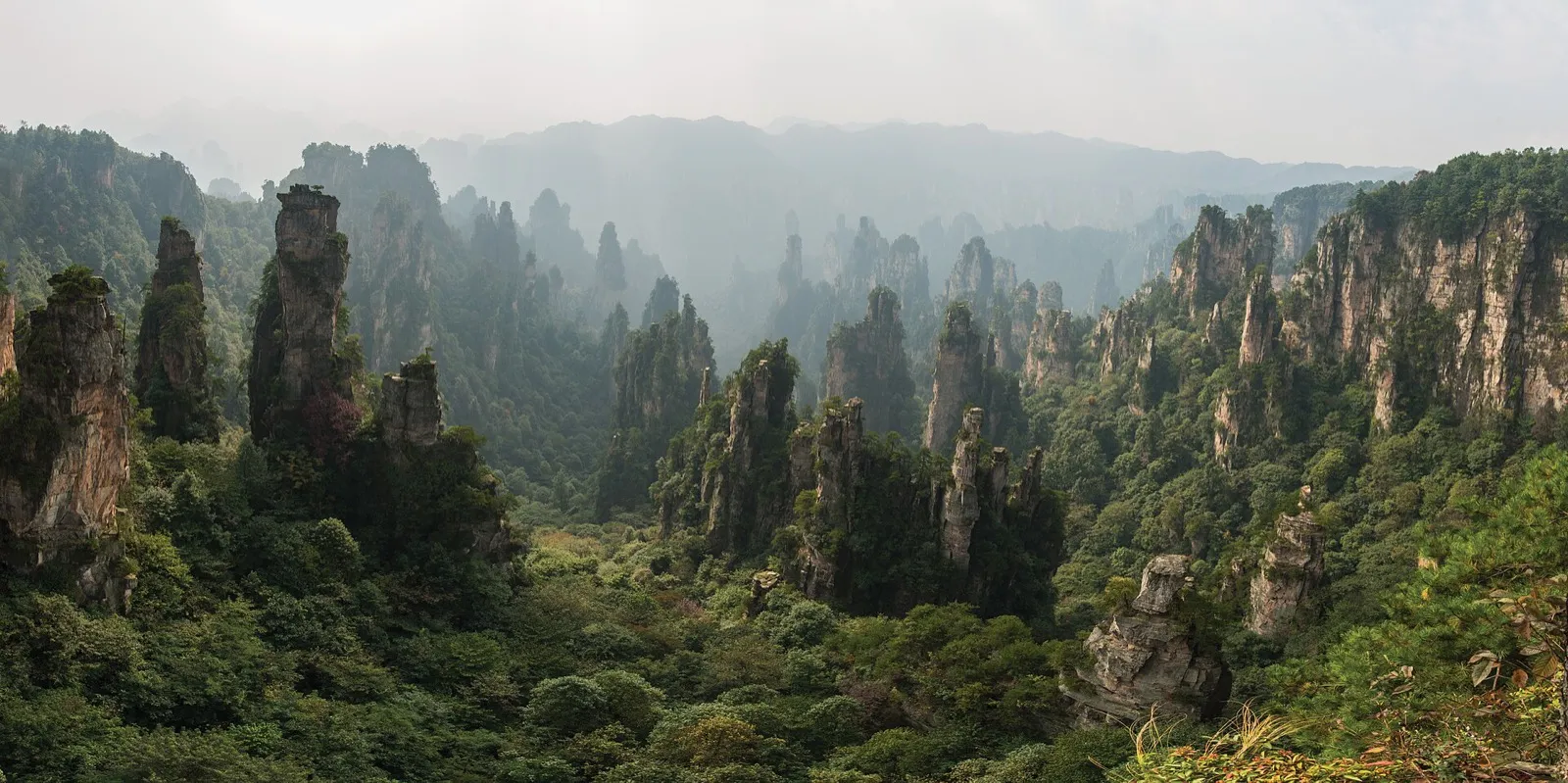
Zhangjiajie, in the mountains of northwestern Hunan, protects the strangest landscape in China: three thousand quartz-sandstone pillars, some hundreds of meters tall, packed into a single national park. That park — Zhangjiajie National Forest Park, the heart of the Wulingyuan UNESCO World Heritage site — inspired the floating mountains of Avatar, and it takes at least two full days to explore properly. Add Tianmen Mountain on the edge of the city, with its 7.5-kilometer cableway and 999-step heaven gate, the glass-bottomed bridge over the Grand Canyon, and an easy high-speed-rail extension to Fenghuang Ancient Town, and you have one of China's great nature itineraries. This page explains how the two headline parks differ (they are tens of kilometers apart — a famously common mix-up), how tickets and timed entry work with a foreign passport, and why the weather will make or break your photos here more than anywhere.
Top sights at a glance
No. 1
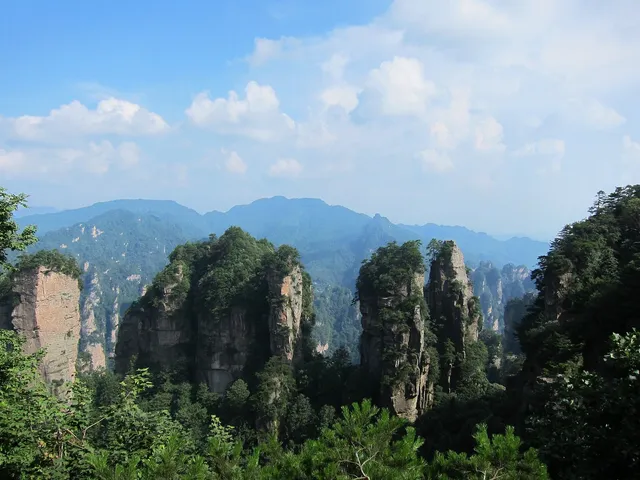
Zhangjiajie National Forest Park
China's first national forest park (1982) and the core of the Wulingyuan UNESCO site, this is the pillar forest you came for. Yuanjiajie's quartz-sandstone columns include the Southern Sky Column, officially renamed the Avatar Hallelujah Mountain after the 2009 film; Tianzi Mountain adds ridge-top lookout platforms over an ocean of stone. The park is enormous — three to four separate scenic areas stitched together by shuttle buses — so most visitors need two days to see it without marching. Capacity is capped daily and tickets sell out on Chinese holidays.
Good to know · The entrance ticket costs around ¥228–236 and is valid for four consecutive days including the internal green buses (as of September 2026). Book online with your passport via Trip.com or the official mini-program (which takes Alipay or WeChat Pay); the Bailong Elevator and cable cars cost extra (roughly ¥65–72 each way). Enter at the Wulingyuan gate and start before 8:30 AM.
No. 2
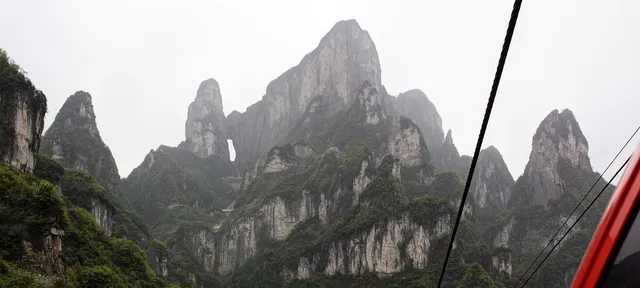
Tianmen Mountain
A separate park on a mountain literally above the city, reached by a cableway of about 7.5 kilometers — among the longest in the world — that lifts you from a station near downtown to a summit network of clifftop walkways and glass skywalks. Below, the legendary Tongtian Avenue road switches back 99 times to the base of Tianmen Cave, a colossal natural arch reached by a 999-step stairway. In cloud it is a ghost mountain; on clear days the panorama down to the city is vertigo-inducing.
Good to know · The through-ticket costs about ¥288 including the cableway and shuttle road (as of September 2026). Line A (cable car up) is the classic route; Line B (bus up first) often means shorter queues. Tickets are passport-linked and the mountain closes in high wind or storms — book a flexible day and check the morning forecast.
No. 3
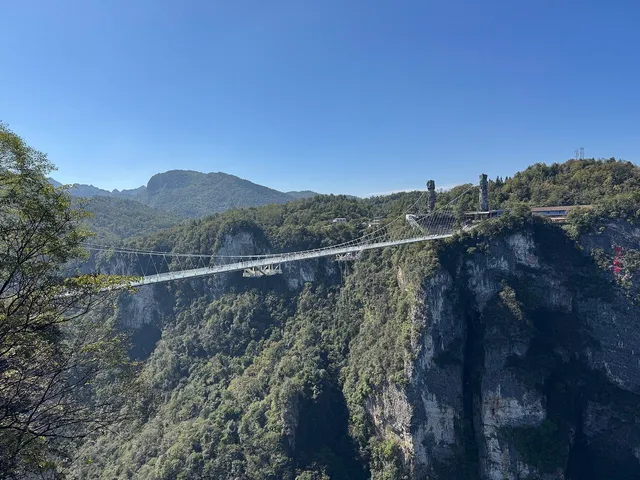
Zhangjiajie Grand Canyon Glass Bridge
When it opened in 2016, this 430-meter span across the Grand Canyon was the world's longest and highest glass-bottomed bridge — a transparent deck suspended roughly 260–300 meters above a riverbed of boulders and green water. Looking straight down through your own shoes never stops being a thrill. Pair it with the canyon below, where a boardwalk threads along a stream between mossy rock walls, with ziplines if you want more adrenaline. Entry runs on timed slots and sells out a day or more ahead.
Good to know · Route B (canyon walk plus bridge) costs about ¥178 and is the best-value ticket; bridge-only and hike-only tickets are cheaper (as of September 2026). Book at least one day ahead with your passport via Trip.com or the official WeChat account — timed entry is enforced. The canyon is roughly an hour from Zhangjiajie city, closer to Wulingyuan.
No. 4
Golden Whip Stream
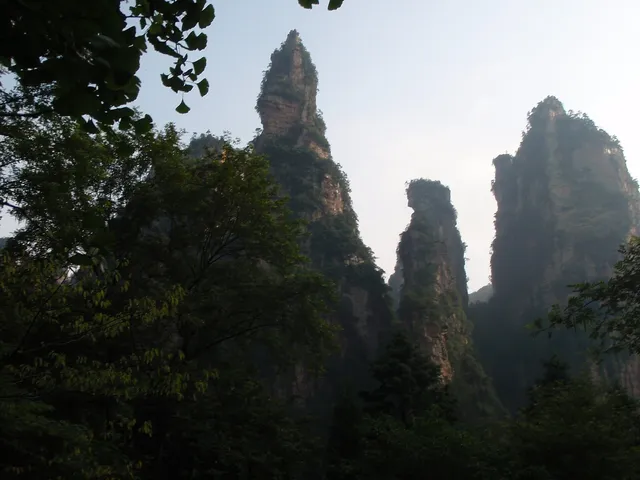
The gentlest and most rewarding walk inside the National Forest Park: about 7.5 kilometers of near-flat trail following a clear stream beneath walls of pillars, named for a rock shaped like a golden whip. Instead of looking down from a platform, you spend two and a half hours inside the landscape — cypress shade, emerald water, monkeys lounging on the railings — and emerge at the shuttle hub below Yuanjiajie. It is the perfect day-one afternoon, and the best place in the park to feel calm rather than queued.
Good to know · The trail is included in the standard park ticket; walk it in the shade-friendly morning or late afternoon and bus back from the far end (shuttles are included). Keep bags zipped and food packed away — the macaques are professional snack thieves. Add roughly 20–30 minutes to any posted walking time for photo stops.
No. 5
Fenghuang Ancient Town
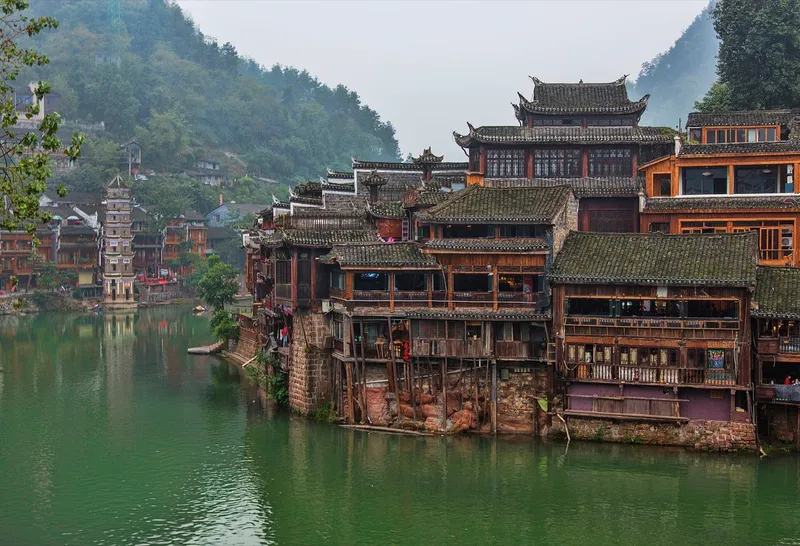
An easy high-speed-rail hop from Zhangjiajie, Fenghuang is one of China's most atmospheric old towns: wooden stilt houses lean over the Tuojiang River, Miao and Tujia heritage fills the side lanes, and the whole riverside lights up with lanterns and reflections after dark. Yes, it is commercialized — the main drags are wall-to-wall shops — but stay overnight and it repays you twice: riverside dawn before the tour buses, and a slow evening boat drifting under the lit bridges. Treat it as the cultural bookend to Zhangjiajie's wilderness days.
Good to know · High-speed trains run from Zhangjiajie West to Fenghuang Gucheng station in about an hour, then a maglev shuttle or bus reaches the old town in about 20 minutes. The town itself is free; a combined ticket for the nine heritage sights costs around ¥128, and the night river cruise around ¥140–170 (as of September 2026).
See it in motion
Some places earn a moving picture
Stills can't show how this place moves — the drift, the light show, the crowd flow. We picked a recent, high-quality walkthrough rather than a promotional cut.
Zhangjiajie National Park - Drone 4K
Nicholas Tan · YouTube · plays on click
Embedded via YouTube's official player (privacy-enhanced mode). Video: Zhangjiajie National Park - Drone 4K by Nicholas Tan. Not affiliated with China Travel Copilot; screened for quality and accuracy on 2026-09-28.
Long before the helicopter scene in Avatar, Chinese painters and poets were already running out of superlatives for this place. Zhangjiajie’s pillar forest is geologically one of a kind — thousands of quartz-sandstone columns rising sheer from densely forested ravines — and it is experienced very differently from Guilin’s gentler karst: you look up, and you look down, a lot. Two warnings before you fall in love with the photos. First, the headline sights are two separate parks, tens of kilometers apart, each needing its own full day — mixing them up is the single most common mistake here. Second, the weather runs the show: a sea of clouds at sunrise is the finest thing you will see in China, while thick fog can erase a ¥300 view entirely. Build in slack, start early, and this becomes one of the most spectacular nature trips on the planet.
A Bit of History
The city is younger than it looks. Until the 1990s this was Dayong, a modest river town in the hills of northwestern Hunan; the name Zhangjiajie — folklore ties it to a Han-dynasty retainer whose family supposedly settled these valleys — was adopted for the city in 1994, and the scenery had by then already outgrown it. The Tujia people, joined by Bai and Miao communities, farmed these mountains for centuries under hereditary chieftains, building the wooden stilt houses (diaojiaolou) you will see recreated all over the region.
The landscape got its official status early and often. In 1982 the State Council designated the newly named Zhangjiajie as China’s first national forest park — the very start of the country’s protected-area system. Wulingyuan, the larger scenic reserve wrapping the park together with Suoxi Valley, Tianzi Mountain, and Yangjiajie, was inscribed on the UNESCO World Heritage list in 1992, and the area became a UNESCO Global Geopark in 2004. Few places on earth have jumped from obscurity to triple-listed within a single generation. Yet for most of the twentieth century these remained some of the least accessible mountains in China — farming villages reached by footpaths, linked to the outside world by a single rough road.
Then came global fame, twice. After James Cameron’s Avatar (2009) borrowed the silhouette of these pillars for its floating mountains, the park formally renamed its most famous rock — the 150-meter Southern Sky Column in Yuanjiajie — the Avatar Hallelujah Mountain, and visitation exploded; the park now ranks among the busiest scenic areas in China, which explains the crowds you will be strategizing around. In 2016 the Grand Canyon Glass Bridge opened as the world’s longest and highest glass-bottomed span, adding engineering spectacle to geology. Infrastructure kept pace: Hehua International Airport gained domestic reach, and the Zhangjihuai high-speed railway (opened December 2021) plugged the mountains into Changsha, Jishou, and Fenghuang. A city that was remote your parents’ whole lives is now a three-hour train ride from a provincial megacity — and the visitor systems, from passport-linked e-tickets to shuttle fleets, have been rebuilt around that reality.
Culture & Daily Life
Zhangjiajie is a multicultural pocket of Hunan. The Tujia — China’s sixth-largest ethnic minority — are the local majority in the hills, and their heritage is visible rather than museum-ified: stilted wooden houses over riverbanks, xilankapu brocade woven on belt looms, and the baishou “hand-waving” dance performed at festivals with whole villages in loose formation. Miao silverwork and Bai customs surface in the valleys toward Jishou and Fenghuang. In the tourist zones this heritage is packaged into evening shows and photo costumes; in the villages along the park’s edges, it is simply how houses are built and weddings are run.
Daily life here is shaped by the mountain economy. Corn and rapeseed still cling to improbable slopes, kiwi orchards line the valley roads (the local kiwifruit is excellent — try the juice and wine), and tourism employs a huge share of working-age adults: ticket checkers, shuttle drivers, raft polemen, guesthouse families. That means service is oriented to visitors, prices are transparent in the official sites, and the official push for quality — Wi-Fi on mountain buses, foreign-card payments at ticket windows — has genuinely improved the foreigner experience over the past few years.
Two practical notes on the ground: Mandarin works everywhere and English is patchy outside hotels, so keep a translation app handy; and this is Hunan, so the default answer to “how spicy?” is “yes.” People are friendly in a laid-back, small-city way — square dancers in the plaza at dusk, chess players under the eaves, morning markets thick with chili and cured pork smoke. If your dates align with Tujia festival days, grab the chance: the sixth-month sixth-day “June 6th” celebrations and the new-year hand-waving dance fill villages with drums, brocade, and rice wine, and they are nothing like the staged evening shows — and even the smallest mountain stall takes Alipay or WeChat Pay.
Nature & Day Trips
The nature here is the whole point, and it is worth understanding what you are looking at. The Wulingyuan scenic zone — over 390 square kilometers combining Zhangjiajie National Forest Park, Suoxi Valley, Tianzi Mountain, and Yangjiajie — protects the world’s only quartz-sandstone pillar landscape on this scale: pre-Devonian quartzite sandstone, uplifted and eroded along vertical joints into hundreds of sheer-walled columns, some over 200 meters tall, cloaked in subtropical forest. Macaques and a wealth of birds live in these ravines.
Weather is the sixth sense of this trip. The pillars form their best theater when mist pours between them — the celebrated “sea of clouds” — which means rain is not automatically bad news: a stormy evening followed by a clear dawn is precisely when the mountain delivers. Equally, a low gray ceiling can flatten everything into white nothing. Check forecasts the night before, keep a flexible day, and never burn your only clear morning on the glass bridge.
Inside the park, plan two full days minimum: one for the Yuanjiajie–Tianzi Mountain high circuit, one for Golden Whip Stream and the quieter valleys. Beyond the park gates, the options stack up: Tianmen Mountain for the cableway-and-arch spectacle, the Grand Canyon for the glass bridge, Baofeng Lake for a quiet boat beneath cliffs, and the vast Yellow Dragon Cave for a rainy day underground. Fenghuang Ancient Town, an hour away by high-speed rail, adds the cultural counterweight — rivers, old houses, and Miao heritage instead of stone.
Food & Drink
Hunan is China’s chili heartland, and Zhangjiajie adds Tujia mountain cooking on top — smoky, sour, pork-forward, and unapologetically hot. The signature dish is sanxiaoguo, the “three-in-one pot”: a small iron wok of cured pork, beef offal, or river fish stewed with tofu, peppers, and local herbs, order-by-the-pot and built for sharing. Cured and smoked meats (larou) hang in rafters everywhere; hezha, a rustic soybean-and-vegetable stew, is the humble peasant counterpoint; and rock-ear (yan’er) — a fungus foraged from cliff faces — gets simmered with local chicken into the region’s celebratory soup.
Snack on kudzu-root (gegen) jelly sweets, grilled tofu, and the sweet fried dough twists sold near the park gates; wash it down with kiwi juice, rice wine, or tea. Fenghuang, if you extend, adds its own famous blood duck and ginger candies. Two street-smart rules: eat where tour groups do not — one street back from the main drags is usually enough — and trust queues of locals over English signage, since the two rarely overlap.
Logistics are easy: Wulingyuan town’s restaurant streets near the park gate cater to every budget, the city’s night market strips do proper local eating, and farmhouse restaurants along the roads out of town serve the most authentic versions of everything above. Budget ¥30–70 per person for a solid meal, more for the rock-ear chicken. If chili is a problem, learn one phrase — “wei la” (mildly spicy) — and order accordingly; spice is adjustable here, everywhere. And keep a stash of snacks for park days: the scenic areas have food courts, but they are priced like captive audiences, and a bag of the local kiwifruit beats a ¥40 plate of fries at 2,000 meters. Breakfast before an early park start is simple: noodle shops and baozi stalls near the gates open by 6:30 AM.
Top Sights
The critical fact: the National Forest Park and Tianmen Mountain are separate scenic areas about 50 kilometers apart, with separate tickets — plan one full day for each, then add the glass bridge and Fenghuang as you have time.
Zhangjiajie National Forest Park
Give this park two days. The essential circuit is Yuanjiajie — the high plateau of quartzite columns where the Avatar Hallelujah Mountain stands and the viewing platforms queue thickest — linked by shuttle and footpaths to Tianzi Mountain’s ridge-top lookouts over the “stone forest under heaven.” The Bailong Elevator, a 326-meter glass shaft bolted to a cliff face, hoists you up in under two minutes (around ¥65–72 one-way, paid separately, as of September 2026); cable cars serve the other high points. Your entrance ticket (around ¥228, valid four consecutive days) includes the green shuttle buses that stitch the park together — buy it online with your passport via Trip.com or the official mini-program, because daily entry is capped. Enter at the Wulingyuan gate before 8:30 AM, ride straight to the high circuit first, and walk downhill as the crowds arrive. On misty days, go anyway: half-veiled pillars beat clear blue for atmosphere.
Tianmen Mountain
The other must-do — an entirely separate park five minutes from downtown. It starts with the cableway: roughly 7.5 kilometers — among the longest on earth — lifting you from the city’s streets over suburbs and ravines to the summit in about half an hour. Up top, a loop of clifftop walkways includes the famous glass skywalks (shoe covers included or a few yuan extra) bolted to the vertical face. The descent is the legend: escalators bored through the mountain down to Tianmen Cave, a 131-meter natural arch in the cliff, and the 999-step stairway to its base — where the Tongtian Avenue road unspools its 99 hairpin bends far below; a paid escalator can spare your knees on part of the route. The through-ticket runs about ¥288 as of September 2026 and covers cableway and road shuttles; Line A goes cable-car-up, Line B goes bus-up and usually queues less. The mountain closes in wind and storms, so keep a flexible day and confirm the morning forecast.
Zhangjiajie Grand Canyon Glass Bridge
Half a day, well spent. The bridge itself is a 430-meter span slung some 260–300 meters above a canyon floor, its deck a strip of transparent glass panels — walk on and the riverbed drops away beneath your feet (an engineering first in 2016, still the standard-setter for the genre). Looking straight down through your own shoes never stops being a thrill. Tickets run on timed entry: book at least a day ahead with your passport via Trip.com or the official WeChat account — walk-up slots are not a thing in season. Route B, combining the bridge with the canyon walk below — a shaded boardwalk along a green stream between moss-boulder walls — costs about ¥178 and suits most people; bridge-only and hike-only tickets are cheaper, and ziplines and other add-ons for more adrenaline cost extra (as of September 2026). The canyon sits about an hour from Zhangjiajie city and is closer to Wulingyuan. Go on a clear morning for the best light, and keep your phone strapped on — nobody believes the view until the photo.
Golden Whip Stream
Not every highlight needs a cable car. Golden Whip Stream is the park’s classic hike: around 7.5 kilometers of almost-flat trail tracking a shallow, improbably green stream between walls of pillars and old-growth shade, from the park’s main gate area to the shuttle hub beneath Yuanjiajie. Allow a relaxed two and a half to three hours with photo stops; it is included in your park ticket. The name comes from a bluff that resembles a golden whip tapered to a point; the real stars are the atmosphere — cypress, water noise, columns leaning over the path — and the macaque troops that lounge along the railings. Keep all food zipped inside your pack and skip the hand-feeding photos — the rangers are serious about it. Hike it in the morning or late afternoon for the best light, then bus up to Yuanjiajie from the far end.
Fenghuang Ancient Town
End on culture. Fenghuang, an hour west by high-speed rail from Zhangjiajie West (then a 20-minute maglev shuttle or bus from Fenghuang Gucheng station), is a jewel of riverside China: centuries-old wooden stilt houses balanced over the Tuojiang River, stone lanes climbing between Miao and Tujia quarters, and drystone bridges where locals still cross mid-river. The town scrapped its general entrance fee years ago — wandering is free — while a combined ticket (around ¥128) covers the handful of heritage sights such as Shen Congwen’s former residence, and the night cruise on the lit-up river costs roughly ¥140–170 (as of September 2026). The honest critique: the main riverside blocks are heavily commercialized. The fix is an overnight. By 10 PM the coaches leave, by 7 AM the river steams and belongs to the residents — and those two hours are among the loveliest you will spend in China.
Getting There & Around
Zhangjiajie Hehua International Airport (DYG) handles domestic flights from every major Chinese hub, with a few regional international routes. It sits about 7 kilometers from downtown — a 15–20 minute taxi — and roughly 35 kilometers from Wulingyuan, where a taxi or ride-hail costs around ¥120 and takes 45 minutes; cheaper is the airport bus into the city, then a bus or DiDi onward.
By rail, use Zhangjiajie West station on the Zhangjihuai high-speed line: about 2.5–3 hours from Changsha, and just 40 minutes to an hour from Fenghuang and Jishou. Note that there are two stations — the older Zhangjiajie station downtown serves conventional trains, while the high-speed West station is actually more convenient for Wulingyuan (30–40 minutes by bus or ~¥100 taxi). Book on 12306 or Trip.com with your passport.
On the ground, DiDi works in both towns and buses are cheap and frequent between the city, Wulingyuan, and the Grand Canyon. Inside the forest park, the green shuttle buses included with your ticket do nearly all the climbing for you; cable cars and the Bailong Elevator are paid extras. Between the two headline parks, allow a full hour of transfer time — they really are that far apart.
Where to Stay
Two bases cover the trip. Wulingyuan town is the right place for the forest-park days: it sits at the main park gate, with walkable restaurant streets, morning-market breakfasts, and the shortest possible start line — stay two or three nights, ideally within ten minutes’ walk of the gate. Zhangjiajie city suits your arrival night and your Tianmen Mountain day, since the cableway’s lower station is right in town and the airport is close by; the riverside area near Tianmen and the bus stations is the practical choice.
For the glass-bridge day, a Wulingyuan start shaves half an hour. If you extend to Fenghuang, spend one night in a river-facing guesthouse inside the old town — accept some late-night music noise in exchange for the lantern-lit view — or pick a lane two streets back for quiet. Book Wulingyuan well ahead for Chinese holidays, when the park caps entry and rooms vanish; shoulder-season rooms here are plentiful and pleasant.