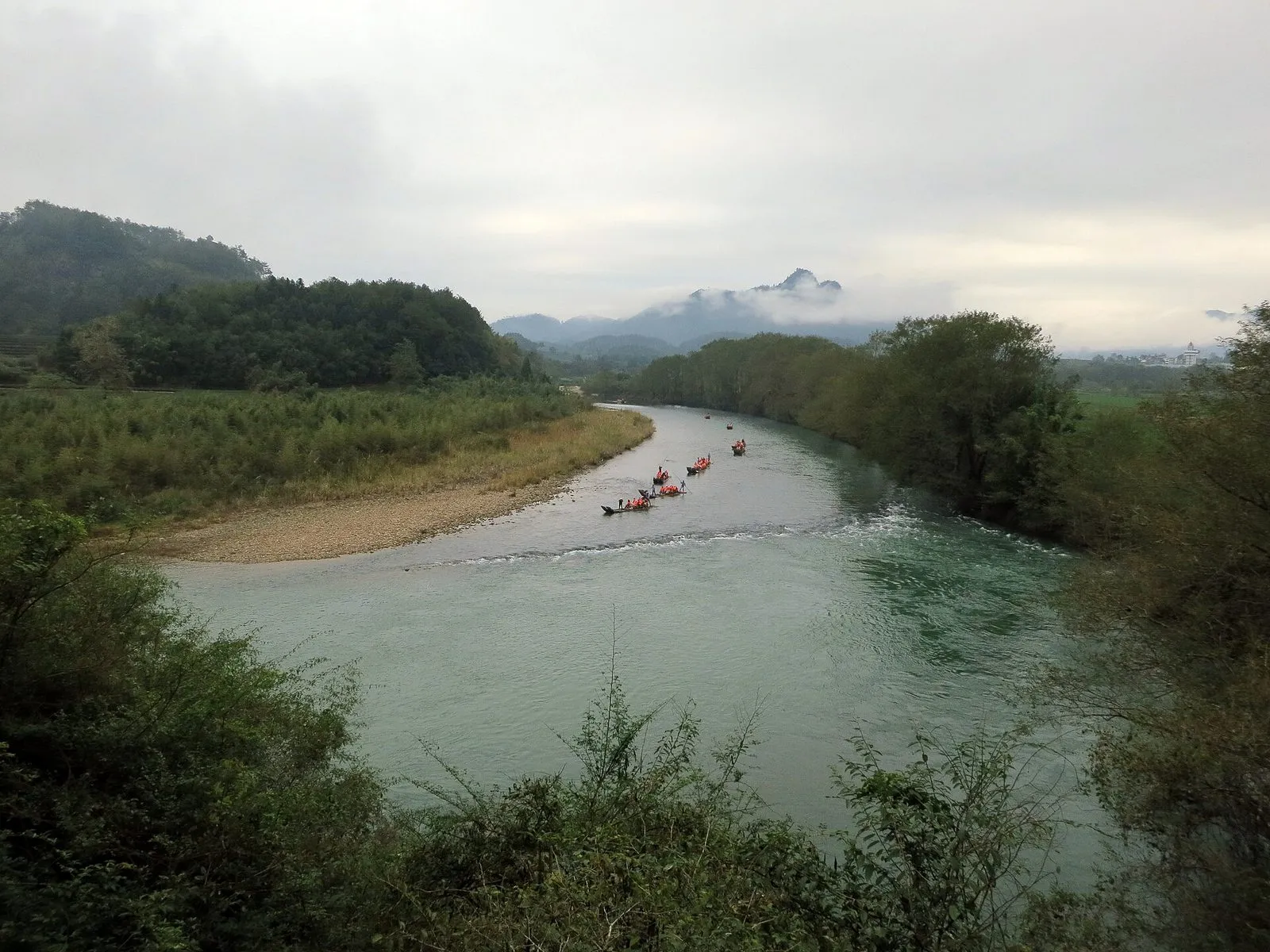
Wuyishan is the rare case of a single park justifying a whole city: a UNESCO World Cultural and Natural Heritage site of burnt-orange Danxia cliffs, a jade-green river, and the birthplace of oolong and black tea. The essential experience is drifting the Nine-Bend River by bamboo raft, boatmen poling you beneath cliffs that have fed poems for a millennium, then climbing Tianyou Peak to watch the river's loops from above. Tea is the second landscape — pilgrimages run to the six protected Da Hong Pao mother trees and to Xiamei village, starting point of the historic Tea Road to Russia. Add the Impression Dahongpao night show, hands-on tea workshops, and waterfall-valley walks, and you get East China's most rewarding nature-plus-culture escape. This page walks through the rafting logistics, the station-name trap, and the tea rituals. Best for travelers with two to three days who like their scenery paired with something to drink.
Top sights at a glance
No. 1
Bamboo Rafting the Nine-Bend River
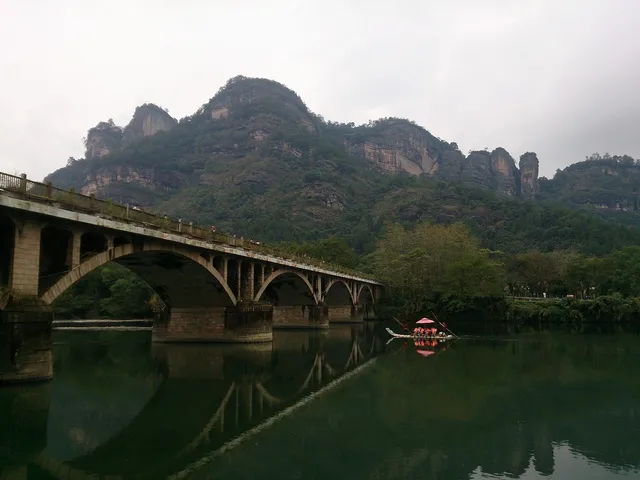
The reason most people come. For roughly two hours, a boatman poles a raft of lashed bamboo down the Nine-Bend River, past oxbow loops, cormorants, and orange cliffs that rear straight out of green water — a slow-motion ride through a scroll painting that changes character bend by bend. It is gentle, suits kids and grandparents, and is the best introduction to the park's geography: after the raft, the trails make sense. Go early, when mist hangs on the water and the light turns the rock the color of rust.
Good to know · Rafting is ticketed separately from park entry and must be reserved at the same time as your mountain ticket on the official Wuyishan booking platform or via Trip.com with your passport — departures sell out around holidays, when authorities add extra raft capacity. Rafts stop running whenever storms raise the water; in August 2026 a typhoon closed the river and the park refunded raft and shuttle tickets in full, so keep a flexible day in your plan.
No. 2
Tianyou Peak
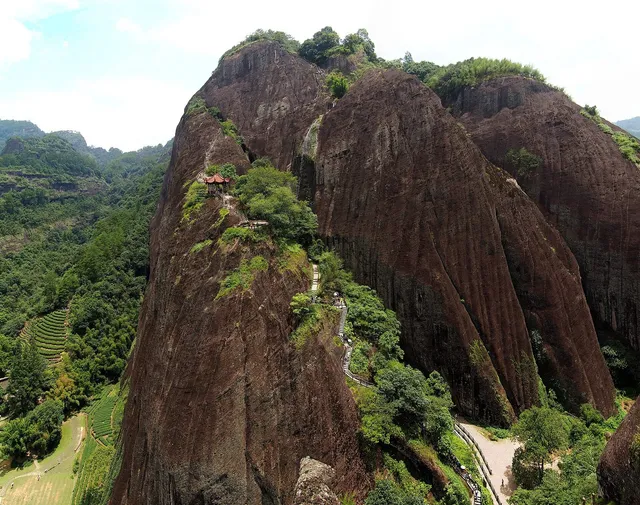
The park's classic viewpoint, an hour-plus of stone steps to a crag pinned above the river's greatest loop. From the top platform the Nine-Bend River unspools beneath you in a series of green horseshoes between layered orange cliffs — the view on every Wuyishan postcard, and worth every stair. The trail climbs through camphor and pine, passes a small temple, and narrows along a rock spine for the final approach. Descend the far side to link up with the valley trail and a riverside walk back toward the rafts.
Good to know · Start before 9:00 AM: the steps are shaded early, crowds are thinner, and haze burns off by late morning. During peak festivals the ticket office at the trailhead has even rented out climbing-assist exoskeleton robots; if your knees vote against the summit, the river-level trail between Wuyi Palace and the raft landing delivers a respectable plan B.
No. 3
The Da Hong Pao Tea Trail
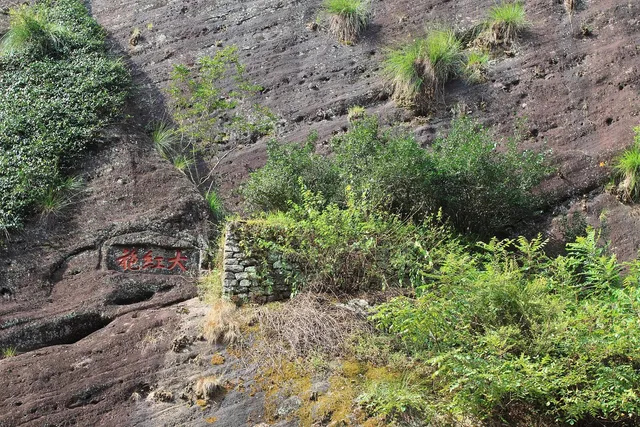
A short, easy valley walk into rock-walled tea country, ending at the most famous shrubbery in Chinese tea: six ancient Da Hong Pao mother trees, clinging to a sheer cliff face behind a protective railing. These are the progenitors of rock tea — Wuyi oolong with a mineral, roasted depth that tea drinkers once ranked above gold. Boards explain the lineage; the surrounding gorge drips with moss, spring water, and carved cliff inscriptions. Extend the walk to nearby Waterfall Cave for hanging Danxia overhangs and more cliff inscriptions.
Good to know · The trailhead sits inside the main scenic area, reached by the park shuttle from the main gate — shuttle and entry tickets are booked together. Pair the walk with a tasting afterward: honest tea shops around the resort district will brew before they sell, and a short tea-ceremony class is the best rainy-day activity in town. Budget roughly an hour for the mother-tree walk itself.
No. 4
Xiamei Ancient Village
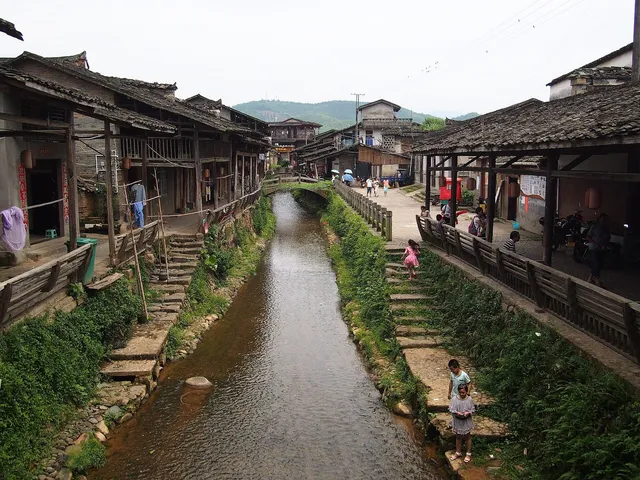
Twenty minutes outside the park, this low-key brick-and-timber village is where the Great Tea Road began: in the 17th through 19th centuries, Wuyi tea was weighed, taxed, and loaded on boats here to begin the overland haul — first north through Shanxi, then across Mongolia to the tea houses of Russia, more than ten thousand li of it. Ancestral halls, carved merchant residences, and a canal that once floated tea barges survive along the lane. It is working farm country first, attraction second, which is exactly its charm.
Good to know · Village entry is ticketed separately from the main park; buses and taxis run from the resort district, and a taxi for the half-day loop (Xiamei plus a tea workshop) is the easy way. Go in the afternoon light when the brick walls glow, and buy tea directly from a drying floor if the harvest is on — prices are nearer farm-gate than gift-shop.
No. 5
Valley Trails of the Scenic Area
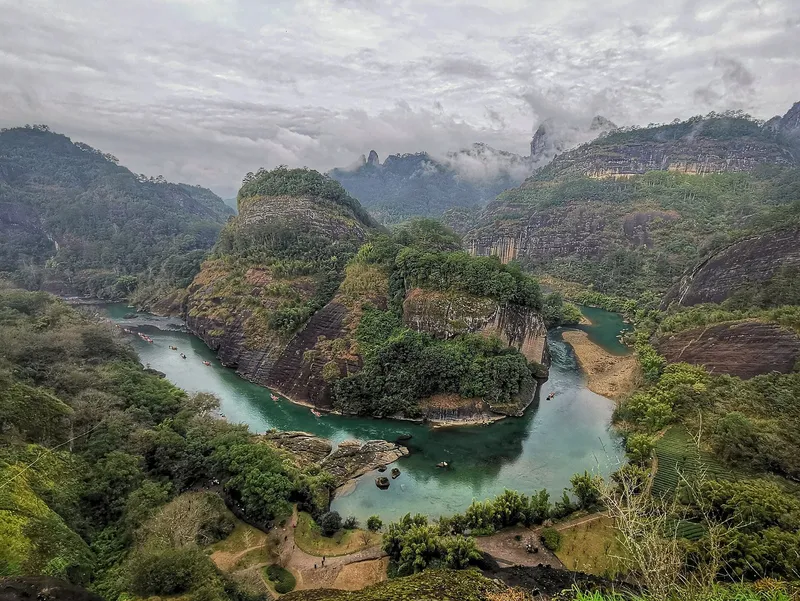
Between the headline raft and the famous peak lies the park's quiet bulk: a lattice of riverside and valley walks under subtropical forest, past swimming holes, hanging waterfalls, and cliff faces inscribed with centuries of calligraphy. The Waterfall Cave area stacks a tilted Danxia overhang over a secluded gorge; the walk between Wuyi Palace and the raft landing strings tea houses and river beaches. The park's network of shuttle buses makes any section a one-way stroll rather than an out-and-back hike.
Good to know · The entry ticket covers the whole trail network, and the green shuttle buses hop between trailheads every few minutes — plan walks as point-to-point segments and let the bus close the loop. Trails turn slick after rain; cheap rubber-soled 'hiking slippers' sold near the gate are a local hack that genuinely works.
Few places in China pack this much landscape and this much culture into one ticket. Wuyishan National Park — the mountains that gave the city its name — has been a UNESCO World Cultural and Natural Heritage site since 1999, one of an elite handful in China honored for both scenery and civilization. The scenery is Danxia: rusty-orange sandstone cliffs sheared into walls and ravines by a jade-green river that bends nine times through the gorge. The civilization is tea, above all — Da Hong Pao rock oolong was born on these cliffs — plus a deep strain of Confucian philosophy planted here by Zhu Xi, the Southern Song thinker who spent some fifty years of his life in these valleys. Most visitors structure it the same way: one day for the river and the peak, a second for tea country and the night show. Neither day is strenuous — the bamboo raft does the distance for you, and the trails top out at viewpoint crags, not 1,800-meter summits. Come with an appetite, a rain shell, and bag space for a tin of tea you will not find at home.
A Bit of History
The valleys kept people long before they kept tea. Han-dynasty-era Minyue kingdoms ruled these basins, and river towns grew where the gorge opened into farmland. The transformation into somewhere special began in the Southern Song, when the philosopher Zhu Xi (1130–1200) made the area his home base for roughly half a century, teaching at lakeside academies and writing the Confucian commentaries that would define Chinese state orthodoxy for the next seven hundred years. Wuyishan became a name in Chinese intellectual history — the “cradle of Zhu Xi’s philosophy,” as official histories have it — and the cliff inscriptions scholars left behind still line the gorge trails.
Tea built the second layer of fame. Monks and farmers had tended cliff-face tea gardens here for centuries, but the Qing era turned Wuyishan into an industry: in villages like Xiamei, merchants consolidated leaf and dispatched it on the route later nicknamed the Great Tea Road — by river, then mule caravan north through Shanxi and Mongolia to Russian tea houses. The trade made local families rich enough to build the carved mansions you can still walk through in Xiamei, and it was Wuyi stock, carried out as seeds and cuttings, that eventually seeded plantations from Darjeeling to Ceylon.
Modern fame arrived by decree. In 1999, UNESCO inscribed the mountain as a mixed World Heritage site for both its biodiversity and its cultural landscape of tea gardens, academies, and cliff inscriptions; in 2021 the area was folded into China’s first tranche of official national parks. The management playbook since has been aggressive accessibility — repeated seasons of free main-park entry, raft capacity boosts, multilingual audio guides — punctuated by hard closures when typhoons flood the river. The mountain is being actively curated as a national showcase, and it shows in how smoothly the machinery runs.
Culture & Daily Life
Everything in Wuyishan smells faintly of roast tea. The valleys around the park are a working tea district first and a tourism zone second: families tend steep garden plots pinned between rock walls, spring brings the yells of the “mountain-waking” ceremony that opens harvest season, and by late April the village courtyards are knee-deep in withering baskets. Rock tea — yancha — is the local specialty: oolong grown on mineral-rich cliff soil, charcoal-roasted until it tastes of stone fruit and woodsmoke. Locals talk about “yan gu hua xiang,” the rock bone and flower fragrance, the way Burgundy drinkers talk about terroir.
Daily life runs on tea and tourism in roughly equal parts. Mornings start with tea eggs and rice noodle bowls at street stalls; afternoons belong to tasting rooms where owners brew flight after flight for browsers who may or may not buy; evenings fill the resort district’s riverside promenade with square dancers, and the Impression Dahongpao show — staged at mountain scale on the river itself — plays the same culture as modern folk theater. English is scarce outside hotels, so keep a translation app handy; the multilingual audio guides at the park gate are genuinely useful. And one social note: tea tasting is hospitality, not obligation. You can drink a dozen cups in an afternoon without buying a gram — though most people leave with a tin anyway.
Nature & Day Trips
Geologically, Wuyishan is a textbook of Danxia landform: red sandstone laid down in ancient basins, then uplifted and undercut by water into sheer cliffs, natural arches, and slot gorges that glow rust-orange in any direct light. The Nine-Bend River threads the whole formation, its clear water supporting enough fish and riverside wildlife that a guide can narrate the ecosystem from mid-current. Subtropical forest mantles everything the rock cannot hold, and the park sits at the heart of a broader national park reserve famous for biodiversity.
Practical nature time splits between the gorge and the highlands. Inside the park, the valley walks — Waterfall Cave’s tilted overhangs, the inscribed cliffs along the river beaches — deliver the landscape at walking pace, with shuttle buses knitting the trailheads together. Beyond the boundary, the National Park No. 1 Scenic Drive strings viewpoints, tea villages, and waterfall valleys such as Longchuan Canyon and Qinglong Falls on the wetter side of the range — low-key, locally run spots rather than ticketed mega-attractions. The best day trip, though, is cultural: Xiamei and the tea country loop, easily combined with a workshop or drying-floor visit. Hikers can link park trails into a half-day loop; ask the ticket hall which connectors are open, as sections close on rotation after heavy rain.
Food & Drink
Wuyishan eats like mountain Fujian: river fish, mushrooms and bamboo from the forest edge, and a chili-and-ferment streak that surprises visitors expecting coastal mildness. The signature dish is smoked goose — a whole bird cured over tea-wood and camphor smoke until the skin turns mahogany, served sliced cold with rice wine. It is the town’s status gift, and the version at ordinary local restaurants outclasses anything sold in vacuum packs. Alongside it look for river shrimp, braised stream fish, bamboo-shoot stir-fries in season, and glutinous-rice cakes stuffed with savory fillings.
Tea runs through the kitchen as well as the cup. A formal “tea banquet” — a set dinner where every course is cooked with tea — is served at certified restaurants around the resort district and makes a fun splurge; the newest hybrid is Da Hong Pao beer, a tea-brewed ale poured at festival stalls. Street level, the unfailing staples are Fujian noodle and dumpling bowls, barbecue skewers along the river promenade after dark, and tea eggs that have sat in their Da Hong Pao bath since dawn. For drinks, obviously, order tea: a proper tasting runs from lighter roasted grades to the black-rock intensity of the cliff gardens, and shops pour freely before you commit. Expect roughly ¥40–80 per person for a good sit-down dinner; tea purchases range from ¥50 tins to prices that require a conversation with your bank.
Top Sights
Two days is the honest minimum: one for the river and the peak, one for tea country and the night show. The sights below follow that order.
Bamboo Rafting the Nine-Bend River
The raft is the trip. From the upstream dock at Xingcun, boatmen pole flat rafts of lashed bamboo down roughly two hours of river, through all nine bends, under cliff walls that tilt over the current, past the odd cormorant fisherman and countless shrieking school groups. A good boatman doubles as guide — pointing out the carved inscriptions, the “two turtles” rocks, the crag where a famous poem was written — and the river’s slow rhythm does the sightseeing for you. It is the calmest, oldest-feeling iconic experience in Chinese tourism, and it suits every age group that can step onto a floating platform.
The logistics matter, so book them deliberately. Rafting is a separate ticket bundled with park entry and the shuttle system, reserved with your passport on the official Wuyishan platform or through Trip.com; holiday demand is heavy enough that authorities publicize extra raft capacity when festivals hit. Weather runs the show: high water or a typhoon stops the rafts entirely — in August 2026 the river closed and every raft ticket was refunded in full — so put the raft on your first full morning and keep a spare slot in case you must reschedule. Go early; morning mist and low sun make the cliffs glow.
Tianyou Peak
If the raft shows you the painting, Tianyou Peak takes you inside the frame. The climb — an hour-plus of stone steps through camphor shade, past a small temple and a spine of exposed rock — tops out on a crag pinned directly above the river’s grandest loop. From the platform, the Nine-Bend River coils beneath you in green horseshoes, rafts reduced to drifting matchsticks, and the layered orange cliffs step away to the haze. It is the most photographed view in the park for good reason, and the descent via the far-side trail lets you loop down to the riverbank walk instead of retracing your steps.
Pace it like a temple, not a sprint: start by 9:00 AM for cool steps and clearer air, carry water, and expect company at the top platform no matter when you arrive. The park has been testing climbing-assist exoskeleton rentals near the trailhead for older visitors — a sign of how mainstream the summit is meant to be. If knees or weather veto the climb, the riverside walk from Wuyi Palace toward the raft landing gives you the cliffs at eye level, which is a fine consolation prize.
The Da Hong Pao Tea Trail
Deep in a side gorge, six ancient tea bushes cling to a cliff face behind a railing, looked down on by carved characters cut into the rock above. These are the Da Hong Pao mother trees — the original stock of Wuyishan’s most famous rock tea, protected and propagated by cuttings for decades, and a genuine pilgrimage site for Chinese tea drinkers. The walk in is easy and beautiful: a valley floor of tea gardens sandwiched between dripping orange walls, spring water threading through moss, tea houses serving tastings at the trail’s mouth. Combined with the Waterfall Cave extension — a tilted Danxia overhang hung with cliff inscriptions — it makes the best half-day in the park after the raft.
Use the visit to understand what you are drinking: the boards explain the clone lineages and the cliff-side terroir, and a tasting flight afterward is the natural graduation. The mother trees themselves were retired from picking long ago, so the tea you buy is from their offspring — which is exactly what the shop will tell you, and the truth makes the story better, not worse.
Xiamei Ancient Village
Twenty minutes from the park gate, Xiamei is where the mountain’s tea met the world. In the 17th to 19th centuries, this canal village was the commercial head of the Great Tea Road: leaf arrived from the surrounding valleys, was processed and packed in these courtyards, then shipped north by river and mule caravan through Shanxi and Mongolia to the Russian border — a ten-thousand-li trade route in which Wuyishan was mile zero. Russian musicians still come to play in the village’s lanes as part of the ongoing Tea Road cultural exchange.
What you see today is a modest brick-and-timber village with merchant-family mansions, ancestral halls, stone bridges over the old tea canal, and drying baskets on the sidewalks — a working-town normalcy the park’s big three lack. The ticket is separate from main park entry; half a day covers it, ideally paired with a tea workshop or a farm-gate purchase where the leaf came off a drying floor an hour ago. Afternoon light flatters the brick, and a cheap local guide doubles the value by explaining which carved lintel belongs to which tea fortune.
Valley Trails of the Scenic Area
Wuyishan’s unsung middle is its network of valley and riverside walks, and on a second day they are the best reason to re-enter the park. Waterfall Cave stacks a vast tilted overhang of rock above a quiet gorge — one of the region’s largest Danxia caves, hung with calligraphy cut into the cliff — and stays cool even at noon. The riverbank stretch between Wuyi Palace and the raft landing strings together tea houses, swimming spots, and the famous view back at the peaks from water level. Shuttle buses hop between trailheads every few minutes, so every walk can be one-way.
This is also where the park’s quieter pleasures live: kingfishers working the shallows, tea pickers on the low slopes, the smell of camphor after rain. Trails turn slick after storms and sections close on rotation, so check the board at the shuttle hub. Between the raft’s overview and the peak’s panorama, these valley hours are where the landscape stops being a sight and becomes a place.
Getting There & Around
High-speed rail is the way in, and here is the trap everyone warns about: two different stations serve the mountain, and confusing them costs hours. Wuyishan North station is the close one — trains from Xiamen (3–4 hours) and other Fujian cities terminate there, roughly 22 kilometers from the scenic area, served by an inexpensive public bus (about an hour) and taxis (around half an hour). Nanping Shi station — literally “Nanping City” station, despite what old maps and some booking screens call it — lies about 50 kilometers away on the main north–south corridor, with frequent trains from Beijing, Shanghai, and Fuzhou directions but a longer drive to the park. Check the exact station name before booking; both are legitimate choices, but they are not interchangeable.
Within the valley, the park runs the green shuttle network from the main gate to all trailheads and the raft dock; private cars do not enter. City buses and metered taxis link the resort district, the old town, and Xiamei village, and authorities have periodically made urban buses free during festival campaigns. DiDi works well across the area. As of September 2026, entry tickets, shuttles, and rafting seats are reserved in advance with your passport on the official platform or Trip.com — pay with Alipay or WeChat Pay as usual.
Where to Stay
One base serves almost everyone: the resort district at the park’s main gate (often called the SanGu or Wuyishan Resort area), a strip of hotels, tea shops, and restaurants within minutes of the shuttle terminal. It is the practical choice for a two-day itinerary — early shuttle access for the raft, evening riverside walks, and the night show a short hop away. Rooms range from business chains to small tea-themed boutique inns; book ones with early breakfast if you want the first rafts.
Two alternatives earn their keep in specific cases. The city of Wuyishan itself is cheaper and more local but adds a commute to the gate. And for atmosphere, a night in a guesthouse in Xiamei or the tea villages along the scenic drive — waking to withering baskets and mountain mist — is the version of Wuyishan people remember for years. In the April–May and October peaks, book everything ahead: resort-district rooms sell out around festivals, and raft seats go with them.
Sources & verification (10)
- https://www.chinadaily.com.cn/a/202603/24/WS69c1e3dca310d6866eb3f745.html
- http://www.chinanews.com.cn/sh/2026/02-24/10576075.shtml
- http://www.chinanews.com.cn/tp/2025/11-15/10516108.shtml
- http://www.chinanews.com.cn/sh/2026/08-08/10674312.shtml
- http://www.chinanews.com.cn/sh/2026/05-22/10626624.shtml
- http://www.chinanews.com.cn/sh/2024/12-17/10338065.shtml
- https://www.chinahighlights.com/china-trains/xiamen-wuyishan-train.htm
- http://www.chinanews.com.cn/tp/2026/08-18/10679630.shtml
- http://www.chinanews.com.cn/cul/2026/03-24/10591873.shtml
- https://www.chinadaily.com.cn/a/202504/21/WS6805b1ffa3104d9fd382099d.html