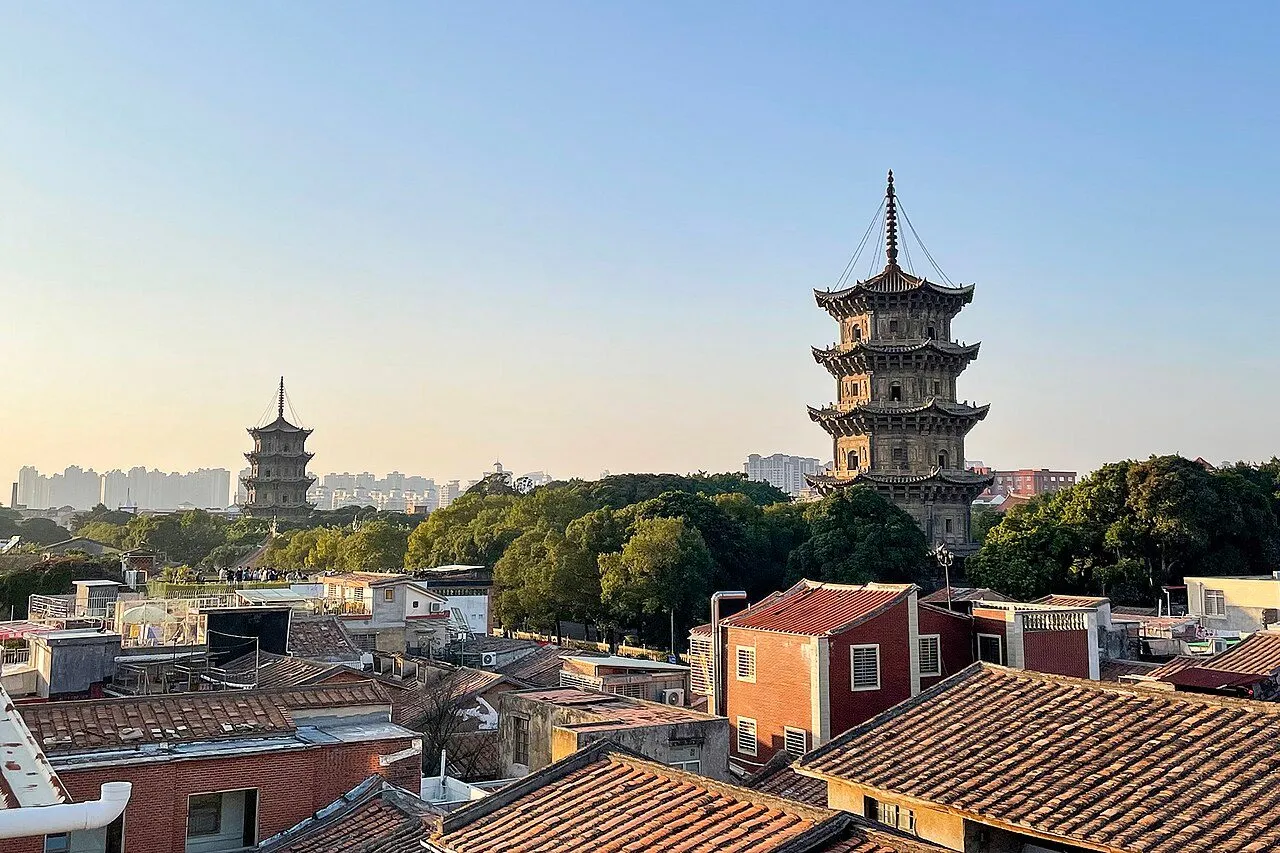
When Marco Polo watched ships leave China in the thirteenth century, he described Quanzhou — 'Zayton' on medieval maps — as one of the greatest ports in the world, and the city still looks the part: a low, red-brick old town where a Tang-era Buddhist temple with twin stone pagodas stands on a lane whose mosque has stood since 1009, beside incense-thick temples to war gods and sea goddesses. UNESCO inscribed the whole ensemble in 2021 as 'Quanzhou: Emporium of the World in Song-Yuan China,' a 22-site serial property. Today it is Minnan culture at full strength — gongfu tea, puppet theatre, flower-crowned women in an oyster-shell fishing village, and some of Fujian's best street food — at a fraction of Xiamen's polish and crowds. Half an hour north of Xiamen by high-speed train, Quanzhou suits travelers who want living heritage rather than scenery: two days, walked slowly.
Top sights at a glance
No. 1
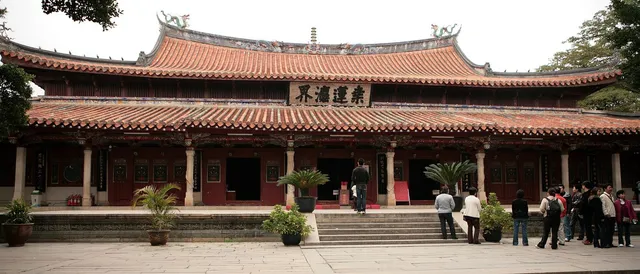
Kaiyuan Temple & the Twin Pagodas
Quanzhou's spiritual heart since 686 AD, founded — by legend — on a merchant's mulberry orchard, and now the largest Buddhist complex in Fujian. Its fame rests on the Zhenguo and Renshou towers: twin granite pagodas of 48 and 45 meters, rebuilt in the 1230s and still the tallest pair of stone pagodas in China, their surfaces crowded with carved guardians that have survived typhoons and earthquakes for eight centuries.
Good to know · Entry is free (as of September 2026); grounds run roughly from early morning — about 6:30–7:30 am — to around 5:30–6 pm. The main gate opens onto West Street, so pair it with the old-town lanes. Late afternoon sun flatters the pagodas; go early for chanting monks and empty courtyards.
No. 2
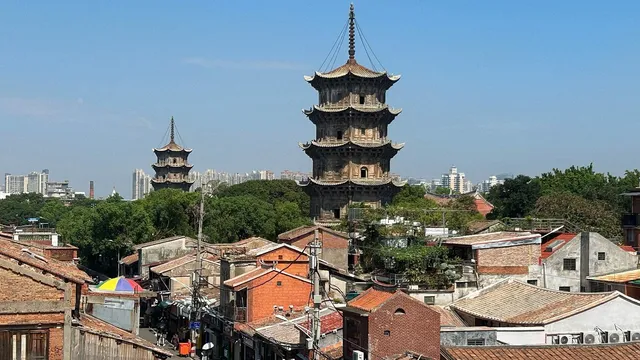
West Street & the Old Town
The old town is the main sight: a low grid of red-brick houses with swallowtail-curved roof ridges, stone lanes and banyan shade, centered on West Street — the lane that has run past Kaiyuan Temple's gate since the Tang dynasty. Free to wander at all hours, it layers snack counters, tea shops, incense stalls and family shrines into the best aimless walking in Fujian, with lantern-lit Zhongshan Road at its southern end.
Good to know · No tickets or reservations anywhere in the quarter (as of September 2026). Mornings belong to breakfast queues and temple incense; evenings to Zhongshan Road and the puppet theatres, whose marionette shows cost roughly RMB 78–108. Duck off West Street into the side lanes — that is where the old houses are.
No. 3
Xunpu Village
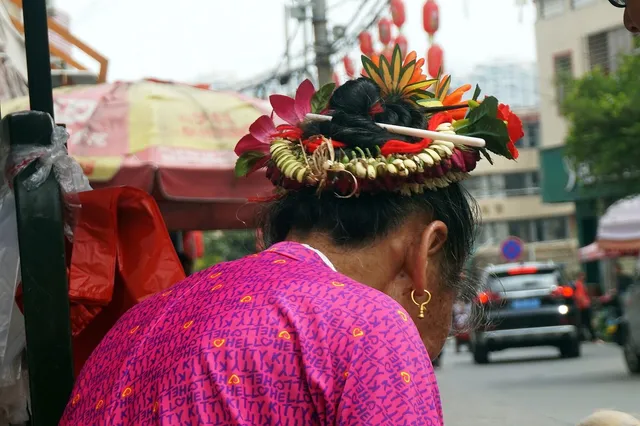
A working fishing village at the Jinjiang river mouth, ten kilometers from downtown, where houses wear walls of oyster shells and the women wear flowers: the Xunpu custom of zanhua — hair buns ringed with fresh blossoms — goes back to the port era and is listed as national intangible heritage. Visitors can have their own hair crowned, eat seafood by the mudflats, and see the famous shell houses up close.
Good to know · The village is free and open at all hours (as of September 2026). Photo outfits rent costumes and do the flower crowns for roughly RMB 40–199 depending on package; go late afternoon for light and stay for dinner. Taxis get scarce at night — your hotel can arrange a pickup, or take the cheap bus in.
No. 4
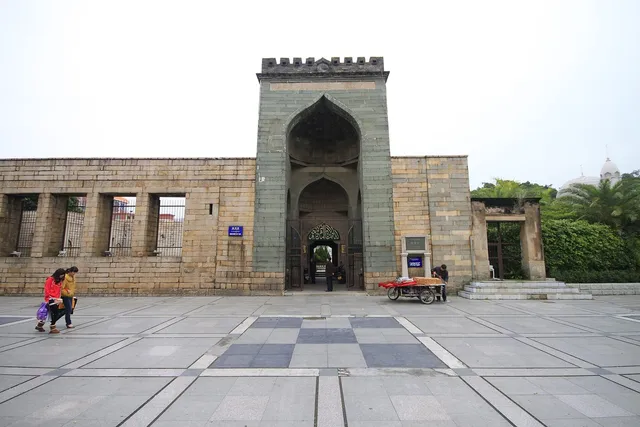
Qingjing Mosque
The oldest Arab-style mosque in China, founded in 1009 by the Muslim merchant community of the port and modeled on a great Damascus mosque, built of dressed granite that has silvered over ten centuries. The roofless prayer hall, ruined by earthquake, is now a haunting stone court — and it stands mid-way down Tumen Street between a roaring Guandi temple and the Confucian temple, the city's whole plural history in one block.
Good to know · Entry is a token few yuan and hours run roughly 8 am–5:30 pm; modest dress is appreciated, and it remains an active place of worship (as of September 2026). Combine with the Guandi and Confucian temples on the same street — all three in an hour. Mornings are quietest and coolest.
No. 5
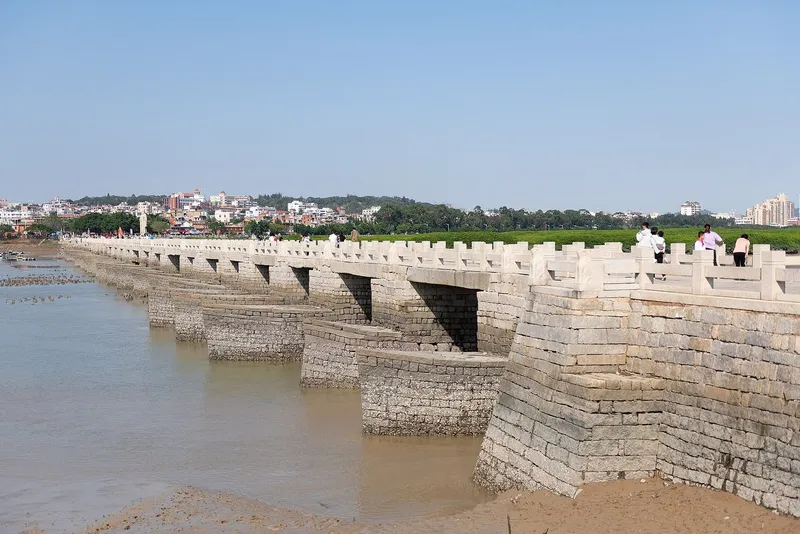
Luoyang Bridge
China's first great stone sea-crossing, completed in 1059 under the governor-calligrapher Cai Xiang: 731 meters of slab-and-pier granite spanning an estuary of mudflats and egrets. Its builders pioneered two tricks later used across the empire — boat-shaped piers to part the current, and beds of live oysters seeded to cement the foundations — making it arguably the first bridge in the world reinforced by shellfish.
Good to know · Walking the bridge is free; it sits at the northern edge of the city, a short taxi ride from the old town (as of September 2026). Time it with low tide for the oyster beds and wading birds, or sunset for the long line of the bridge itself. Combine with a seafood lunch in the riverside village nearby.
Some cities show you what China built; Quanzhou shows you whom China traded with. For four centuries around the year 1000, this was one of the largest ports on earth — the “Zayton” of medieval charts, where Arab, Persian, Indian and Southeast Asian merchants moored beneath hills of exported porcelain and silk. They left their religions behind, and improbably, the city kept them: a granite mosque on the main street, Hindu carvings in Buddhist walls, churches and Manichaean relics in the surrounding counties. UNESCO inscribed the whole ensemble in 2021 as a 22-site World Heritage property. Yet Quanzhou is no museum piece — it is a functioning Minnan city of tea trays and temple incense, cheaper and more local than nearby Xiamen, and one of the few places in coastal China where two days of walking still feels like discovery.
A Bit of History
The location made the city: a deep, sheltered bay on the Fujian coast facing the monsoon routes to Southeast Asia and the Indian Ocean. From the Tang dynasty onward, Quanzhou’s shipwrights and merchants grew wealthy on the outbound trade in silk and — above all — ceramics, and under the Song and Yuan dynasties the port became one of the largest in the world. Medieval travelers knew it as Zayton, a European rendering of Citong, the coral trees the city famously planted along its walls; at its peak the harbor held, by contemporary accounts, fleets of over a thousand ships, and the customs office the Song court established here became the empire’s most lucrative. Quanzhou’s own ships grew famous in that trade: deep-hulled Fujian junks that worked the monsoon calendar, riding winter winds south and summer winds home — their routes, and the faiths they carried, wrote the city’s character centuries before any European arrived.
The foreigners came in communities, not just crews. Arab and Persian merchants maintained quarters, cemeteries and mosques — the stone mosque on Tumen Street dates to 1009 — and the port’s tolerance was practical: Buddhism, Islam, Taoism, Nestorian Christianity and Manichaeism all kept buildings here, and Hindu carvings from a merchant temple survive in local walls today. The wealth built what tourists now come for: the twin granite pagodas of Kaiyuan Temple, raised in the 1230s when the port was at its height, and the great estuary bridge finished in 1059 — both still standing in daily use.
Decline was political. Ming-dynasty sea bans strangled private overseas trade in the late fourteenth century, the harbor silted, and commerce moved to Canton and beyond. Quanzhou spent the following centuries as a provincial backwater — which, ironically, preserved its medieval street plan, its temples and its distinctive Minnan culture while other coastal cities modernized them away. UNESCO’s 2021 listing of 22 sites as “Quanzhou: Emporium of the World in Song-Yuan China” finally gave the city its due; the tourists, arriving in numbers only since then, are the latest wave in a very old tide.
Culture & Daily Life
Quanzhou is the root of Minnan culture — the language, food and customs of southern Fujian — and locals will tell you, correctly, that the cultural capital moved to Xiamen only in modern times. The everyday texture is dense and unselfconscious: gongfu tea sets steeping in shop doorways, family shrines flickering beside flat-screen televisions, opera rehearsals in neighborhood halls. Tea shops roast peanuts in woks out front; nobody is in a hurry, including you. The local tongue, Hokkien, fills the markets; it is as distant from Mandarin as Portuguese is from Spanish, and street signs now helpfully print it.
Religion here is not a category but a habit. The same block can hold a Buddhist temple, a Muslim prayer hall and a Taoist god of war, all funded by the same pragmatic families. The Guandi temple on Tumen Street draws the thickest incense crowds in town — firecrackers, golden roofs, queues of business owners — and near the river mouth the Tianhou Palace honors Mazu, the sea goddess every Fujianese sailor trusted with his life; her 1196 temple here is among the oldest and largest anywhere.
Two art forms are worth planning around. Marionette theatre — strings, up to thirty per figure — is the region’s signature craft, and evening performances near the old town draw mixed audiences for roughly RMB 78–108; check the boards along West Street for session times, and arrive early, because seats are few. And there is the everyday spectacle of the city itself: elders playing cards under banyans, wedding fireworks at noon, pensioners swimming off the rocks by the river mouth. Practicalities are simple — Alipay and WeChat Pay run everything, the old town is flat and walkable, and outside the main streets English is rare, so keep a translation app loaded.
Nature & Day Trips
Quanzhou’s setting — a bay rimmed by low green hills — supplies more nature than its heritage reputation suggests. The classic escape is Qingyuan Mountain, the forested 5A scenic area at the old town’s northern edge (entry from around RMB 70): stone steps wind past the famous Song-dynasty colossus of Laozi, carved from a single rock face, to terraces with the city and the sea beyond. Go early; locals hike it at dawn and the stone heats up by ten.
The coast is the other vein. The mudflats around Xunpu village support oyster farmers and egrets at low tide, and the northeast headlands hold working fishing harbors where the day’s catch comes in at dusk. For a bridge-side picnic with a view, the estuary lawns at Luoyang Bridge double as bird-watching in the cooler months.
Farther afield, most travelers route through neighboring cities rather than rural Fujian: Anping Bridge, the two-and-a-half-kilometer medieval causeway southwest of town, makes a half-day add-on, while the tulou country and Xiamen’s coastline lie an hour or two away by train. The practical pattern for a first visit is pairing: Quanzhou for heritage and food, Xiamen for coast and cafes — the two cities are so close by rail that doing both is easier than choosing.
Food & Drink
Minnan cooking leans on the sea, the peanut, and the starch that binds them, and Quanzhou’s version is regarded — by locals at least — as the tradition’s source code. The breakfast that defines the city is mianxian gu: a bowl of thin rice-vermicelli in a silky broth, thickened just enough to suspend braised pork, squid, oysters or tofu exactly as you order them, finished with fried shallots and pepper. It costs a few yuan, exists on every corner, and locals eat it standing up before the workday starts.
From there, graze. Oyster omelets — plump local oysters in sweet-potato starch, fried crisp at the edges — are the region’s shared classic, done here with a lighter hand than in Xiamen. The adventurous should try Tudicong jelly, a chilled aspic set from local sea worms: translucent, briny, and exactly as challenging as it sounds, chased with the local sweet chili sauce. Peanut soup, steamed meat buns and fish-ball soups fill the gaps, all washed down with Anxi tieguanyin, the famous oolong grown an hour inland and poured everywhere from tea stalls to temple courtyards. Save room for sweet endings: peanut soup thick enough to stand a spoon in, and warm rice cakes sold by weight from street trays.
Geographically, West Street and the lanes around Kaiyuan Temple hold the old guard — breakfast shops with generations of regulars — while Tumen Street packs snacks between its mosques and temples, and Zhongshan Road does the lantern-lit evening circuit. Prices run comfortably below Xiamen’s across the board: a generous grazing tour of the classics costs less than a cinema ticket. Do the thing visitors forget — eat breakfast twice, once at dawn, once at ten — and you will have understood the city, because the menu shifts with the tide.
Top Sights
Kaiyuan Temple & the Twin Pagodas
Start at the center of gravity: Kaiyuan Temple, founded in 686 when — the story goes — a merchant’s mulberry orchard bloomed with lotus omens too good to refuse, now the largest Buddhist complex in Fujian. The grounds fold Tang footprints, Song halls and Ming courtyards into one incense-scented campus — the “Hundred Pillars” great hall, ancient banyans, and carved Hindu stones from the port era set into the walls.
The twin pagodas are the reason photographers climb rooftops: Zhenguo, the east tower at 48.27 meters, and Renshou, the west at 45.06 — both rebuilt in fine granite in the 1230s and, panel by carved panel, the finest stone architecture of their era anywhere in China, shrugging off eight centuries of typhoons to anchor every skyline view.
Admission is free; hours run from early morning (sources vary between 6:30 and 7:30 am) to around 5:30–6 pm (as of September 2026). No reservation is currently required — verify during peak holidays. Enter from West Street, budget ninety minutes, and finish in the back courtyards among the port’s Hindu fragments.
West Street & the Old Town
Quanzhou’s old town is not a single monument but a preserved grid, and West Street is its spine: a lane of stone and red brick running east from Kaiyuan Temple’s gate, continuously commercial since the Tang and still owned by the families behind its snack counters, tea shops and incense stalls. The architecture is the local dialect in built form — woven red brick, granite bases, swallowtail ridges sweeping up at the corners — and because almost nothing is ticketed, the quarter rewards the slow, repeated walking that ticketed cities make impossible.
Work it in layers: dawn for breakfast queues and monks’ rounds, midday for the side lanes south of the main drag where old courtyards survive behind wooden doors, dusk for Zhongshan Road’s arcaded, lantern-lit stretch. Puppet theatres nearby run marionette shows most evenings — genuine craft, roughly RMB 78–108 a seat — and the riverside gates frame the sunset properly (as of September 2026).
No tickets, no wrong turns. Weekend mornings are densest; the alleys one block north of West Street hold the oldest facades with the fewest selfie sticks.
Xunpu Village
Ten kilometers from downtown, at the mouth of the Jinjiang river, Xunpu is a working fishing village that became — almost accidentally — one of the most photogenic places in China. Two traditions built its look. The oyster-shell houses — walls faced with giant shells carried back as ship ballast, layered until they shimmer like fish scales, cool in summer and warm in winter. And the zanhua: the Xunpu women’s custom of coiling their hair into buns ringed with fresh flowers, dating to the port era and now listed as national intangible heritage, recently famous nationwide.
Visit late afternoon, when light comes low across the mudflats and the boats come home. The village is free to wander at all hours; small outfits will do your hair in a proper flower crown and rent you traditional dress — roughly RMB 40 for the simple version, several hundred for the full photo package (as of September 2026). Eat a seafood dinner by the water. Taxis are scarce at night — arrange a pickup or take the bus, and navigate to the market side of the village, not the map pin.
Qingjing Mosque
On Tumen Street, between the incense-roaring Guandi temple and the Confucian temple, stands the quietest building in Quanzhou and one of the most surprising in China: the Qingjing Mosque, founded in 1009 by the city’s Arab merchants and built in dressed granite, modeled on the great mosques of Damascus, for the traders who made this port rich. It is the oldest Arab-style mosque in China, and its austere stone faces stop visitors mid-stride: architecture that belongs in the Levant, silvered by ten centuries of coastal weather.
An earthquake brought down the original prayer hall’s roof, leaving the haunting open-air sanctuary you see today, a stone arch framing the sky, while later halls on the side serve the small congregation that still worships here. Entry is a token few yuan, hours run roughly 8 am–5:30 pm, and modest dress is appreciated in prayer areas (as of September 2026).
Give it half an hour, then walk the block: the contrast between the mosque’s silence, the war god’s firecrackers and the Confucian temple’s gravitas is the port’s whole history compressed into three doorways. Few blocks in Asia do more in less space.
Luoyang Bridge
Begun in 1053 and finished in 1059 under Quanzhou’s governor Cai Xiang — one of the Song dynasty’s four great calligraphers, whose stele still stands at the approach — Luoyang Bridge threw 731 meters of stone slabs across a tidal estuary where nothing of the kind had been attempted. Its builders invented two techniques that spread across Chinese engineering: boat-shaped piers to part the current, and beds of live oysters seeded to cement the foundations — arguably the first structure in the world reinforced by biology.
Walking it is free and open. Come at low tide, when the oyster beds glare and waders pick through the mud in clouds; come again at sunset, when the line of piers turns gold and locals fish from the railings as they have for centuries, past stone lions and pagodas.
The bridge sits at the city’s northern edge, a short taxi ride from the old town, and pairs naturally with a seafood lunch in the riverside village nearby (as of September 2026).
Getting There & Around
The Xiamen–Quanzhou rail corridor is one of the busiest short-hop routes in China: high-speed and D-class trains run from Xiamen or Xiamen North to Quanzhou or Quanzhou East in as fast as 17 minutes — more typically 25–50 — with well over a hundred departures a day and second-class fares from around RMB 27 (as of September 2026). Book on 12306 or Trip.com with your passport. Most visitors do the pairing: fly into Xiamen, split the week between the two cities, and let the railway do the driving.
In town, everything in this guide except Xunpu and Luoyang Bridge sits inside the old town, which is flat, compact and best on foot. Buses cost a yuan or two and cover the rest; DiDi rides across the center typically run RMB 10–25, and the trip out to Xunpu or the bridge is short enough to do casually in an afternoon. The city has no metro yet — rare in eastern China and part of its charm — so build in extra time and spend it in a tea shop.
Where to Stay
Stay inside the old town — Quanzhou is a walking city, and the reward of a good base is stepping out at dawn into breakfast steam and temple incense. The West Street–Kaiyuan quarter is the character pick: guesthouse conversions in old courtyard houses, pagoda views from the upper floors, and the whole heritage grid on foot — best for first-timers and heritage-focused travelers. Around Zhongshan Road and the riverside gates, you trade a little quiet for evening energy: arcaded streets, snack lanes and the lantern-lit promenade at your doorstep. Near the east side and stations, hotels are newer and cheaper, but you will taxi everywhere that matters.
Prices run noticeably below Xiamen’s for equivalent quality, and the top heritage courtyards sell out first around Chinese holidays — book ahead for May, October and summer weekends. Strategic note: rather than day-tripping from Xiamen, sleep in Quanzhou at least one night. The old town’s best hours — dawn incense, 10 pm snack lanes — belong to the people who stay.
Sources & verification (10)
- https://www.chinadiscovery.com/fujian/quanzhou.html
- https://www.travelchinaguide.com/attraction/fujian/quanzhou/kaiyuan-temple.htm
- https://www.chinadiscovery.com/fujian/quanzhou/kaiyuan-temple.html
- https://www.travelchinaguide.com/attraction/fujian/quanzhou/qingjing-mosque.htm
- https://www.travelchinaguide.com/attraction/fujian/quanzhou/luoyang-bridge.htm
- https://www.travelchinaguide.com/cityguides/fujian/quanzhou/
- https://www.trip.com/trains/china/route/xiamen-to-quanzhou/
- https://you.ctrip.com/sight/quanzhou243.html
- https://you.ctrip.com/sight/quanzhou243/1477976.html
- https://you.ctrip.com/sight/quanzhou243/8877.html