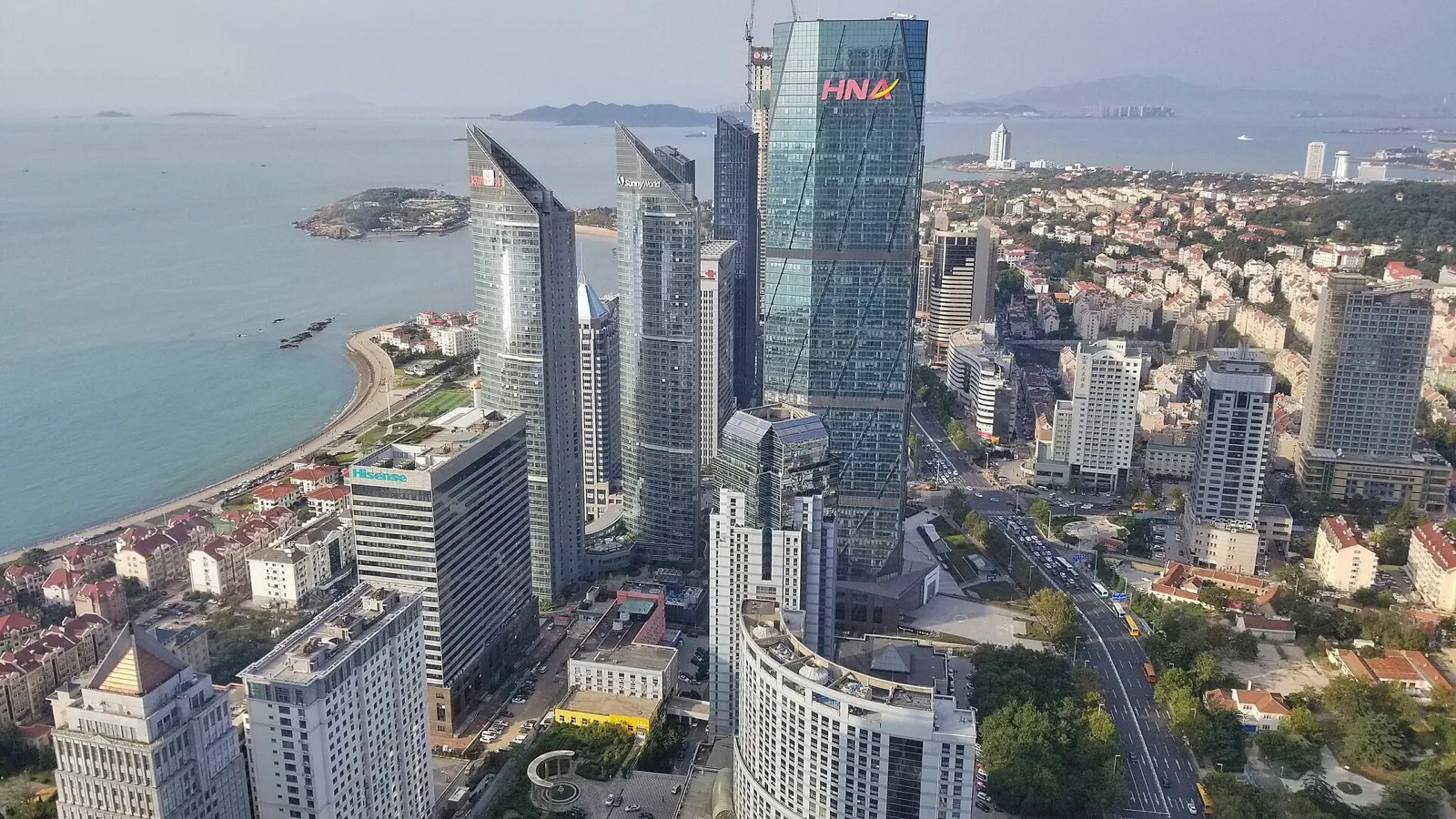
Qingdao is the rare Chinese city where the sea, not the skyline, sets the agenda. Ceded to Germany in 1898, this Shandong port grew up with red-tiled roofs, neo-Romanesque churches and a brewery that turned local spring water into Tsingtao, China's most famous beer — and the legacy makes its old town one of the most walkable, most European-feeling districts in the country. The core experiences are a loop of free sights around the bay: Zhanqiao Pier, the arcaded shopping streets, St. Michael's Cathedral, and the flower-lined villas of Badaguan above the city beaches. Add fresh draft beer poured into plastic bags at neighborhood beer houses, seafood dumplings, and a day hike on Taoist Mount Laoshan where granite peaks drop straight into the ocean. Best for independent travelers who want coastal walking, colonial history and cold beer — ideally in late spring or autumn.
Top sights at a glance
No. 1
The Badaguan Scenic Area
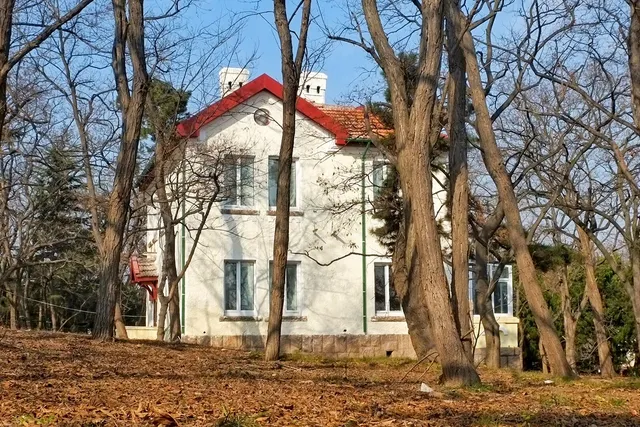
A grid of quiet streets named after Chinese mountain passes, Badaguan ('the Eight Great Passes') is where 1930s merchants, warlords and foreign consuls built villas in a dozen European styles, and where each street was planted with a single species — peach on one, cherry on another, golden ginkgo on a third. It is free to wander, bookended by two city beaches, and amounts to the loveliest hour of walking in northern China, especially in April blossom and late-October ginkgo season.
Good to know · No ticket needed for the district itself; a couple of showcase villas (the stone Huashi Lou among them) charge small entry fees. Come early morning to share the streets with wedding photographers instead of buses. Metro Line 3 to Taipingjiao Park, then walk in; give it two unhurried hours, ending at the No. 1 Bathing Beach.
No. 2
Zhanqiao Pier
The stub of a 440-meter pier walking out into Qingdao Bay is the city's symbol — it is literally the logo on every bottle of Tsingtao beer. Built as a naval jetty in the early 1890s, when Qingdao was still a Qing garrison town, it ends at the octagonal, green-roofed Huilan Pavilion. Free and open around the clock, it is at its best at dawn: glassy water, cormorants on the lamps, and the red-and-German skyline of the old town behind you.
Good to know · The pier is free 24 hours; climbing Huilan Pavilion costs a few RMB. Arrive before 8 am — tour groups take over by 9 — or come after dark when the lights come up. From November to March, clouds of black-headed seagulls winter here and make the pier the best free show in town. Metro Line 3 to Qingdao Station, then a five-minute walk.
No. 3
Tsingtao Beer Museum
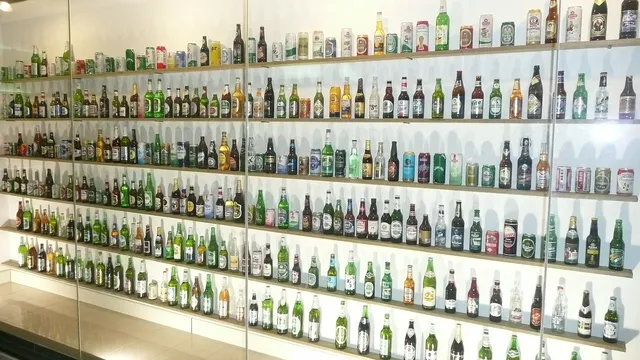
Set in the actual German-built brewery of 1903, the Tsingtao Beer Museum walks you from copper brew kettles and century-old yeast labs to the packaging lines that feed one of the world's largest brewing groups. The price of admission includes what you actually came for: fresh, unfiltered beer poured on site, straight from the source, plus a second pour of the draft locals drink daily. Few museum visits anywhere end with this much goodwill.
Good to know · Tickets run about RMB 60–70 as of September 2026 with tastings included; book via the official mini-program or OTA platforms with your passport. Hours run roughly 8:30 am to 4:30/6:30 pm by season; some platforms have listed late-year maintenance closures, so confirm before a November–December visit. The surrounding Dengzhou Road ('Beer Street') is lined with bars pouring bagged draft.
No. 4
St. Michael's Cathedral
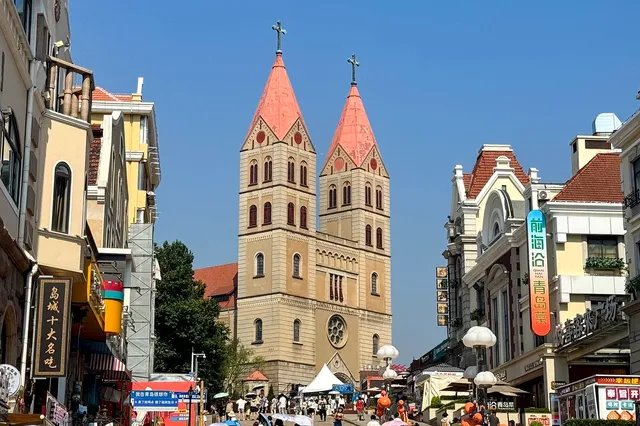
Twin 56-meter spires of pale granite rise above the old town's rooflines at St. Michael's, the Catholic cathedral built for Qingdao's German community between 1932 and 1934. Designed by a German missionary architect in a sturdy neo-Romanesque style, it survives as the most photogenic anchor of the colonial grid — and, unusually for a monument, as a working church whose pews still fill on Sundays. The square in front doubles as the city's favorite wedding-photo backdrop.
Good to know · Entry for visitors is about RMB 10, roughly 8:30 am–5 pm (later at summer peak); as an active church it closes to tourists during Mass, especially Sunday mornings. Photography inside is permitted but keep it respectful during services. Pair it with the Zhanqiao-to-Badaguan old-town walk; it sits mid-route on Zhejiang Road.
No. 5
Mount Laoshan
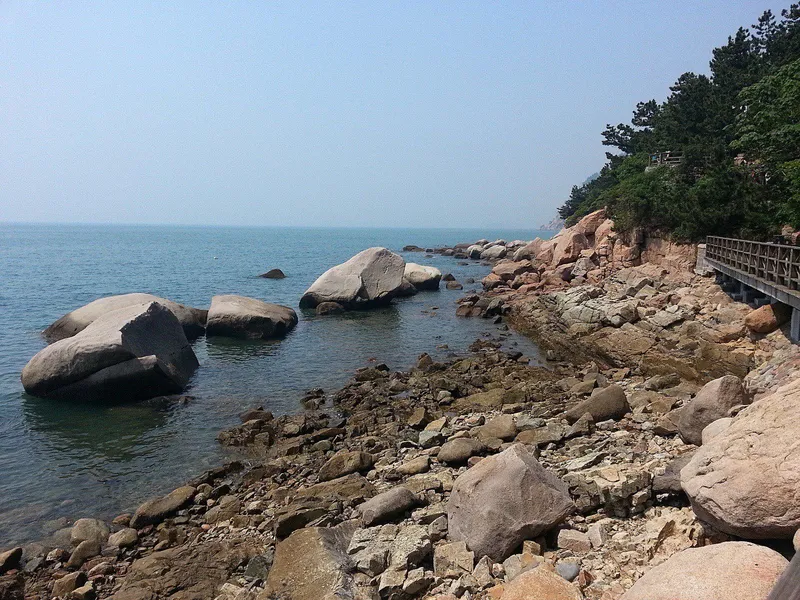
Where else does a 1,133-meter granite massif rise straight out of the sea? Laoshan, an hour east of downtown, has been a Taoist sanctuary since the Song dynasty — the birthplace of one of the school's great lineages, studded with cliff-hugging palaces and fed by the springs that give Tsingtao beer and Laoshan green tea their names. Pilgrims came for the temples; hikers come for the trails where the mountain's waterfalls and pines meet the Yellow Sea horizon.
Good to know · The mountain is split into zones: the south line (Taiqing Palace and coast views), the Jufeng summit with a cable car, and the quieter Beijiushui valley. Zone tickets run roughly RMB 90–130 with shuttle as of September 2026, Taiqing Palace RMB 27 extra; book real-name via the official Laoshan mini-program and start early — it is a full day from downtown.
Most Chinese cities announce themselves with cranes and glass. Qingdao announces itself with salt air and the smell of malt. This port on the Shandong coast — a former German concession turned seaside metropolis of about ten million — has spent a century cultivating a specific identity: red-tiled roofs above a blue bay, a beer brand the whole country knows, and a public culture built around beaches and cold mugs of draft. Locals summarize it in seven characters meaning “red tiles, green trees, blue sea, clear sky,” and you will concede the point within an hour of arriving. For independent travelers it is one of China’s easiest coastal stops: free sights chain into walking routes, the food economy runs on seafood and beer, and one big excursion — Mount Laoshan, a sacred granite peak dropping into the sea — justifies an extra day. Come in May–June or September–October, give it two to three days. One early warning: this is a city that sells beer in plastic bags, and once you have seen that, other cities may disappoint.
A Bit of History
Until the 1890s, Qingdao was a scatter of fishing villages around a superb natural harbor that the Qing court had only recently thought to garrison. That sleep ended in 1897, when Germany used the murder of two missionaries in inland Shandong as a pretext to seize the bay, and in 1898 forced a 99-year lease of the territory it called Kiautschou. The Germans, more urbanist than most colonizers, built with unusual ambition: a planned capital with zoning laws, a rail line inland to Jinan, deep-water docks, churches, schools, and — in 1903 — a brewery founded by German merchants that remains the origin story of Tsingtao beer, today among the best-selling beer brands on earth.
The colonial arrangement did not last, but the city it created did. Japan seized the territory at the start of World War I in 1914; China’s demand for its return helped ignite the May Fourth Movement of 1919, one of the founding episodes of modern Chinese nationalism, and the territory came back under the Chinese flag in 1922. Qingdao changed hands again under Japanese occupation from 1938 to 1945, hosted the US Navy’s Pacific fleet in the civil-war years, and settled into the People’s Republic as an industrial and naval port.
The Germans’ brief stay left an outsized inheritance: a European-style urban core that survived because later development flowed around it rather than through it, a brewing culture that became civic identity, and a strain of architectural nostalgia unusual in China. Modern additions have been canny — the city hosted the 2008 Olympics sailing on Fushan Bay, and the old quarter is now a protected historic district. Very few places in China let you read a century of history in a ten-minute walk. Qingdao is one of them.
Culture & Daily Life
Qingdao’s cultural signature is the easiest to describe of any Chinese city: it is a beer-and-seafood town. The local phrase for a good evening is “ha pijiu, chi gala” — Shandong dialect for “drink beer, eat clams” — and the infrastructure supporting it is everywhere. Neighborhood beer houses (pijiuwu) keep stainless kegs of fresh, unfiltered draft behind the counter and pour it, to order and by weight, into plastic bags knotted at the top; locals bicycle home with a bag swinging from the handlebars. The draft is hours old because it does not keep — freshness is the point, and bottled beer is considered a compromise.
The sea sets the calendar here the way it does in a Mediterranean town. Come June, the city beaches — a dozen or so along the coast — fill with swimmers, and the beach-as-neighborhood habit runs from retirees doing morning stretches to kids surfing at Stone Old Man beach. Outside beach season the waterfront promenades and squares carry daily life: kite flyers, ballroom dancers, fishermen with hand lines off the pier.
Shandong people have a reputation among Chinese for directness and generosity, and Qingdao fits it; hospitality tends toward the insisted-upon second helping. The city is also an economic success story on its own terms — a manufacturing belt (the appliance giants Haier and Hisense both started here) and one of the country’s busiest ports. For visitors, the practical notes are simple: life runs on Alipay and WeChat Pay as everywhere in China; winters are cold, windy and briskly seaward; and the one great crush is the International Beer Festival, held mid-July to mid-August.
Nature & Day Trips
Qingdao’s natural endowment is the coastline, and the city wears it well: a promenade system follows the shore for tens of kilometers, from the old-town piers around to the eastern headlands. The beaches headline them — the No. 1 Bathing Beach below Badaguan for the classic broad-sand scene, the smaller No. 2 tucked under rocky bluffs, and out east the longer, sportier Shilaoren (“Stone Old Man”) beach backed by the university district. The swimming season runs roughly late June to early September, when lifeguards are on duty.
The city’s green counterweight is Fushan, a wooded hill on the urban edge, but the genuine expedition is Mount Laoshan, the granite massif east of the city where a 1,133-meter summit rises almost vertically from the sea — a national park, a Taoist sanctuary and, with its springs, the water source whose name the beer borrows. It is covered in full below as one of the top sights, and it takes a day.
Beyond the city, the high-speed rail network puts a string of Shandong coast towns within easy range: Yantai and its apple orchards under two hours north, Weihai’s beaches a bit beyond, and the myth-heavy Penglai — legendary home of the Eight Immortals — on the northern shore. Most travelers find the city’s own combination of urban coast and sacred mountain fills a long weekend.
Food & Drink
Qingdao eats from the sea and drinks from the keg, and both at a very local altitude. The seafood repertoire starts with gala — small clams stir-fried with chili and scallion, the default order of every beer table — and runs through grilled squid skewers, salt-and-pepper shrimp, sea urchin steamed with egg, and the local dumpling tradition, which folds seafood into the wrappers: mackerel dumplings (bayu shuijiao) are the household standard, and sea urchin dumplings the connoisseur’s order. A satisfying seafood dinner in a busy local place runs RMB 60–120 a head, beer included.
That beer deserves its own paragraph. Qingdao’s draft culture works at three levels: the festival-ground mega-pour, the museum’s fresh-from-the-keg tasting, and the everyday bag. In a pijiuwu, fresh draft — usually the unfiltered beer locals call yuanjiang — is ladled from a stainless keg into a plastic bag, knotted, and carried home; a big bag costs a few RMB more than a bottle and tastes nothing like it. Poured over a bowl of clams on a plastic table with the harbor in view, it is one of the great cheap experiences in China.
Geographically, the old town’s Pichaiyuan food arcade near Zhongshan Road packs a century of snack stalls into one courtyard (touristy, but the squid and dumplings are honest); Dengzhou Road, the “Beer Street” by the museum, handles the after-tour pours; and the Yunxiao Road area in the eastern district is where locals actually go for late-night seafood-and-beer. Breakfast is a Shandong affair of millet porridge and da bing flatbread.
Top Sights
The Badaguan Scenic Area
Badaguan — “the Eight Great Passes” — is a pocket of prewar villa streetscape between downtown and the sea where Qingdao turns quietly luxurious. Its grid of streets is named after Chinese mountain passes, and its planners gave each street a signature tree: peach on one road, cherry on another, and the blazing gold ginkgo that makes late October the district’s second spring. Between them stand several hundred villas built from the 1930s onward for merchants, generals and foreign consuls, in enough revival styles that guidebooks call the area an “exhibition of world architecture.”
The main experience is free: Badaguan is a neighborhood, not a gated park, and the pleasure is walking it — past hedges, stone gates and bridal photo parties — with the No. 1 Bathing Beach at one end and rocky Taipingjiao at the other. Two paid interiors are worth a stop: the Huashi Lou, a 1932 granite-and-marble villa that later hosted Chiang Kai-shek, and the pink Princess House nearby, both charging modest entry fees. Go early morning, or in April and late October for the flowering and foliage shows; it is walkable from downtown in 25 minutes.
Zhanqiao Pier
Every Chinese city has one image it puts on the tea tin; Qingdao’s is a pier. Zhanqiao extends 440 meters into Qingdao Bay, begun in the early 1890s as a naval jetty for the Qing garrison — the harbor’s first structure, older than the German city — and capped in the early 1930s with the octagonal Huilan Pavilion, a green-roofed kiosk that appears on every bottle of Tsingtao beer and therefore on dinner tables worldwide.
The pleasure here is proportion and position: a short walk from the old town’s arcades, with the red roofs and twin spires of the German quarter stacked behind you and the lighthouse on Little Qingdao Island across the water. It is free and open around the clock, but time it well — by mid-morning the pier is a conga line of tour groups, while at dawn it belongs to fishermen and cormorants drying their wings on the lamp posts. From November through March, thousands of gulls winter in the bay and turn the pier into the best free wildlife show in northern China. Huilan Pavilion opens for a small fee, mostly for the view back at the city; Metro Line 3 to Qingdao Station puts you five minutes away.
Tsingtao Beer Museum
The museum sits inside the real thing: the German-built brewery of 1903, whose red-brick complex on Dengzhou Road still anchors a working plant that has made this China’s most famous beer for over a century. The route runs through the old fermentation halls — copper kettles, wooden tanks, a recreated lab with the yeast strain kept alive since 1903 — then out through the modern bottling story and a slightly deranged 4D “drunk ride.” The final rooms are why tickets sell: two generous pours, the first the cloudy, yeasty unfiltered beer straight from production, the second the crisp standard draft, served with a packet of salted beer nuts.
Tickets run about RMB 60–70 as of September 2026 with tastings included; book real-name via the official mini-program or OTAs, and mind seasonal hours (winter closes around 4:30 pm) plus possible late-year maintenance closures — confirm a November or December visit ahead. Afterward, stay on Beer Street: every second doorway pours fresh draft by the bag.
St. Michael’s Cathedral
Two square granite towers, rising 56 meters over a plateau of lawns at the top of Zhejiang Road, make St. Michael’s the visual anchor of Qingdao’s old town. Built between 1932 and 1934 as the Catholic cathedral for the city’s German community — designed by a German missionary priest in a robust neo-Romanesque style — it survived the twentieth century’s upheavals better than most churches in China, was returned to worship in the 1980s, and today functions as both monument and parish: tourists in the aisles on weekdays, full congregations on Sundays.
The interior is neater than the exterior promises — pale columns, a coffered ceiling, German-made stained glass — and visitors pay a token entry of about RMB 10, roughly 8:30 am to 5 pm daily (extended hours at summer peak). As an active church it closes to sightseers during Mass, particularly Sunday morning. The stone square in front is Qingdao’s prime wedding-photography stage — on a Saturday you may count a dozen brides queued against the facade — and the arcaded streets around it are the heart of the old German grid, an easy stroll from Zhanqiao Pier on the walking route east toward Badaguan.
Mount Laoshan
Laoshan is the excursion that justifies an extra day in Qingdao. An hour east of downtown, the mountain’s granite flanks climb to 1,133 meters almost straight out of the Yellow Sea — the most dramatic meeting of mountain and ocean on the Chinese coast, hence the old claim “first famous mountain on the sea.” It is also a great Taoist sanctuary: temples have stood here since at least the Song dynasty, the mountain became a major center of the Quanzhen school, and the cliff-set Taiqing Palace at its southern foot has drawn pilgrims for a thousand years. The springs are famous twice over — Laoshan mineral water and Tsingtao beer both borrow the name — and the terraced hills grow Laoshan green tea, one of northern China’s few serious tea regions.
The scenic area is divided into zones, and you should pick one per day. The south line combines Taiqing Palace (RMB 27 on top of entry, as of September 2026) with coastal lookouts and the waterfall trail up the Shangqing valley toward Longtan Falls. The Jufeng zone is the summit option, with a cable car most of the way up and stairs to a top-of-the-world view of sea and haze. The Beijiushui valley, a route of pools and plank walkways in the northern hills, is the quietest and the best hot-weather walk. Zone entry runs roughly RMB 90–130 including the shuttle bus; book real-name through the official Laoshan mini-program (passport works), start early, and pack a layer — the sea wind at the top is serious even in August.
Getting There & Around
Qingdao Jiaodong International Airport (TAO), which replaced the old Liuting field in 2021, sits about 40–50 kilometers northwest of downtown. Metro Line 8 links it to the city network in around 40–60 minutes (change at Qingdao North for the old town); a taxi or Didi runs 45–70 minutes depending on traffic. By rail, high-speed trains from Beijing reach Qingdao in about three hours at the fastest (from around RMB 320 second class), Shanghai in five or so; the main arrival points are Qingdao North station and the older Qingdao station in the old town.
Within the city, the metro (Lines 1, 2, 3, 4, 8, 11 and 13) covers the coast and airport; Didi and metered taxis fill the gaps cheaply. The old town and Badaguan are best on foot, and the coastal promenade lets you walk from Zhanqiao to Shilaoren beach in an energetic morning. For Laoshan, tour buses and the metro’s eastern lines get you close, but the scenic-area shuttle is the reliable last leg — budget the full day.
Where to Stay
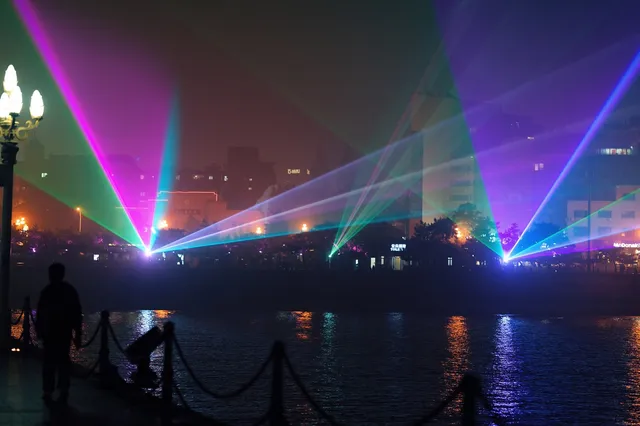
Pick a quarter to match the trip. The old town around Zhanqiao, Zhongshan Road and the cathedral puts you inside the German-era street grid — walkable to the pier, the food arcades and Beer Street — and suits first-time visitors who want atmosphere out the door. The Fushan Bay area around May Fourth Square is the modern Qingdao: business hotels, Olympic-sailing marina, metro connections and the evening light show — best for comfort-first travelers and families. The Badaguan and No. 1 Bathing Beach quarter trades convenience for quiet: leafy villa streets, the beach across the road, and boutique stays converted from old houses. Two calendar notes: during the Beer Festival (mid-July to mid-August) rooms sell out citywide, and in beach season the Badaguan-side hotels fill earliest — book well ahead.
Sources & verification (10)
- https://en.wikipedia.org/wiki/Zhanqiao_Pier
- https://en.wikipedia.org/wiki/Badaguan
- https://en.wikipedia.org/wiki/St._Michael%27s_Cathedral,_Qingdao
- https://en.wikipedia.org/wiki/Mount_Lao
- https://www.chinadiscovery.com/shandong/qingdao/qingdao-beer-museum.html
- https://us.trip.com/travel-guide/attraction/qingdao/tsingtao-beer-museum-10559061
- https://www.klook.com/en-US/activity/165246-tsingtao-beer-museum
- https://www.thatsqingdao.com/qingdao-international-beer-festival
- http://qingdao.chinadaily.com.cn/xihaian/2026-07/21/c_1198934.htm
- https://www.trip.com/trains/china/route/beijing-to-qingdao/