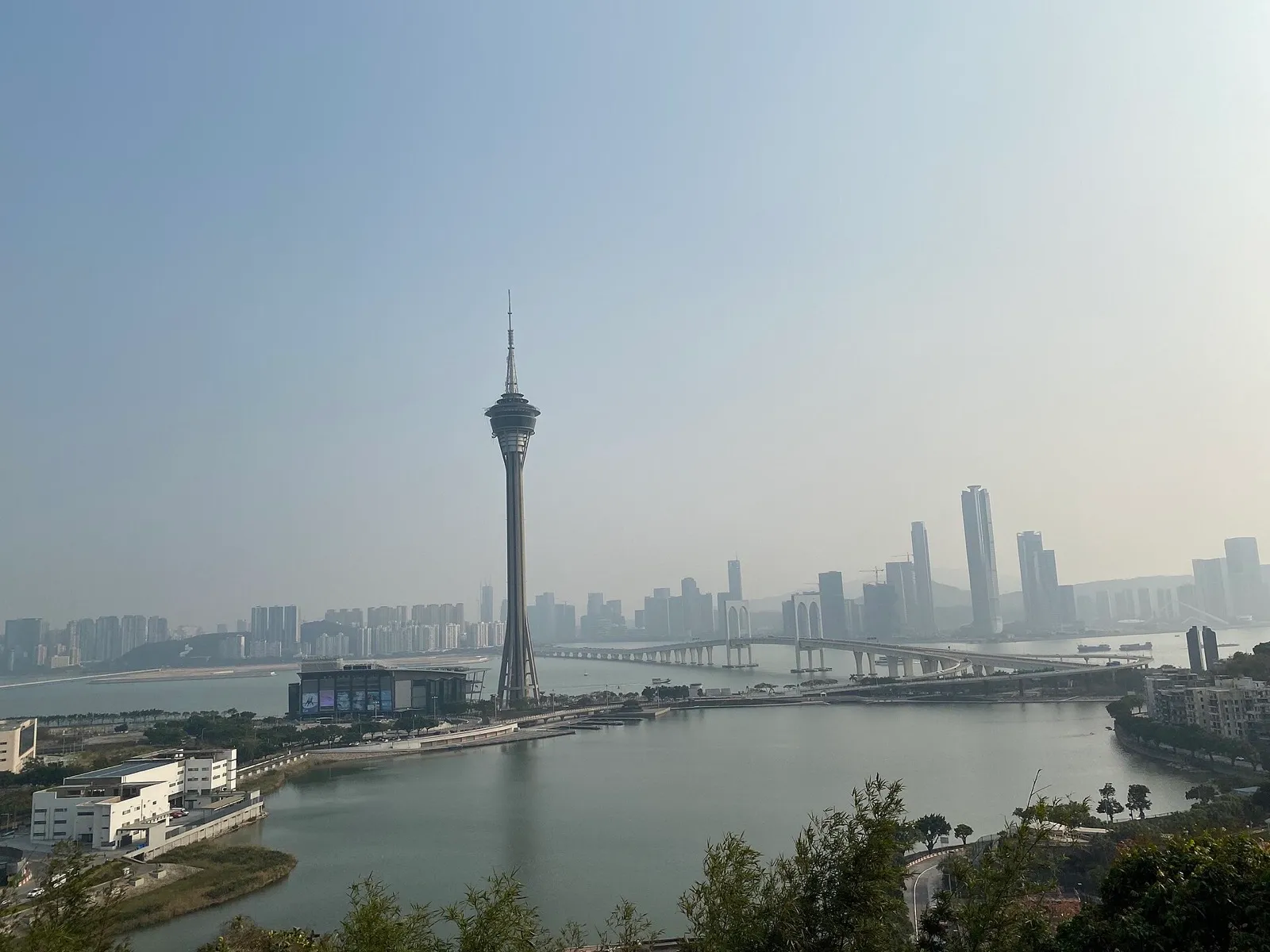
Macau is China's other special administrative region, and the surprise is how much of old Europe survives here: wave-tiled plazas, baroque church facades, Portuguese-style egg tarts and four centuries of East-meets-West cooking, all folded into a city you can walk end to end in an afternoon. Layered on top is Asia's casino capital — a Cotai Strip of fantasy resorts where the shows, arenas and hotel architecture now out-spectacle Las Vegas itself. The practical wrinkle is that Macau runs its own border: mainland China's visa-free policies do not apply, though most Western passports get in easily on arrival. Best for travelers pairing it with Hong Kong or the mainland who want UNESCO-listed streets in the morning and a world-class show at night.
Top sights at a glance
No. 1
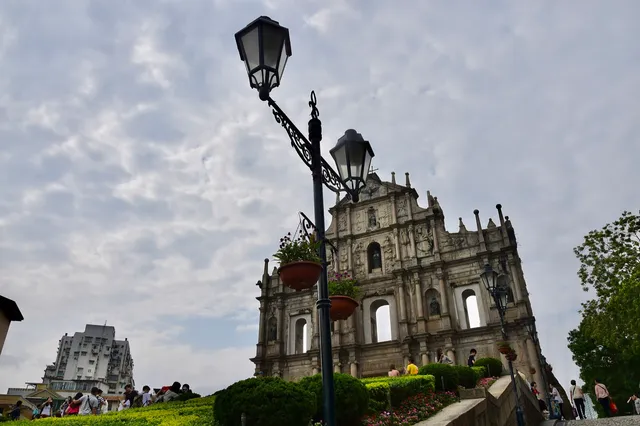
The Ruins of St. Paul's
The stone facade of a 17th-century Jesuit cathedral is Macau's icon: carved saints and oriental motifs surviving above a grand staircase after fire destroyed the rest of the church in 1835. The site anchors the UNESCO-listed Historic Centre of Macau, and behind the facade a small museum of sacred art and an archaeological crypt reward the climb.
Good to know · Free and open around the clock; the facade restoration work on the bronze statues concluded in early 2026 and the site remains open. Come before 9 am or after dark to dodge the crowds on the staircase. The Macau Museum on Mount Fortress, five minutes uphill behind the ruins, covers the city's story well.
No. 2
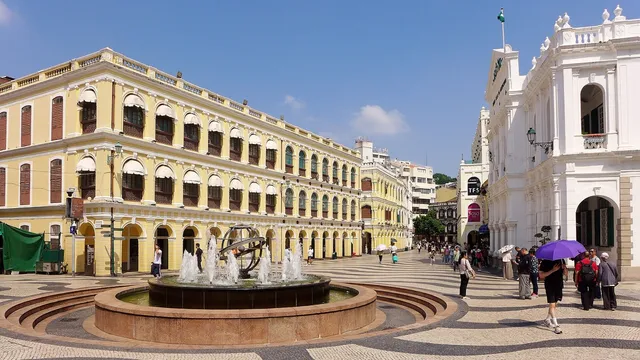
Senado Square
Macau's civic heart is a triangular plaza paved in snaking black-and-white Portuguese wave tiles, hemmed by pastel colonial buildings and the 16th-century St. Dominic's Church. The square and the lanes fanning off it — some selling almond cookies and jerky by the sidewalk, others hiding Portuguese-style chapels — form the easiest and most rewarding stroll in the old city.
Good to know · Free, pedestrianized, and part of the UNESCO World Heritage site; it is a five-minute walk from the Ruins of St. Paul's down Rua de São Paulo. Weekends and Chinese holidays get packed — mornings are calmer. Pop into St. Dominic's Church and the restored Leal Senado building flanking the square.
No. 3
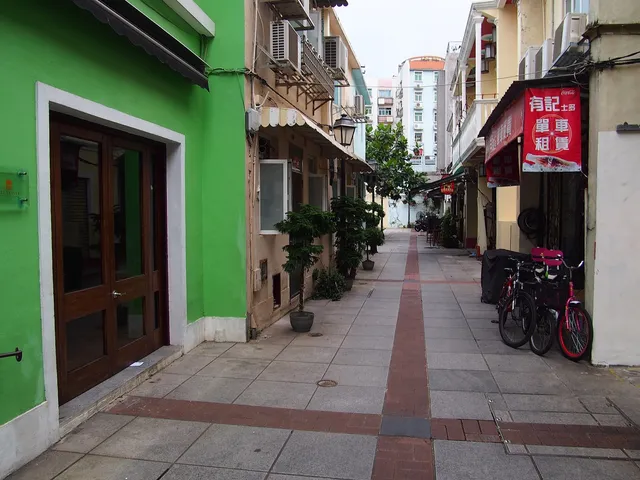
Taipa Village
On the island of Taipa, two generations before the casino boom, a fishing-and-shipyards village of narrow lanes, baroque church and low Chinese shop-houses survived — and now sits improbably in the shadow of Cotai's resorts. Rua do Cunha, the main food street, packs in almond-cookie bakeries, herbal-tea shops and pork chop bun counters; the surrounding lanes hold the old Taipa Houses museum and Our Lady of Carmel Church.
Good to know · Free to wander; allow two to three hours, ideally late afternoon into an early dinner. The LRT Taipa line stops within walking distance, and Cotai's resorts are minutes away. Sample the cookies warm, and walk off dinner along the Estrada do Governador Albano de Oliveira waterfront.
No. 4
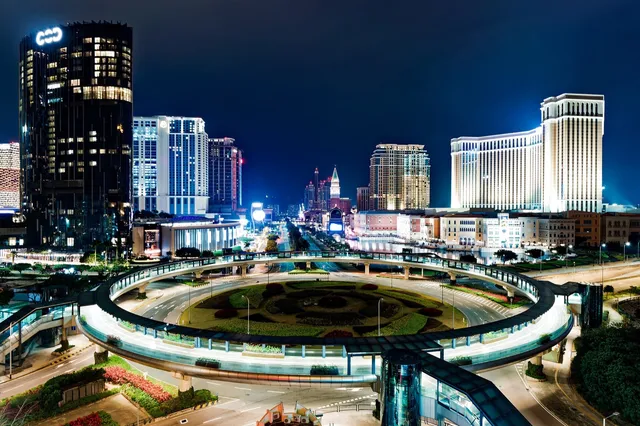
The Cotai Strip
Cotai — the name literally fuses Coloane and Taipa — is reclaimed land turned into a two-kilometer corridor of gargantuan resorts: Venetian canals with gondolas, Parisian half-scale Eiffel Towers, arenas, malls and some of the largest casino floors on earth. Even visitors who never gamble come for the shows, notably The House of Dancing Water, and the spectacle is genuinely world-class.
Good to know · Casino floors require visitors to be 21 or older with photo ID (passport), and photography on the floor is prohibited. The House of Dancing Water at City of Dreams runs most evenings with tickets from MOP 698 — book ahead. Free resort shuttle buses loop between the ferry terminals, border gates and the major hotels.
No. 5
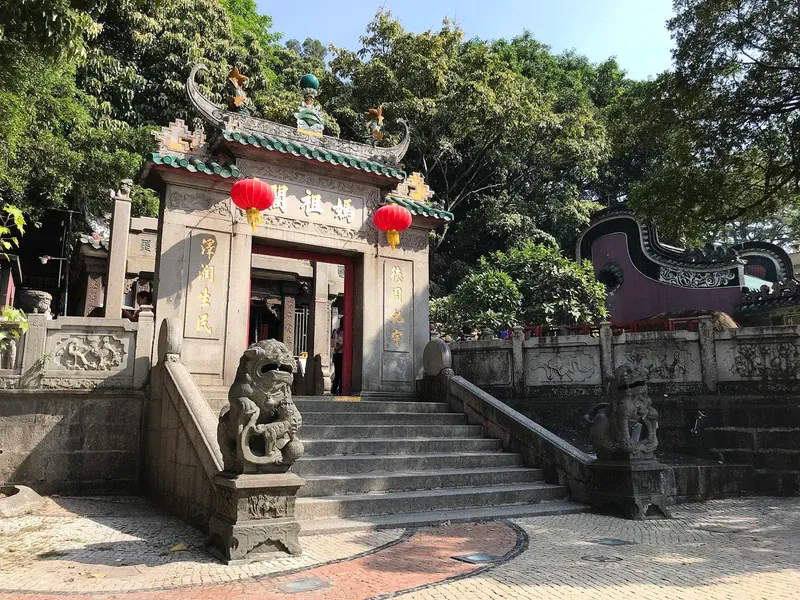
A-Ma Temple
Macau's oldest temple, founded in 1488 and dedicated to Mazu, the Chinese sea goddess, predates the Portuguese by decades — and many historians trace the very name 'Macau' to 'A-Ma-Gau', the bay of A-Ma. Pavilions, prayer halls and rock inscriptions climb the slope of Barra Hill above the harbor, thick with incense coils and the murmur of worship. It is the best counterweight to the casinos.
Good to know · Free entry, generally open about 8 am to 6 pm daily. It sits at the southwest tip of the peninsula — the LRT's Barra terminus (opened 2023) is the easiest approach. Climb slowly; the pavilions stack uphill, and the harbor-view terraces near the top are the payoff.
Macau compresses a remarkable amount of travel into a small frame. In one day you can stand under the baroque facade of a Jesuit cathedral, eat a pork chop bun in a fishing village-turned-food-street, ride a gondola past fake Venetian frescoes, and watch acrobats dive into the deepest theater pool on the planet. Four centuries of Portuguese presence left China with its most European city — cobblestone plazas, pastel churches, an entire fusion cuisine — while the modern era of licensed gambling turned reclaimed mudflats into the world’s richest casino market, several times the size of Las Vegas. The two halves sit side by side without apology, and both are worth your time. Macau works best as a two- or three-day chapter bolted onto Hong Kong or southern China: arrive by ferry or bridge, walk the UNESCO-listed lanes, see a show, and go home having visited a country within a country — which, administratively, you did.
A Bit of History
The Portuguese arrived in the Pearl River Delta in the 1510s and by the 1550s had settled at Macau, a hinged peninsula at the estuary’s western shore — the beginning of Europe’s oldest continuous foothold in East Asia. For the next three centuries Macau thrived as the hinge of the silk-and-silver trade between Japan, China and Europe, administered loosely by Portuguese residents under a rent paid to Chinese officials. In 1887 the arrangement hardened into formal colonial rule, and Macau remained a Portuguese territory while every other European power’s Asian holdings were decolonized around it.
Portugal’s own revolution in 1974 reclassified Macau as “Chinese territory under Portuguese administration,” and after long negotiation the handover came on December 20, 1999, two years after Hong Kong’s. Macau became a Special Administrative Region under the same “one country, two systems” formula: Beijing controls defense and foreign affairs while Macau keeps its own legal system, its own immigration borders and its own currency, an arrangement set to run until 2049.
The decision that shaped modern Macau was made in 2002, when the government ended a decades-old gambling monopoly and licensed several casino operators. Investment poured into Cotai, the strip of reclaimed land between the islands of Taipa and Coloane, and the result was a building boom unlike anywhere on earth: gaming revenue multiplied far past Las Vegas, and although the junket-led VIP business collapsed under Beijing’s 2021–22 crackdown, mass-market tourism roared back to record levels by 2024–25. The 2026 traveler gets the best version of that pivot: heritage sites restored, and an entertainment calendar that finally matches the architecture.
Culture & Daily Life
Macau is Cantonese China wrapped in a Portuguese shell. Chinese is the majority language and Portuguese remains a co-official one — court documents, street signs and government notices run bilingually — but English gets you by comfortably in the historic center and the resorts, and usually by everywhere else. Signage is trilingual in the tourist core.
The people who make the city distinctive are the Macanese: a small Eurasian community born of centuries of Portuguese men marrying women from Macau, Malacca and beyond. Their legacy is mostly intangible now — a dialect nobody under sixty speaks, a Catholic-Chinese blend of customs — except at the table, where Macanese cuisine remains one of the world’s genuinely singular food traditions. Roughly seven hundred thousand people fit into Macau’s tight footprint, and daily life runs dense and vertical: apartment towers over old shop-houses, washing lines over temple courtyards.
The calendar mixes both worlds: Catholic processions still thread through the streets each May for Our Lady of Fátima, Mazu’s birthday fills A-Ma Temple with opera and incense, and November belongs to the Macau Grand Prix, when the city’s ordinary roads become a street circuit and the whole peninsula acquires a festive, fence-lined hum.
For the visitor, daily life is easy in the ways Hong Kong is easy: cards work widely in resorts and shops, Alipay and WeChat Pay cover most smaller merchants, and the city is safe to wander at all hours. The rhythms worth respecting are the crowds’ — midday tour groups hit the Ruins of St. Paul’s like weather, so shift your sightseeing to mornings and evenings and your eating to whenever you are hungry, because here someone is always cooking.
Nature & Day Trips
Macau is small and mostly built, but its green corners are better than the skyline suggests. Coloane, the southernmost island, retains an actual village center around a chapel and square, and its hills carry marked walking trails with harbor and sea views; at the foot of the island, Hac Sa beach — named for its streaks of black sand — stretches beneath a beachfront path that fills on warm weekends. On the peninsula, Guia Hill keeps a fortress, the oldest modern lighthouse on the Chinese coast, and a loop trail with the best aerial view of the old city. Penha Hill, above the Barra temple, offers a quieter church and shady lanes.
The classic day trip is Zhuhai, the mainland Chinese city directly across the water — but remember that crossing means mainland immigration and the mainland’s own visa rules, so it only works if your China paperwork allows. For most visitors, the better “day trip” is none: Macau’s sights are compact enough that an unhurried loop of the peninsula plus Coloane fills two or three days without a car or any particular plan.
Food & Drink
Macau is one of the world’s great small eating cities, with two traditions braided together. The first is Cantonese — dim sum, roast meats, fresh seafood, done with the intensity you would expect this close to Guangdong. The second is Macanese, the fusion cuisine created when Portuguese settlers cooked with Chinese, Malay, Indian and African ingredients: minchi (minced pork and potato with a fried egg), African chicken in a chile-coconut marinade, bacalhau done a dozen ways. It is China’s oldest fusion food and still hard to eat well outside these seven square miles.
Then there are the icons. The Portuguese egg tart Macau made famous was born in 1989, when an English-trained baker named Andrew Stow adapted the pastel de nata at his Coloane bakery; a former spouse opened her own rival bakery near Senado Square, and today every bakery in the territory sells a version fresh from the oven. The pork chop bun — a fried cutlet in a crisp roll — is the city’s other handheld ritual.
Geographically: Senado Square and the lanes around it cover the classic snacks; Taipa Village’s Rua do Cunha is the food street to graze; Coloane village does the most atmospheric sit-down Portuguese and Macanese dining; and Cotai’s resorts run everything from food-hall dim sum to name-brand fine dining. A good local meal runs cheaper than Hong Kong, and even the resort restaurants undercut their Vegas equivalents. Do not leave without an egg tart eaten warm within sight of something baroque.
Top Sights
The Ruins of St. Paul’s
The stone facade of the church of St. Paul — São Paulo to the Portuguese, Da San Ba to locals — is Macau’s defining image, and it earns the crowds. The Jesuits built the cathedral between 1602 and 1640 beside their college; fire consumed the wooden body of the church in 1835, leaving only the granite facade and the great staircase, carved with saints, angels and distinctly non-European motifs by craftsmen who may have included Japanese Christian exiles. What survives is arguably better than the whole: a monumental stone stage where the whole city becomes the audience.
The site is free and open around the clock, and the light changes it completely — honeyed at sunrise, floodlit after dark. Bronze statues lining the facade spent 2025–early 2026 in phased conservation; the Cultural Affairs Bureau confirmed the second phase complete in February 2026, and the site itself remained open throughout, so do not expect scaffolding today but do expect company. Behind the facade, a small museum of sacred art and an archaeological crypt occupy the church’s foundations, and five minutes further uphill sit the cannoned walls of Mount Fortress with the Macau Museum inside. Visit early or after dinner; the staircase at 11 am is a wall of selfie sticks.
Senado Square
Every old city keeps a living room, and Macau’s is Senado Square, the wedge-shaped plaza where the Portuguese-style municipality faced the Chinese town. The floor is the show: black-and-white limestone laid in rippling wave patterns, a pavement style imported from Lisbon’s Rossio. Around it stand pastel neoclassical facades — the old Leal Senado council building, the Holy House of Mercy, and St. Dominic’s Church, founded by Dominican friars in 1587 and among the oldest European church structures in China.
The square anchors the Historic Centre of Macau, the UNESCO World Heritage site inscribed in 2005, and the pleasure is in the drift: take any lane radiating off the square and you reach another fragment — a chapel, a guild hall, a temple — within minutes. Street-level Macau does commerce the same way it has for a century: almond cookies toasted in rolling ovens, jerky fanned over charcoal, herbal tea in porcelain cups. Everything is free; the square is pedestrianized and five minutes downhill from the Ruins of St. Paul’s. Mornings are calm, holidays are a tide, and both are worth seeing once.
Taipa Village
Fifty years ago Taipa Village was the whole of Taipa: a fishing and shipbuilding village of two-story shop-houses between mangrove flats and green hills. Then the airport and Cotai rose around it, and the village survived as a preserved pocket — which is precisely why it is lovely now. Rua do Cunha, the central food lane, hums with almond-cookie ovens, herbal-tea counters and pork chop bun shops, while the quieter lanes around it hold whitewashed colonial villas, the small Museum of Taipa and Coloane History, and Our Lady of Carmel Church watching over a garden square.
Come in the late afternoon, graze your way down Rua do Cunha — the cookies are best warm — and stay for dinner at one of the old-line Portuguese or Cantonese kitchens. The LRT Taipa line and Cotai’s resorts are both within easy reach, so the village slots neatly between the old city and an evening show. It is the easiest place in Macau to feel the scale of what the casino boom changed — and what it, for once, left alone.
The Cotai Strip
Cotai is the strip of reclaimed land Macau built between Taipa and Coloane starting in the 2000s — the name literally splices COloane and TAIPA — and in twenty years it became Asia’s answer to, and in revenue terms decisively its better than, Las Vegas. The resorts are cities unto themselves: the Venetian Macao alone packs gondola canals, painted skies, an arena and one of the world’s largest casino floors under one roof; across the boulevard stand a half-scale Eiffel Tower, Broadway-style theaters and malls the size of airports. Even committed non-gamblers should treat the strip as sightseeing, because the architecture is the attraction.
The strip’s crown is theatrical. The House of Dancing Water, the record-breaking aquatic show at City of Dreams, returned to its purpose-built theater in 2025 after a five-year hiatus and runs most evenings; tickets start around MOP 698 and sell out on weekends. Know the rules of the casino floor before you wander in for a look: visitors must be 21 or older, show passport or ID at the door, and leave cameras in pockets — photography on the floor is prohibited. Free shuttle buses connect the resorts with the ferry terminals and border gates, so the strip is easy to reach from anywhere in the territory. Budget one evening here, show included, and wear the comfortable shoes the malls demand.
A-Ma Temple
Long before the Portuguese, before the cathedrals and the casinos, there was A-Ma. The temple at the foot of Barra Hill, founded in 1488 and dedicated to Mazu, the Fujianese sea goddess who protects fishermen, is the oldest building in Macau — and, by a widely told account, the source of the city’s name, which European sailors are said to have borrowed from “A-Ma-Gau,” the bay of A-Ma. When UNESCO listed the Historic Centre of Macau in 2005, the temple stood at one end of it: the beginning of the story the rest of the city tells.
The compound climbs the hillside in a series of pavilions, prayer halls and courtyards tied together by banyan shade, moongates and rock inscriptions, the oldest carved in the Ming dynasty. Incense coils hang from the eaves; worshipers press hands to red-inked wishes; the harbor murmurs below, as it did when the junks came in. Entry is free, hours run roughly 8 am to 6 pm, and the mood is devotional rather than performed — move with it. The easiest approach is the LRT’s Barra terminus, at the end of the Taipa line since 2023, or the coastal walk from Penha Hill. Twenty minutes here reframes everything else you have seen in Macau: the European century was a latecomer.
Getting There & Around
Macau is easy to reach from Hong Kong, which is how most visitors do it. The fastest link is the ferry: TurboJET sails from Hong Kong’s Macau Ferry Terminal in Sheung Wan to the Outer Harbour in about 55 minutes, and Cotai Water Jet runs a parallel route direct to Taipa — one-way economy fares run roughly HK$175–215 depending on day and sailing time, and booking online ahead shaves both money and queue. The cheaper option is the Hong Kong–Zhuhai–Macau Bridge shuttle bus: around HK$65 by day, running about every five to ten minutes, 24 hours — figure 1.5–2 hours door to door once both immigration crossings are counted. Macau International Airport has solid regional connections but thin long-haul ones; from Europe or the Americas you will usually route via Hong Kong or a mainland hub. High-speed rail travelers can cross from the mainland at the Hengqin border, joined to the LRT network since late 2024.
Now the critical part: Macau’s border is separate from both mainland China’s and Hong Kong’s, and every crossing is a full immigration passage. Mainland China’s visa-free entry policies do not apply to Macau. The good news is that entry is generous: US, Canadian and Australian passports get 30 days visa-free, most EU passports 90, and UK passports up to 180 (US authorities advise a passport valid 90 days beyond departure). Within Macau, the LRT covers the airport–Cotai–Taipa corridor and reaches the peninsula’s Barra end; buses cost a few patacas; taxis are metered but sometimes scarce, with no Uber; and the free resort shuttles are the open secret that stitches it all together. The historic peninsula is simply walkable — cobblestones and all.
Where to Stay
Three zones, three trips. The historic peninsula around Senado Square and the Ruins of St. Paul’s puts you inside the UNESCO streets — morning light on the facade before the crowds, noodle shops and egg tarts at the door — with the widest range of affordable rooms; choose it for a heritage-focused stay. The Cotai Strip is the resort option: huge rooms, pools, shows and dining steps from your elevator, convenient to Taipa Village and the airport but a ride from the old city; choose it for families and show-centric weekends. Taipa Village itself is the middle path — small hotels, the best eating density per square meter, quiet nights. Rooms surge in price around Chinese holidays and big event weekends, so book early for anything between October and December. One money note: the local pataca is pegged to the Hong Kong dollar, and Hong Kong dollars are accepted nearly everywhere — change usually comes back in patacas, so spend those before you leave. Payments run through cards and Alipay/WeChat Pay (see the payments guide); carry some cash for the old-town bakeries.
Sources & verification (12)
- https://travel.state.gov/en/international-travel/travel-advisories/macau.html
- https://en.wikipedia.org/wiki/Visa_policy_of_Macau
- https://whc.unesco.org/en/list/1110/
- https://www.gov.mo/en/news/393176/
- https://www.icm.gov.mo/en/news/detail/24318
- https://www.macaupostdaily.com/news/27435
- https://thehouseofdancingwater.com/en/tickets/
- https://en.wikipedia.org/wiki/Gambling_in_Macau
- https://en.wikipedia.org/wiki/Hong_Kong%E2%80%93Zhuhai%E2%80%93Macau_Bridge
- https://en.wikipedia.org/wiki/Macau_Light_Rapid_Transit
- https://en.wikipedia.org/wiki/Macanese_pataca
- https://en.wikipedia.org/wiki/Cathedral_of_Saint_Paul_in_Macau