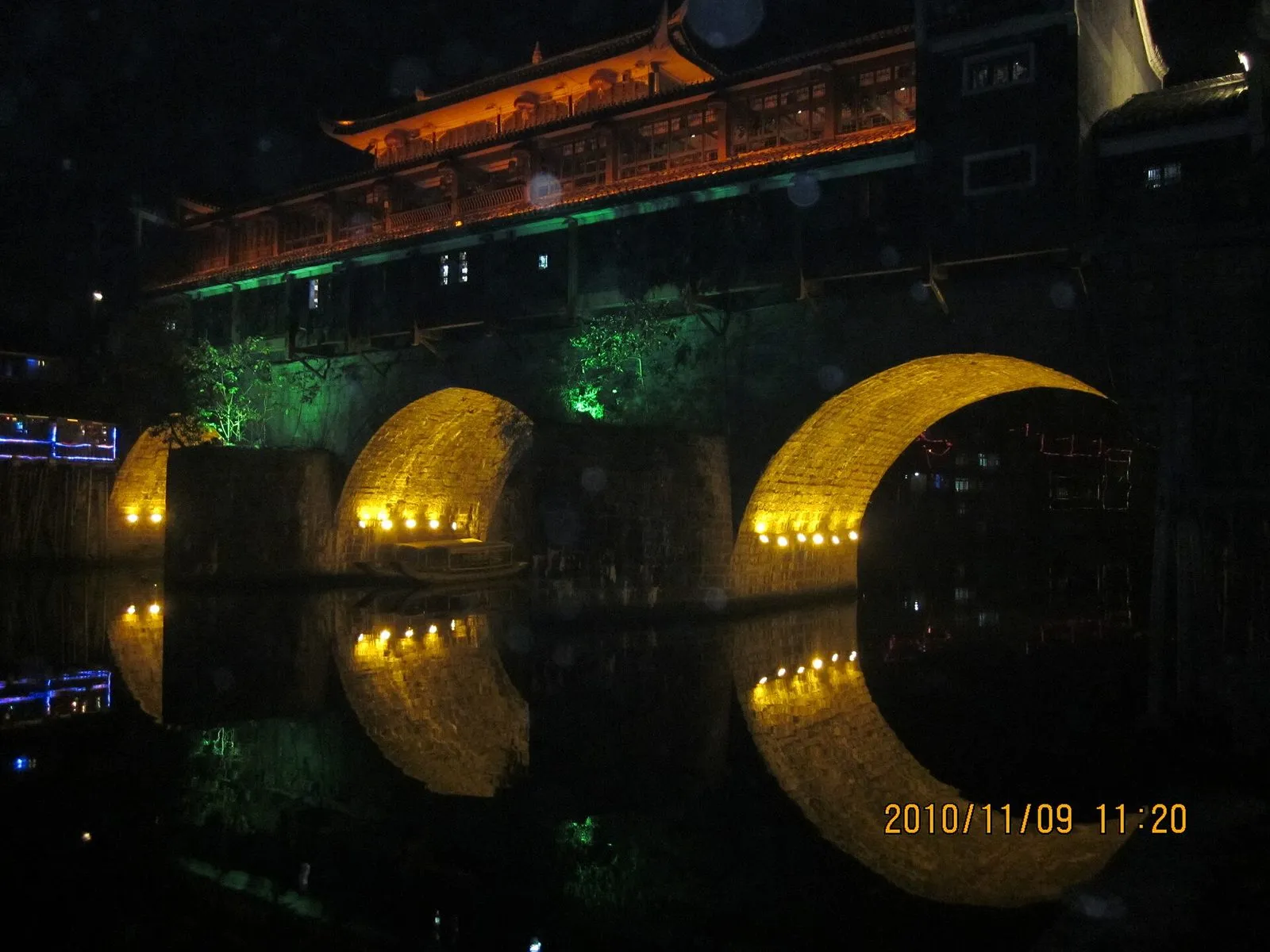
Fenghuang — Phoenix Ancient Town — is the most atmospheric river town in China and the literary soul of the western Hunan border region. Wooden stilt houses (diaojiaolou) lean over the green Tuojiang River, stone lanes climb past Ming- and Qing-era courtyards, and after dark the whole riverside turns into a lantern-lit stage reflected in the water. This was home soil of writer Shen Congwen, whose novel Border Town fixed Xiangxi in the Chinese imagination, and the surrounding hills remain Miao and Tujia country, with villages, terraces, and the spectacular Aizhai suspension bridge within a short drive. Walking the town itself is free; the paid sights are the heritage buildings and the famous night cruise. Paired with Zhangjiajie an hour north by high-speed rail, Fenghuang is the cultural bookend to Hunan's great outdoors. Details verified as of September 2026.
Top sights at a glance
No. 1
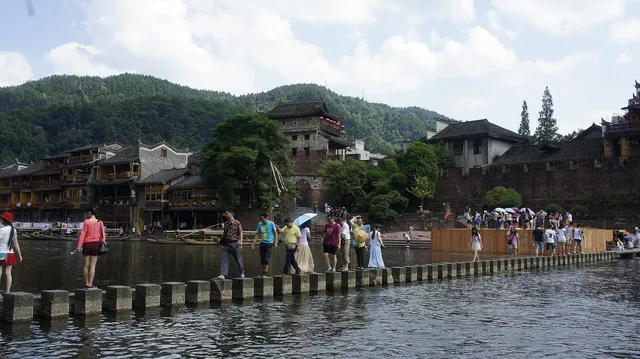
Tuojiang Riverside & the Jumping Stones
The Tuojiang is the reason Fenghuang exists, and its banks hold the town's iconic view: rows of wooden diaojiaolou stilt houses standing on pillars above the water, some for three centuries. At the old crossing point, dozens of bluestone piers — the jumping stones, laid in 1704 when this was the town's main gate — step across the river in a line about a hundred meters long, no railings, just the current underfoot. Come at sunrise for mist and washing day, at night for lanterns doubled in the current.
Good to know · The riverside is free and open around the clock; the crossing stones sit just downstream of Hong Bridge on the town side. Dawn (before 7:30 a.m.) gives you mist and near-empty banks; the stone surfaces are slick after rain, so wear grippy shoes. The famous river photographs happen from the bridges, not from the stones themselves.
No. 2
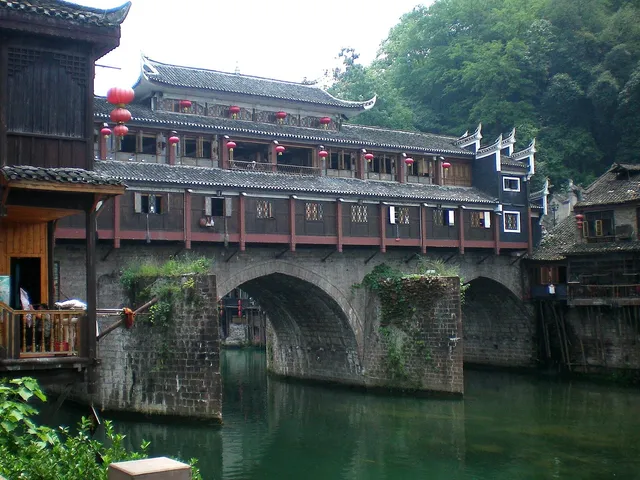
Hong Bridge & the Old Town Lanes
Hong (Rainbow) Bridge, built in 1670 of vermilion sandstone, has watched the town for three and a half centuries from its mid-river perch. Its lower deck is a passage of snack stalls and craft shops; upstairs, a sightseeing floor frames the classic panorama of stilt houses stacked along both banks. Around it, lanes of gray flagstone thread past carved doorways, ginger-candy vendors pounding fresh batches, and the low wooden doorways of Ming- and Qing-era houses — the best of the town's architecture hides one street back from the water.
Good to know · Walking the bridge and lanes is free; the bridge's upper viewing floor is included with heritage tickets or a small separate charge at the door. Wander the alleys on the east bank early in the morning, when residents still outnumber visitors and the light hits the flagstones sideways. Skip the riverside costume-photo hard sell unless you want it.
No. 3
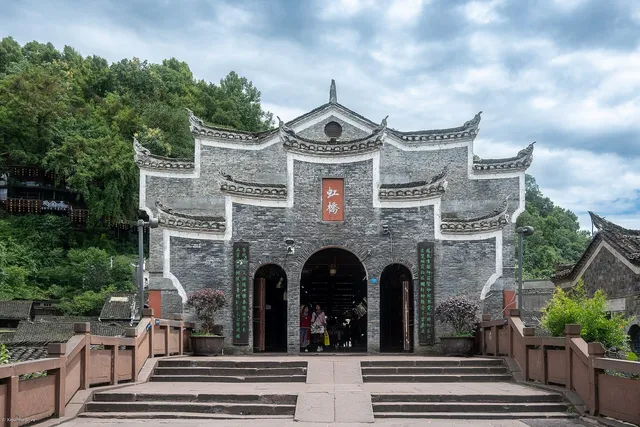
Ancestral Halls & Old Courtyards
Fenghuang's ticketed sights are a family of small heritage buildings rather than one big monument. The best known is Shen Congwen's Former Residence, the modest courtyard house where Xiangxi's great 20th-century writer was born and grew up; nearby sit Xiong Xiling's residence — the first premier of the Republic of China came from this town — the Yang Family Ancestral Hall with its stage and carved screen, the East Gate Tower, the Longevity Palace riverfront complex, and the Ancient City Museum. Each takes ten to twenty unhurried minutes.
Good to know · Individual tickets run roughly 25–45 yuan, and a daytime package combining the river cruise with six heritage buildings cost 128 yuan as of September 2026 — no official online sales, so buy at the Nanhuali or Qifeng Square tourist centers or at each sight's ticket office. Hotels sometimes offer small discounts; ask before you book elsewhere.
No. 4
Miao Villages of the Border Region
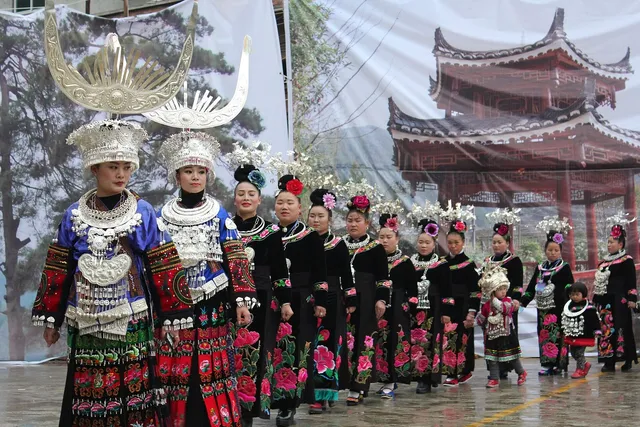
Fenghuang county sits on the old Miao frontier, and the hills around the town still hold villages where silver headdresses, embroidered aprons, and stilt houses are daily life rather than costume. Half-day trips reach villages such as Shanjiang and Dehang — the latter set beneath sandstone cliffs in Jishou — where you can hear antiphonal singing, watch batik and silverwork, and eat at a family table. In town, the nightly bonfire shows borrow the same songs; the villages are where they still mean something.
Good to know · Village trips work best as a half-day tour from Fenghuang (guesthouses arrange them) or by hiring a car with driver; public transport is thin. Expect entry tickets of 50–100 yuan class for the developed villages and bring cash-friendly apps — Alipay or WeChat Pay work, but signal can drop in the valleys. Ask before photographing people, especially elders in full dress.
No. 5
Aizhai Suspension Bridge
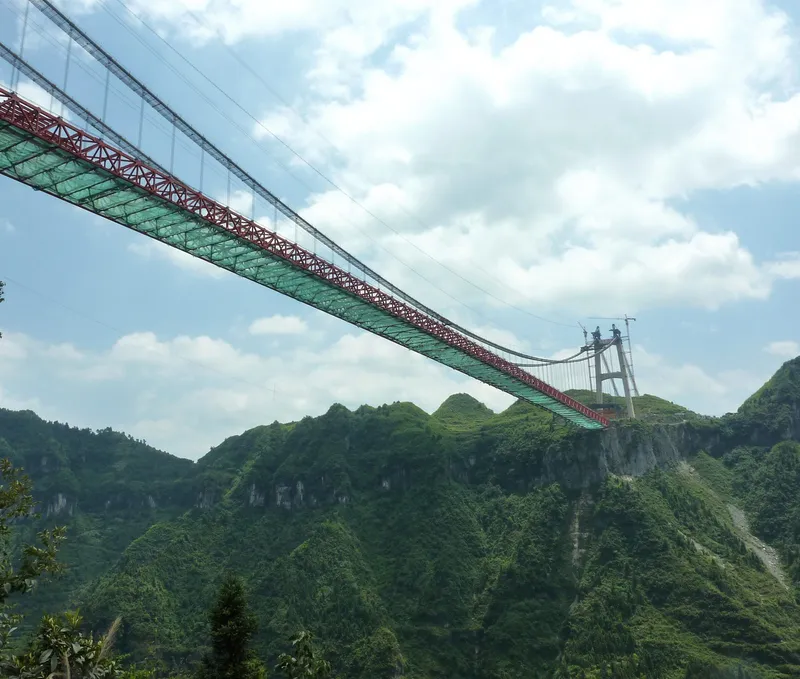
About an hour north of town, the Aizhai Bridge carries the Baotou–Maoming expressway on a 1,414-meter suspension span directly across the Dehang Grand Canyon — a road deck hung on cables above a mile of green descent, opened in 2012 as one of the engineering wonders of China's mountain west. Driving it is a whoosh; the real thrill is from the canyon roads and walkways below, where the bridge reads as a silver thread through cloud. Pair it with Dehang village for a full border-region day.
Good to know · You cannot stop on the bridge — view it from the Aizhai scenic area's walkways and platforms below, where a modest admission applies. From Fenghuang, hire a car or join a tour (roughly an hour each way); from Jishou or on the Zhangjihuai railway, combine it with Dehang. Mornings give you the best chance of cloud flowing under the deck.
Every traveler who photographs Fenghuang takes the same picture, and it is still worth taking: wooden stilt houses stacked along a jade-green river, a stone bridge below, lanterns coming on as the water darkens. Fenghuang — “Phoenix” — is the town where western Hunan’s mountains slow down enough to become literature. It is small enough to cross on foot in forty minutes, old enough to have guarded the Miao frontier for centuries, and famous enough that the main riverside blocks get seriously crowded. So time it right: come at dawn before the coaches, stay for the evening cruise, and give one day to the hills where the Miao villages and the Aizhai Bridge live. One night here, slotted between Zhangjiajie’s peaks and Changsha’s neon, is the most atmospheric 24 hours in Hunan.
A Bit of History
Fenghuang’s setting was strategic before it was beautiful. The town sits on the Tuojiang River at the edge of the Miao frontier, where the Ming and Qing states pushed a line of walls, garrisons, and watchtowers into the western Hunan hills — the “Southern Great Wall” whose remnants still trace the ridges nearby. The grid of the old town you walk today was formalized in 1704, under the Kangxi emperor, as the administrative and military headquarters of that border country; stone gates, courtyard houses, and ancestral halls went up in the Ming and Qing styles that survive now. The river did the trade, the barracks held the line, and the two communities — Han officials and Miao villagers — shaped a border culture unlike anything in lowland China.
The town’s outside fame arrived through fiction. Shen Congwen, born in this town in the first years of the twentieth century, left as a teenager and became one of modern China’s most influential writers, pouring the rivers, boatmen, and border people of Xiangxi into stories and novels — above all Border Town, the tale of a ferry girl and a love that arrives too late. His work turned this stretch of river into one of the most loved landscapes in Chinese letters; China Daily traces the region’s tourism fame directly to those books. His childhood house survives as a museum, and open-air performances of Border Town on the water have become part of the evening program.
The modern era was turbulent, then transformative. Fenghuang spent the twentieth century as a poor, remote county town; its salvation was its own stubborn old fabric, recognized with national historic-town status and a UNESCO World Heritage tentative listing in 2008. Tourism arrived like a flood: guesthouses filled the courtyards, and in 2013 the county tried charging every visitor a flat town entry fee — one of the most unpopular ticketing experiments in modern Chinese tourism, abandoned a few years later. The Zhangjihuai high-speed railway, opened in December 2021, then cut the journey from Changsha to under two hours and put Fenghuang an hour from Zhangjiajie; a county-run maglev shuttle — the first of its kind in China — now links the station to the riverside. The town that was once the end of the road is now the easiest culture stop in western Hunan.
Culture & Daily Life
Fenghuang is the cultural capital of the Miao frontier, and its population mixes Miao and Tujia families with Han newcomers — a blend visible in the silver shops, the embroidery stalls, and the grandmothers in indigo headwraps selling ginger candy by the riverside. Miao tradition here is ornamental and musical: festival dress can weigh kilos of hand-forged silver, courtship songs are sung in exchange between rooftops, and batik and paper-cut patterns fill the craft shops. In the old town much of this is performance for visitors — costume rental runs about 100 yuan and every riverside corner offers a photographer — but it draws on the real thing, and an hour in a village shows you the difference and the continuity at once.
Daily life in the lanes keeps its own rhythm underneath the tourism. Morning belongs to residents: market stalls stacking ginger and chilies, washing beaten against the jumping stones, breakfast steam over rice noodles in backstreet shops. By late morning the tour current arrives; by afternoon the riverside is a moving photo studio; by night the town flips to its lantern persona, bars humming along the bank while the illuminated skyline of pavilions and pagodas doubles itself in the black water.
Two practical notes shape your experience. First, Fenghuang runs on foot: the core is car-free, luggage wheels hate the flagstones, and the fastest route is almost always the alley, not the bank. Second, the commercialized strip is real — the main east-bank stretch can feel like one long souvenir stand. The fix is simple and repeated by everyone who loves the place: sleep inside the old town. After the coaches leave around 10 p.m. and before they return around 9 a.m., the riverside belongs to residents again, and those misty, quiet hours are the reason this town is famous. Mandarin works everywhere; English is scarce, so keep a translation app handy, and carry your passport for tickets and hotels.
Nature & Day Trips
The town is a flat, walkable pocket — its nature is the river and the karst-green hills stacked behind the rooftops — but the surrounding Xiangxi hills hold some of Hunan’s best country. The nearest spectacular is the Dehang Grand Canyon near Jishou, where sandstone walls close over a boulder river and the Miao village of Dehang sits beneath overhangs an hour’s walk up the valley; the same canyon is the void that the Aizhai Bridge crosses high overhead, and the two make one outstanding day out from Fenghuang. Closer to town, the Miao villages of the hills — Shanjiang, with its silverwork tradition, and others strung along the border wall — combine terraced fields, old stockaded houses, and valley walks between them. The Southern Great Wall, the Ming-era frontier line that ran through this county, can be visited at restored sections north of town and pairs naturally with a village drive. Bird life on the Tuojiang — egrets working the shallows at dawn — rewards early risers without any ticket at all.
Practical shape of a trip: one full day covers the town — riverside morning, courtyards midday, cruise after dark. Add a second day for the border-region circuit, and you have the ideal two-day, one-night stay. Rain is not a dealbreaker here — mist on the Tuojiang is half the postcard — but April-to-June downpours can lift the river and mute the stone colors, so pack accordingly.
Food & Drink
Xiangxi cooking is the mountain branch of Hunan food: smoky, sour, pork-forward, and unafraid of chili. The town’s signature dish is blood duck (xueba ya) — duck braised with its own blood congealed around sticky rice, then stir-fried with ginger and chilies, dense and savory and better than it sounds; order one for the table. Miao sour soup, sharpened with fermented rice and tomatoes, wraps fish and pork; cured and smoked meats hang in kitchen rafters and turn up in almost every wok. Ginger candy is the town’s confection — fresh ginger and sugar pounded and pulled into thin brittle sheets, sold warm off the slab along the riverside — and kiwifruit from the surrounding hills appears as juice, wine, and dried snacks.
Eating is concentrated where the visitors are, so calibrate. The riverside strips charge scenic-view prices for uneven food; the back lanes and the streets toward the bus station cook for locals at half the cost, and the plain-looking noodle shop with a queue of dialect speakers is always the right choice. Breakfast is rice noodles with self-serve toppings for a handful of yuan; the evening ritual is snacks along the water before or after dinner. Spice is adjustable: “wei la” buys you mild. Most places are cashless-first, so set up Alipay or WeChat Pay. Budget 30–70 yuan per person for most meals, more for the blood duck.
Top Sights
Fenghuang’s ticketing is now clean and simple: the town itself is free, with no gates, and you pay only for the heritage buildings, the mountain, and the river boats. Prices below are as of September 2026.
Tuojiang Riverside & the Jumping Stones
Start here, because everything else in town is a variation on this view. The stilt houses — diaojiaolou — rise on wooden pillars above the Tuojiang in a continuous stretch a couple of hundred meters long, buildings with three centuries of flood seasons behind them. At the old crossing, the jumping stones (tiaoyan) step across the river: a line of bluestone piers laid in 1704, about a hundred meters end to end, once the town’s formal gateway and now its most photogenic crossing. Locals still use them, hopping the gaps with shopping bags; there are no railings, and the water is quick after rain, so cross at your own comfort level. Mist and washing at dawn, costume photos at noon, lanterns and reflections at night — but the best hour is dawn, when the fog stands in the willows and the town belongs to its residents.
Hong Bridge & the Old Town Lanes
Hong Bridge has straddled the river since 1670, a 112-meter span of vermilion sandstone that functions as the town’s hinge — all four quarters of the old town meet here. Its arcades hold snack stalls and craft shops; climb to the upper deck for the classic elevated view down the river (a heritage ticket or small charge applies to the viewing floor). Around the bridge, the flagstone lanes are where the town’s Ming-and-Qing bones show: carved lintels, family courtyards behind wooden doors, ginger being pounded into candy in shopfronts, and side alleys that suddenly go quiet five steps off the current. This is also the best stretch for the batik, silverwork, and embroidery that are the Miao crafts worth buying. Do the lanes in the morning light, come back to the bridge at dusk, and you will have seen two different towns wearing the same stones.
Ancestral Halls & Old Courtyards
The ticketed interiors are small, quick, and worth the package. Shen Congwen’s Former Residence is the anchor — the modest courtyard house where the author of Border Town was born, with his writing desk, photographs, and editions on display; the exhibits tell his story accessibly even if you have not read him in translation. Xiong Xiling’s residence commemorates the town’s other improbable export, the first premier of the Republic of China; the Yang Family Ancestral Hall keeps an opera stage and carved screens; the East Gate Tower lets you walk a stretch of the old ramparts; the Longevity Palace (Wanshou Gong) is the riverfront temple complex where the night boats dock; and the Ancient City Museum gathers the border region’s odds and ends under one roof. Each takes ten to twenty minutes. As of September 2026, individual tickets run roughly 25–45 yuan (Shen Congwen’s house 45, Longevity Palace 25), and the sensible buy is the daytime cruise-plus-six-buildings package at 128 yuan, sold at the tourist centers at Nanhuali and Qifeng Square — there is no official online booking, so plan for an in-person purchase.
Miao Villages of the Border Region
Give the hills one day; the town will make more sense for it. The Miao villages scattered through Fenghuang county and next-door Jishou are the living side of the culture the town performs: villages like Shanjiang, known for silver, and Dehang, folded deep beneath the cliffs of its canyon, keep the stilt-house architecture, antiphonal singing, embroidery, and festival calendar that the riverside shows borrow from. Visits run as half-day tours arranged through guesthouses, or as a car-and-driver day combining a village with the Aizhai Bridge and the remains of the Southern Great Wall; independent buses exist but waste your morning. Expect entrance fees in the 50–100 yuan class at the developed villages, and go anyway even if you suspect a tourist trap: between the staged welcomes are real kitchens, real looms, and landscapes that explain the whole Miao frontier. Ask before pointing cameras at elders in full dress.
Aizhai Suspension Bridge
Roughly an hour north of town, the road to Jishou runs out over a void: the Aizhai Bridge, a 1,414-meter suspension span opened in 2012 to carry the G65 expressway straight across the Dehang Grand Canyon, its deck hanging hundreds of meters above the valley floor on cables strung between tunnel portals. It was a landmark of Chinese mountain engineering, and it remains one of the most startling drives in Asia. You cannot stop on it, so the experience splits in two: the whoosh of crossing, and the proper look from below, where the Aizhai scenic area’s walkways put the silver deck in the clouds above you. The canyon below deserves its own hour — a boulder river, the Miao village of Dehang, walls of dark sandstone — making this the best single day trip from Fenghuang. Come by hired car or tour, go in the morning for the cloud chance, and hold your camera with both hands at the tunnel exit.
Getting There & Around
The game-changer is the Zhangjihuai high-speed railway, opened in December 2021, which threads the mountains on a 245-kilometer line that is more than 90 percent bridges and tunnels. Fenghuang Gucheng station puts the town within reach of everyone: about an hour from Zhangjiajie West (second class around 65–93 yuan, roughly twenty departures a day) and under two hours from Changsha South, with through connections from as far as Hong Kong and Beijing via Changsha. From the station it is 11.5 kilometers to the old town: the inter-city shuttle bus runs 7 a.m.–10 p.m. every half hour for 7 yuan to the Nanhuali or Qifeng Square tourist centers (about 20 minutes), the county’s little maglev shuttle trundles the same corridor as a scenic option, and guesthouses frequently send drivers — confirm when you book. Flying in, most travelers come through Changsha or Zhangjiajie airports and connect by rail.
Inside the town you walk; the core is closed to cars, and distances are minutes. Luggage strategy matters: flagstone lanes and bridge steps punish rolling suitcases, so pack a daypack for the final walk or choose a guesthouse near Nanhuali or Qifeng Square where the lanes are gentler. Taxis and DiDi work fine for the station run and the Aizhai day; agree destinations in Chinese script on your phone, since drivers may not follow spoken English. For the village circuits, a driver for the day costs a few hundred yuan split among your group and buys the flexibility buses cannot. Book rail tickets on 12306 or Trip.com with your passport, and in holiday weeks treat every seat — train, boat, or van — as something to reserve days ahead.
Where to Stay
One decision defines a Fenghuang stay: river-view guesthouse inside the old town, or quiet modern hotel on the edge. The riverside diaojiaolou guesthouses are the romantic choice — lantern-lit windows over the water, mist at dawn, bars humming below until late; accept the noise, the stairs, and the luggage-hauling over flagstones as the price, and choose upstream or downstream stretches for calmer nights at lower rates. One street back from the water, courtyards and small inns give you the same stone lanes with real sleep and noticeably lower prices — the smart default for most travelers. For drivers and early train departures, modern hotels near the station and Qifeng Square are practical but soulless. Two nights — one full day in town plus the border-region day trip — is the sweet spot. Book well ahead for the May and October holidays, when the riverside rooms sell out entirely and prices triple; in the March–June and September–November shoulder, walk-in rates are reasonable and the mist is free.
Sources & verification (11)
- https://www.travelchinaguide.com/attraction/hunan/zhangjiajie/fenghuangcheng.htm
- https://www.chinahighlights.com/fenghuang/
- https://www.chinadaily.com.cn/a/202208/09/WS62f1c36aa310fd2b29e71203.html
- https://www.chinadaily.com.cn/a/202112/07/WS61aeafa7a310cdd39bc79b91.html
- https://www.travelchinaguide.com/cityguides/zhangjiajie-to-fenghuang.htm
- https://www.chinadaily.com.cn/a/202004/02/WS5e85a6f0a310128217283faf.html
- https://www.trip.com/trains/china/route/zhangjiajie-to-fenghuang/
- https://www.trip.com/trains/china/route/changsha-to-fenghuang/
- https://www.chinadaily.com.cn/a/202007/31/WS5f23bb74a31083481725d6f5.html
- https://www.chinadaily.com.cn/a/202306/01/WS6477fb1ca3107584c3ac3562.html
- https://www.chinadaily.com.cn/a/201710/11/WS5a0c0229a31061a738406364.html