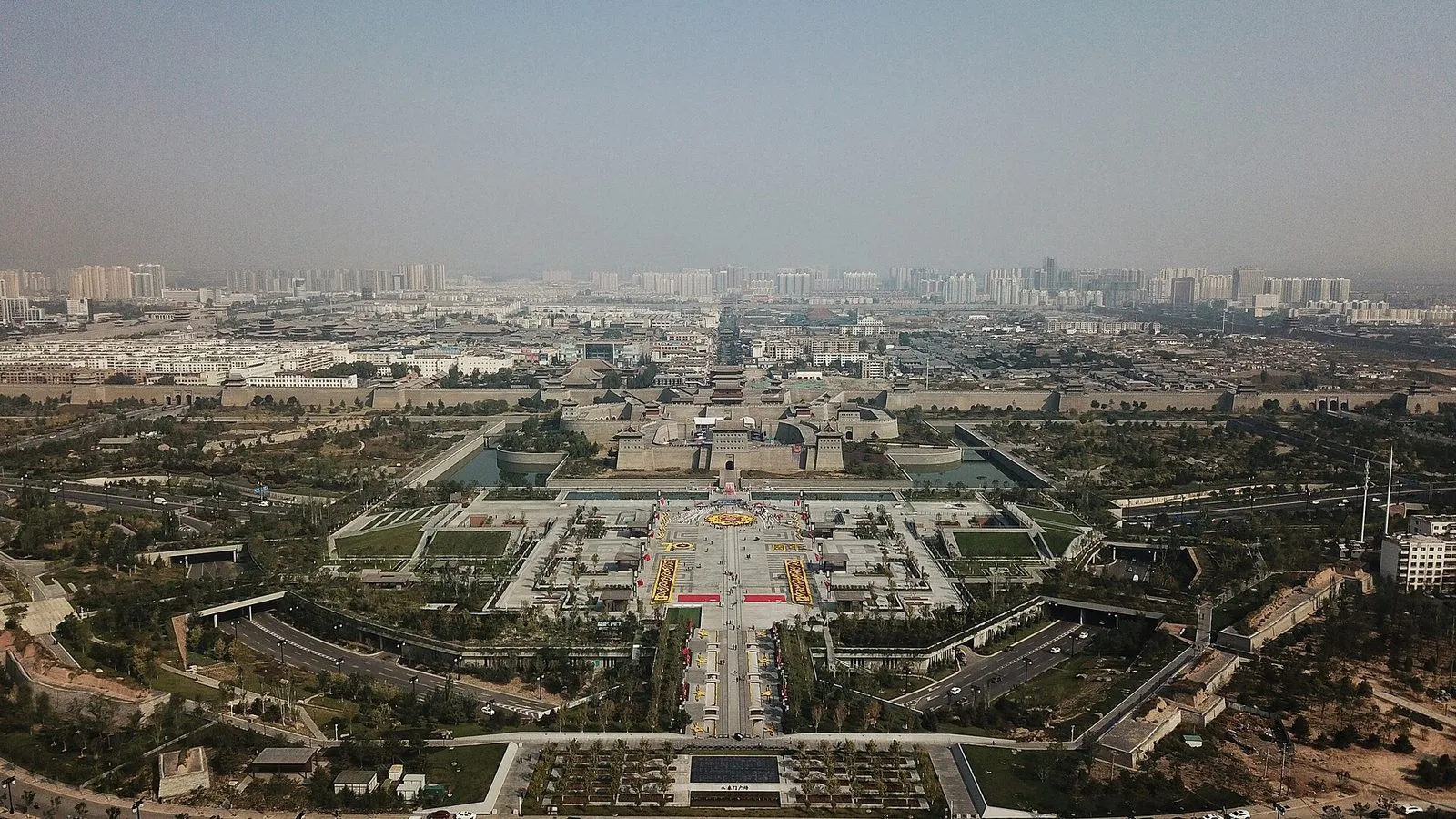
Datong, in the far north of Shanxi province, is China's most underrated ancient capital. For a century it was Pingcheng, capital of the Northern Wei nomadic dynasty, whose rulers carved the Yungang Grottoes into sandstone cliffs west of town — more than 51,000 Buddhas in about 45 major caves and a UNESCO World Heritage site. The Liao and Jin dynasties that followed left giant timber halls, including Huayan Monastery, the largest surviving monastery of their era — buildings a thousand years old. Today the city pairs those treasures with a rebuilt Ming wall you can walk for free, knife-shaved noodles worth the train fare alone, and a working-city grit that keeps prices low. High-speed trains reach Datong South from Beijing in around two to two and a half hours, and the Hanging Temple and Yingxian Wooden Pagoda line up neatly on one day trip south. Best for history lovers, photographers, and second-trip travelers.
Top sights at a glance
No. 1
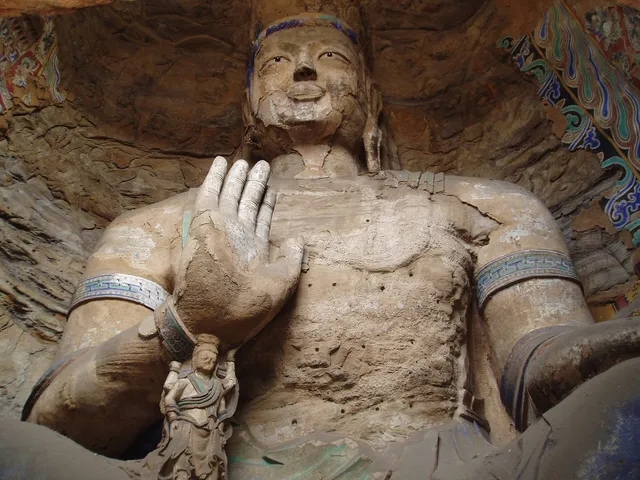
Yungang Grottoes
Carved into a sandstone cliff between roughly 453 and 495 under the Northern Wei dynasty, this UNESCO World Heritage site holds more than 51,000 Buddhist figures across 45 major caves. The Tanyao Five Caves of the 460s open the sequence; Cave 20's open-air seated Buddha, 13.7 meters tall, is the site's enduring symbol; Caves 5 and 6 pack in the finest painted carving. It is among the half-dozen essential art sites in China, and only about an hour from downtown.
Good to know · Tickets cost 120 yuan as of September 2026 and must be booked in advance on the official WeChat mini-program (search its Chinese name, Yungang Grottoes) or Trip.com with your passport — the gate sells no same-day tickets. Hours run about 8:30 a.m. to 5 p.m.; city bus 3 reaches the gate for pocket change, or a taxi takes around 40 minutes. Allow three to four hours.
No. 2
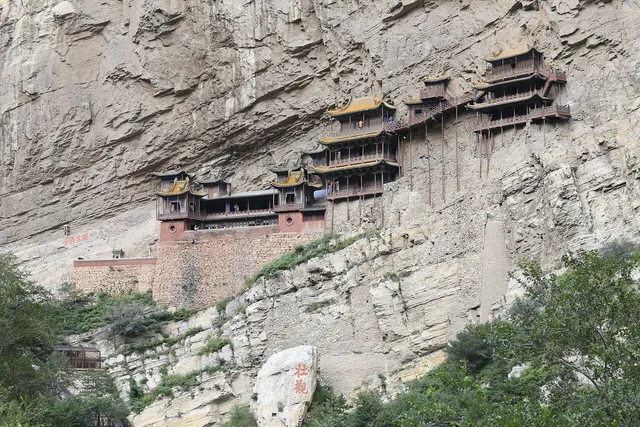
The Hanging Temple
Forty halls of Buddhism, Taoism, and Confucianism share one timber structure pinned to a cliff face more than 50 meters above the floor of Jinxia Gorge — a building trick of half-embedded crossbeams that has held since the temple's founding in 491. Walkways cantilever past shrines and some 80 sculptures; the views down are as memorable as the carpentry. It sits at the foot of Mount Hengshan, about 65 kilometers and ninety minutes from downtown Datong.
Good to know · Expect roughly 15 yuan to enter the gorge and view from below, plus around 100 yuan to climb the monastery itself — climbing tickets are capped daily, so arrive early or book ahead via Trip.com as of September 2026. Hours run about 9 a.m. to 5 p.m. Most visitors combine it with the Yingxian pagoda on a hired-car day trip (a full-day taxi runs around 360 yuan).
No. 3
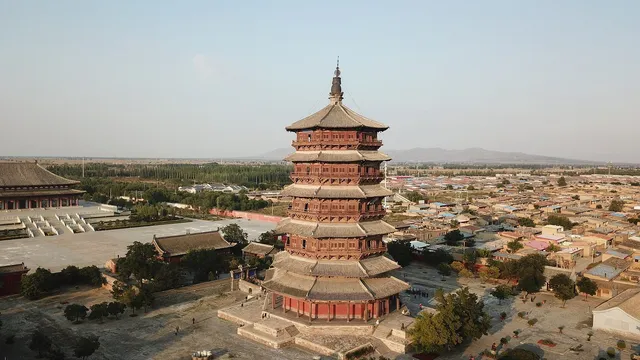
Yingxian Wooden Pagoda
The Sakyamuni Pagoda of Fogong Temple, raised in 1056 under the Liao dynasty, is the oldest and tallest surviving wooden pagoda in the world: about 67 meters of interlocking mortise-and-tenon joinery — roughly 54 bracket types, not a single nail — apparent in five stories but actually nine. An 11-meter Buddha fills the ground floor beneath Liao-style murals. Nine and a half centuries of earthquakes have not shaken it down.
Good to know · Admission is 50 yuan as of September 2026; hours run about 8:30 a.m. to 6 p.m. from March to late October and shorter in winter. The interior upper floors are closed to protect the structure — only the ground floor is on view, so the best photography is from the temple grounds. The pagoda sits in Yingxian town about 70 kilometers south of Datong, paired easily with the Hanging Temple.
No. 4
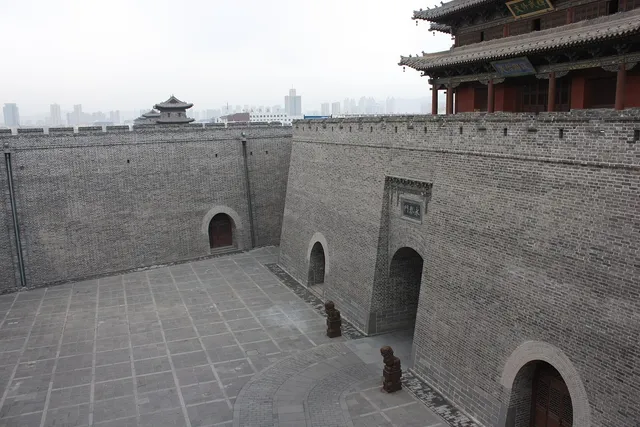
Datong City Wall
Datong's Ming-era wall, first raised in 1372 as the empire's northern shield, has been rebuilt almost from scratch across the 2010s into one of the most imposing urban ramparts in China — crenellated, towered, and floodlit after dark. Walking it is free, and the circuit frames the old city's temples and hutong-like grid on one side and the sprawl of a working city on the other. Sunset into lantern-hour is the signature experience.
Good to know · The wall is open to the public without a ticket as of September 2026; access points sit by the main gates, and the south gate is the classic start. Go in the last hour of daylight, walk twenty to thirty minutes in either direction, and come down for the Drum Tower night streets. Bring your passport in case a gate checks ID.
No. 5
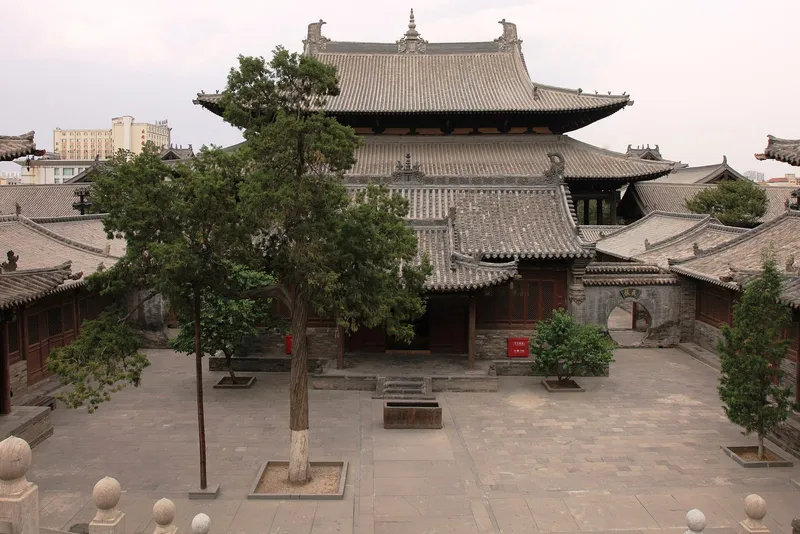
Huayan Monastery
The greatest surviving building complex of the Liao dynasty, begun as an imperial ancestral temple in the eleventh century. Its upper hall — one of the largest Liao-era halls in China at some 1,550 square meters — holds five giant Ming Buddhas beneath more than 890 square meters of Qing frescoes, while the lower monastery's Bhagavan Library shelters about 18,000 volumes and the famous smiling bodhisattva known as the Oriental Venus. Unusually, the halls face east, toward the Khitan sun.
Good to know · Admission is 50 yuan as of September 2026; hours run roughly 9 a.m. to 5 p.m. It sits on Daxi Street inside the old city, a short walk or taxi from the south gate — Metro-style city buses 4, 15, or 30 also stop nearby. Allow ninety minutes, and pair it with the Nine-Dragon Screen and Shanhua Temple in one old-city loop.
Datong is the answer to a question most first-timers do not know to ask: where do you go after the Great Wall stops surprising you? Two hours by bullet train west of Beijing, this former coal capital guards some of the oldest and greatest art in China — a cliff full of Northern Wei Buddhas at Yungang, thousand-year-old timber temples from the Liao and Jin, and the world’s oldest surviving tall wooden pagoda one county south. For a century it was the capital of a nomad dynasty, and the city still carries that frontier confidence. A decade of aggressive rebuilding wrapped it all in a photogenic wall and lantern-lit old streets, while prices stayed coal-town low. Come for two days: one for the grottoes, one for the southern loop of cliff temple and pagoda, with noodles and city-wall nights in between.
A Bit of History
Datong’s golden ages came from the borderlands. Around the end of the fourth century the Northern Wei — a dynasty of Tuoba Xianbei horsemen who unified north China — fixed their capital here, then called Pingcheng, and held court for nearly a century before moving downstream to Luoyang. The dynasty’s masterwork survives on the cliffs 16 kilometers west: the Yungang Grottoes, carved in waves between roughly 453 and 495, beginning with the monk Tanyao’s five imperial caves of the 460s and swelling to more than 51,000 figures. This is where Buddhism first married Chinese stone-carving at imperial scale, and UNESCO listed them accordingly.
The next builders were the Khitan Liao and the Jurchen Jin, who made this their Western Capital and endowed the city with timber architecture of almost impossible age: Huayan Monastery, the largest and best-preserved Liao monastery in existence, and Shanhua Temple, whose layout preserves the Liao-Jin plan better than any complex in China. In 1056, Liao carpenters raised the Sakyamuni Pagoda in Yingxian to the south — 67 meters of wood, still standing. The Ming turned Datong into a fortress: the wall first built in 1372 anchored the “Nine Garrisons” that shielded Beijing from the steppe, and the ruins of frontier walls still thread the nearby hills.
The modern era traded temples for coal. Datong spent the twentieth century as China’s coal capital — the furnaces of the industrial north burned Shanxi black rock, and the city grew rich, gray, and rough-edged. The turn of this century forced the reckoning: mines winding down, air quality notorious, a single-industry economy in decline. The response has been one of China’s most ambitious urban reinventions — new boulevards, a wholesale reconstruction of the Ming wall, and an old city rebuilt in period style around the surviving monuments. Locals will tell you the rebuild is heavy-handed, and it is; it is also, combined with the high-speed rail link to Beijing in around two to two and a half hours, the reason you can now spend a weekend walking among fifth-century Buddhas in a city that markets itself, half-joking, as the “ancient capital of universal harmony.”
Culture & Daily Life
Datong wears its working-city identity openly, and that is its charm. This is not a polished tourist town: coal trucks still roll the ring roads, breakfast is lamb-offal soup at steamy counters, and shopkeepers deal in the direct, deadpan style of northern China — blunt at first contact, generous the moment you engage. Nobody performs for visitors here, which is exactly why the rewards feel earned. The old city, rebuilt in gray brick around the monuments, fills after dark: lanterns over the Drum Tower streets, food stalls doing brisk business, wedding parties photographing under the south gate. The slogan on the gates — Datong can be read as “great unity” — is a civic pun the whole town is in on, and locals will happily explain it over a bowl of noodles.
Religion here is not a museum piece. Huayan and Shanhua remain working monasteries: incense smoke, chanting, and pilgrims from the Mongolian grasslands circle the great Buddhas daily, and the Buddhist art you see at Yungang has an unbroken devotional line to the worshippers beside you. That living link is the best argument for hiring a guide for an hour — the iconography rewards context, and good English-speaking guides can be booked through agencies or hotels for modest fees.
Practically speaking, Datong is easy. The old city is flat and compact enough to cover on foot in a day; taxis and DiDi are cheap and everywhere; English is rarer than in Beijing, so keep your hotel’s Chinese address handy. Summers are cool and dry by Chinese standards — the emperors summered in these hills for a reason — while winters are serious business, cold and clear. Payments run through Alipay and WeChat Pay at every counter and stall. And bring an appetite: Datong’s kitchens are a genuine reason to come, not a footnote between sights.
Nature & Day Trips
Datong’s landscapes are of the dry, sculptural sort — wind-carved cliffs and big skies — and the day trips are among the best in North China. The southern loop is the essential one: 65 kilometers out at the foot of Mount Hengshan waits the Hanging Temple, and 70 kilometers south of the city, in Yingxian, the great wooden pagoda. The two sites line up on the same road corridor toward the south, so a hired car or driver for the day — expect around 360 yuan as of September 2026 — turns them into a single, spectacular circuit of early timber engineering. Formal buses also run from Datong’s long-distance stations to both towns if you would rather piece it together.
Westward, the Yungang cliffs themselves provide the best easy nature walk: beyond the famous caves, a green park stretches along the bluff with quieter later caves carved into the rock face, and the stroll between them is half the visit. To the north, eroded Ming frontier walls break the horizon toward Inner Mongolia, and the dormant volcanic cones east of the city offer bleakly beautiful hiking for drivers with an extra half-day. In town, the wall circuit and the riverside parks cover the after-dinner walk. You do not come to Datong for lakes and forests; you come for stone, wood, and sky, and it delivers.
Food & Drink
Shanxi is noodle-and-vinegar country, and Datong is arguably its noodle capital. The signature is daoxiao mian — knife-shaved noodles, where the cook shaves ribbons of dough directly from a block into boiling water with a practiced wrist-flick — served with braised pork, tomato-egg, or mutton toppings at prices that feel like typos. Around the canon: lamb-offal soup with fried dough for breakfast, yang za ge; youmian kaolaolao, oat-flour tubes steamed in bundles and dressed with garlic-vinegar; and youzha gao, crisp fried millet-paste cakes served at celebrations. This is the same province that perfected mature vinegar, so dip everything — the local bottled vinegar drinks are a curiosity worth trying once just for the story. The best shops shave each bowl to order, and the theater is half the meal.
Eating well is a matter of following the counters, not the signage. Mornings start early and hot: offal-soup shops fill before seven, and a sit-down breakfast rarely costs more than pocket change. Lunch is noodle-shop territory, and the streets around the Drum Tower and the old-city lanes hold dense clusters of kitchens doing steady local business. In warm months the night market near the south gate spreads skewers, baked flatbreads, and fresh soy milk through the evening. Tourist restaurants inside the rebuilt quarters look handsome and cost more for the same bowls — one meal there is pleasant, then go local. Vinegar sits on every table; chili oil is optional but encouraged. Budgets are friendly: a generous meal runs 20–50 yuan, and even banquet-style feasts with lamb and local liquor stay well below big-city prices. Pay by Alipay or WeChat Pay everywhere, carry the hotel address in Chinese for the walk home, and do not leave without one more bowl of knife-shaved noodles — they are the single taste most travelers carry out of Shanxi.
Top Sights
Yungang Grottoes
The reason the train exists. Sixteen kilometers west of downtown, a kilometer of sandstone cliff holds 45 major caves and more than 51,000 carved figures — Buddhas, bodhisattvas, musicians, and flying apsaras chiseled from the 450s to the 490s under the Northern Wei. The Tanyao Five Caves (16–20) came first, commissioned by the monk Tanyao in the 460s; Cave 20’s colossal open-air Buddha — 13.7 meters, exposed when the cliff face collapsed centuries ago — is the image from every photograph of China. Deeper in, Caves 5 and 6 are the showpieces: a seated Buddha counted among the tallest indoor statues in China, and a pagoda pillar wrapped in more than thirty relief panels of the Buddha’s life — the pair opens on a rotating schedule to protect the pigments. The later “Five Magnificent Caves” (9–13) hold the best-preserved color. Tickets are 120 yuan as of September 2026 and sold online only — reserve days ahead on the official WeChat mini-program or Trip.com with your passport; the gate sells no same-day entry. Hours run about 8:30 a.m. to 5 p.m.; bus 3 gets you there for pocket change, a taxi in about 40 minutes. Give it half a day.
The Hanging Temple
Fifty meters up a gorge wall at the foot of Mount Hengshan dangles the most improbable building in China: a monastery founded in 491, its slender columns braced against rock, its real weight carried by half-embedded crossbeams — the whole timber stack appears to float. Buddhism, Taoism, and Confucianism share the forty halls and some eighty sculptures, a doctrinal ecumenicalism you will not see elsewhere, and the walkways between them cling to the cliff with views straight down Jinxia Gorge. The engineering has held for fifteen centuries. As of September 2026, expect around 15 yuan to enter the gorge and admire from below, plus about 100 yuan to climb the monastery itself; climbing slots are capped daily, so arrive at the 9 a.m. opening or book ahead via Trip.com — roughly 130 yuan all-in at peak. The temple lies about 65 kilometers south — roughly ninety minutes by hired car, round-trip taxi around 150 yuan — and pairs naturally with the Yingxian pagoda in one day.
Yingxian Wooden Pagoda
An hour further south in Yingxian town stands China’s most astonishing piece of carpentry: the Sakyamuni Pagoda of Fogong Temple, raised in 1056 by the Liao dynasty without a single nail. About 67 meters tall on a 30-meter base, it shows five visible stories over four hidden ones, held up by some 54 bracket types — joinery so supple the tower has shrugged off nine and a half centuries of earthquakes. Preservation rules close the interior beyond the ground floor, where an 11-meter Sakyamuni stands beneath original Liao-style murals — a disappointment to climbers that has almost certainly saved the building. Admission is 50 yuan as of September 2026, open about 8:30 a.m. to 6 p.m. March through late October, shorter in winter. The pagoda sits about 70 kilometers south of Datong — long-distance bus plus a short taxi, or naturally combined with the Hanging Temple on a hired-car day. Walk the grounds, study the bracket sets from below, and appreciate a building that is one enormous wooden joint.
Datong City Wall
Datong’s rebuild is the most controversial urban project in China’s heritage world, and the wall is its monument — literally. The Ming wall first raised in 1372 guarded the empire’s northern march; across the 2010s the city rebuilt it almost from scratch into a full crenellated rampart with gate towers and corner turrets. Purists debate the rebuild; visitors get the best city-viewing platform in North China, free to walk. From the top, the old city reads as a grid of gray roofs anchored by temple complexes — Huayan, the Drum Tower, the Nine-Dragon Screen — while outside sprawls the modern city, and beyond it the ranges that made this a frontier. Come in the last hour of daylight and stay for the floodlights: heavy-handed, irresistible, the illumination draws strollers and wedding photographers to the gate plazas. As of September 2026 the wall is open to the public without a ticket; enter at the south gate, walk twenty to thirty minutes in either direction, and finish into the lantern-lit Drum Tower streets for dinner. Bring your passport in case a gate checks ID.
Huayan Monastery
Inside the old city, a five-minute walk from the wall’s south gate, stands the finest surviving complex of Liao timber architecture — begun in the eleventh century as an imperial ancestral temple of the Khitan dynasty. Two things set it apart: scale and orientation. The upper monastery’s main hall runs some 1,550 square meters — among the largest Liao-era halls in existence — crowded by five giant Ming Buddhas under more than 890 square meters of Qing-era frescoes. And the halls face east, toward the rising sun, in the Khitan manner, rather than south as Chinese ritual prescribed. In the lower monastery, the Bhagavan Library shelters a carved scripture cabinet holding about 18,000 volumes, and the smiling bodhisattva nicknamed the Oriental Venus is the most photographed figure in Datong. It remains a working monastery: incense, chanting monks, and Mongolian pilgrims give it a warmth the rebuilt quarters lack. Admission is 50 yuan as of September 2026, hours roughly 9 a.m. to 5 p.m.; the setting makes an easy loop with Shanhua Temple, the Nine-Dragon Screen (a 45-meter glazed Ming dragon wall, 10 yuan), and dinner in the Drum Tower lanes.
Getting There & Around
Beijing is the natural gateway: high-speed trains run from Beijing North or Qinghe station to Datong South in around two to two and a half hours as of September 2026, with no direct flights worth considering. Datong South is the terminus of two high-speed lines — toward Zhangjiakou and Beijing on one side, and down the Datong–Xi’an line on the other — so direct trains continue south through Taiyuan toward Pingyao (budget around two and a half to three hours) and Xi’an. That makes Datong the natural hinge of a Shanxi loop. Datong Yungang Airport, 17 kilometers north of downtown, handles domestic routes; Taiyuan’s larger airport is the fallback for international connections.
On the ground, the old city is walkable and flat; taxis and DiDi are inexpensive and essential for the far sights. City bus 3 runs to the Yungang Grottoes for a few yuan (about 40 minutes by road), long-distance buses serve Yingxian and Hunyuan from the north bus station, and a hired car with driver — around 360 yuan for the southern loop day — is the honest best value for Hanging Temple plus pagoda. There is no metro; let that shape your hotel choice.
Where to Stay
Two bases cover most travelers. Inside or beside the rebuilt old city is the atmospheric choice: gray-brick courtyard-style hotels cluster near Huayan Monastery and the Drum Tower, putting the wall’s south gate, the night streets, and dinner within a ten-minute walk — best for first visits and short stays. The area around Datong South railway station trades charm for logistics, suiting travelers with early trains toward Beijing or Pingyao; new business hotels there are modern and inexpensive. A third option for drivers: lodging along the Yungang road cuts the morning run to the grottoes, at the cost of evening walks in the old city. Whatever you pick, book ahead for the early-October Golden Week and summer weekends, when Beijing weekenders fill the old city; winter, though cold, is quiet and cheap. Rooms here cost noticeably less than Beijing or Xi’an for comparable quality — one more way the former coal town under-promises and over-delivers.
Sources & verification (10)
- https://www.chinahighlights.com/datong/
- https://www.chinahighlights.com/datong/attraction/yungang-grottoes.htm
- https://www.travelchinaguide.com/attraction/shanxi/datong/
- https://www.travelchinaguide.com/attraction/shanxi/datong/hanging.htm
- https://www.travelchinaguide.com/attraction/shanxi/datong/wooden_pagoda.htm
- https://www.travelchinaguide.com/attraction/shanxi/datong/huayan.htm
- https://www.travelchinaguide.com/attraction/shanxi/datong/shanhua.htm
- https://www.travelchinaguide.com/attraction/shanxi/datong/9dragon.htm
- https://www.travelchinaguide.com/cityguides/shanxi/datong/transportation/
- https://www.chinadiscovery.com/shanxi/datong.html