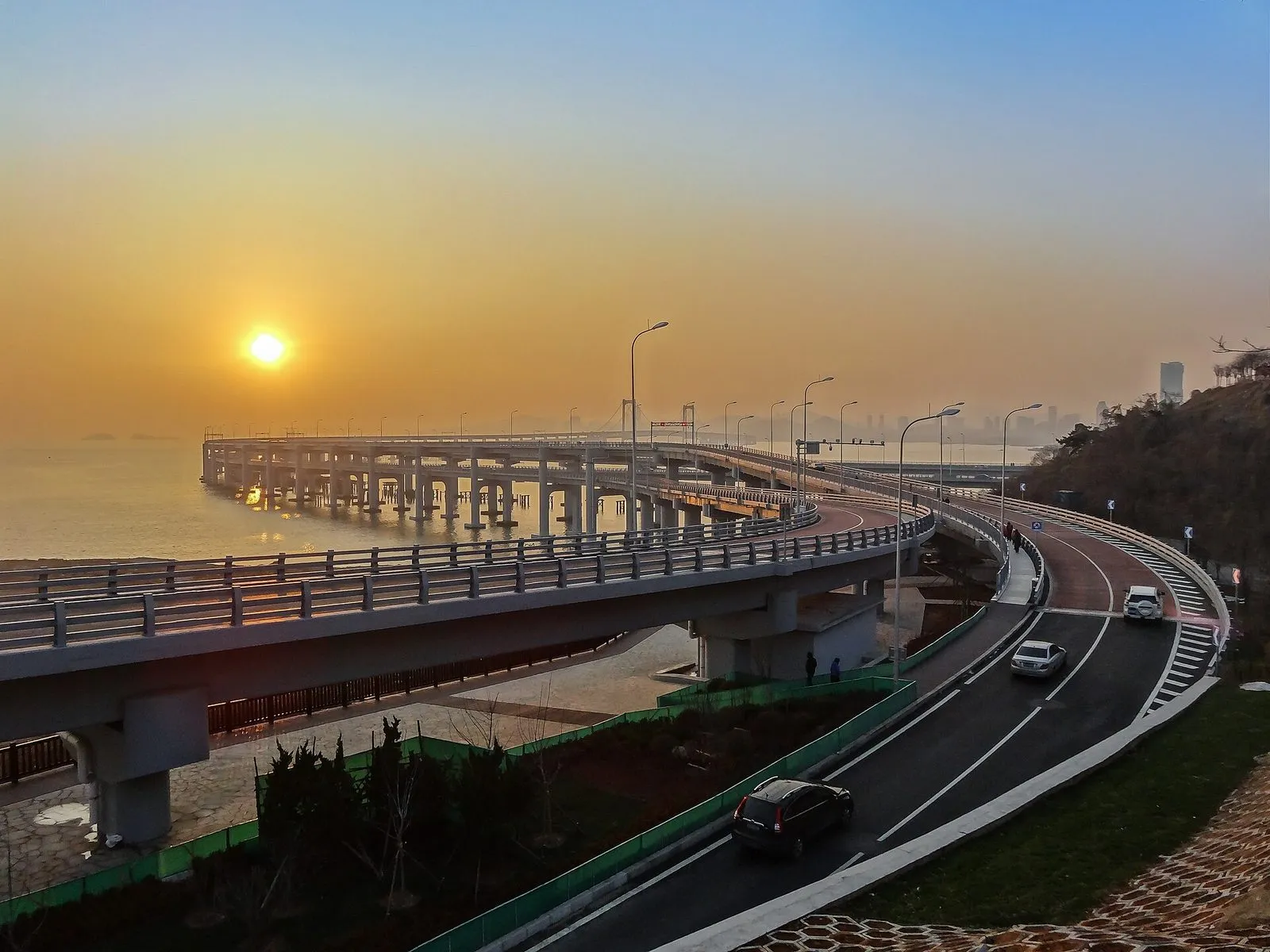
Dalian sits at the tip of the Liaodong Peninsula, where northeast China finally runs out of land and the Yellow Sea takes over — and the city behaves accordingly: hills and squares instead of smokestacks, boardwalks and beaches instead of blast furnaces. Built from 1898 as a Russian planned port, fought over in the Russo-Japanese War, and developed for four decades as a Japanese colonial showpiece, it layers that turbulent history into grand roundabouts, a century-old tram line and the war-scarred harbor of Lushun. Modern Dalian is China's comfortable seaside north: clean air, a walkable coast road, an enormous reclaimed city square, family ocean parks, surf-pounded rock formations at Jinshitan, and a seafood table — sea urchin, abalone, braised starch cakes — that justifies the trip alone. Best for summer escapees, families, history readers, and anyone pairing it with Harbin or Shandong by high-speed rail or overnight ferry.
Top sights at a glance
No. 1
Xinghai Square & the Coast
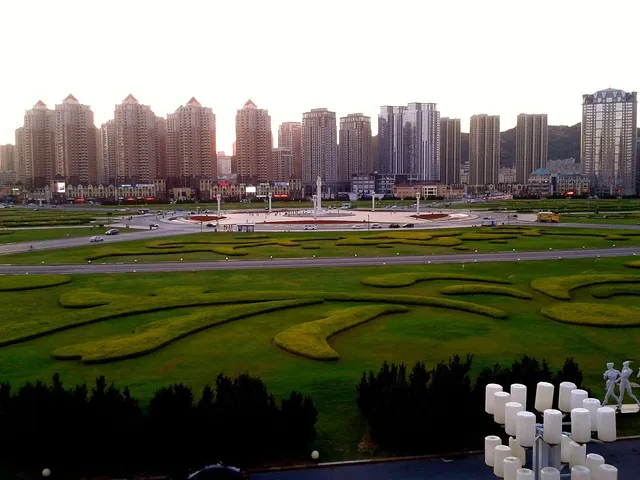
Carved out of the sea by landfill, Xinghai Square spreads across 110 hectares — by most reckonings the largest city square in the world — opening onto Xinghai Bay and the curling span of the cross-sea bridge. A bronze open-book sculpture and a thousand cast footprints mark the city's centenary; a musical fountain plays after dark; and the shore path links beaches, a shell museum and seafood strips. In late July and early August the square hosts China's biggest beer festival.
Good to know · The square is free and open at all hours; sunset into fountain-and-lights evening is the peak window (as of September 2026). Metro Line 1 and tram 202 both serve the area, and the beach beside it is sandy and family-friendly. Festival weeks are lively but crowded — book rooms well ahead.
No. 2
Binhai Road
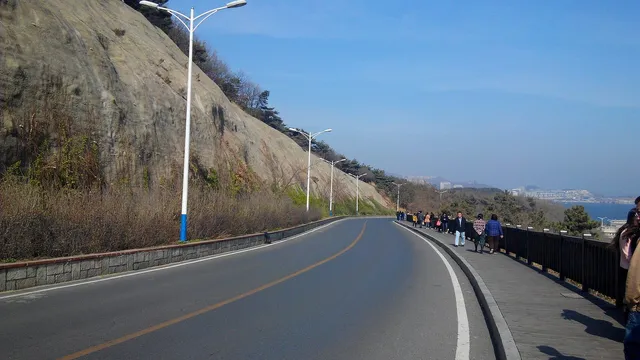
Dalian's masterpiece is a road: some thirty kilometers of cliff-hugging coastline threading from Xinghai Bay past beaches, kiosk terraces and hanging walkways to Laohutan and Bangchuidao, with forested hills on one side and the Yellow Sea on the other. A wooden boardwalk runs much of the route, and the city's annual walking festival fills it with tens of thousands of strollers. However you do it — on foot, by tourist bus, or in installments by taxi — it is the best free sightseeing in northeast China.
Good to know · A circular tourist bus (around ¥10) runs the coastal sights from near the railway station roughly 8:00–16:00 in season (as of September 2026). Walk the prettiest stretch between Fujiazhuang and Laohutan; wear real shoes, not sandals. Mornings have cleaner light and thinner crowds.
No. 3
Laohutan Ocean Park
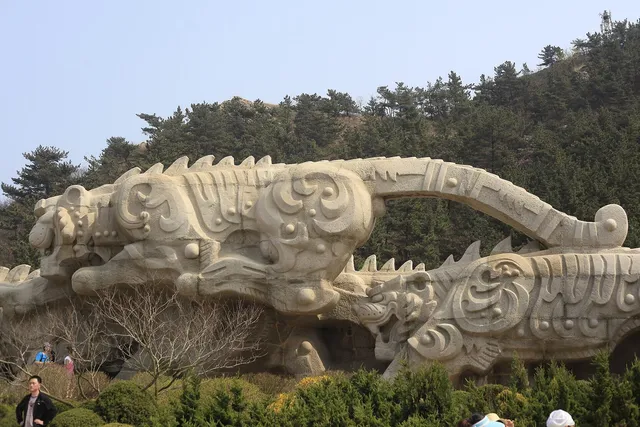
On the southern shore, Laohutan (Tiger Beach) is one of China's largest ocean parks, spreading over more than a square kilometer of coastline anchored by the Polar Aquarium — belugas, penguins, polar bears and dolphin shows — plus a bird forest, coral hall and the landmark Tiger Sculpture plaza, where six granite tigers glare at the sea. Cable cars and sightseeing boats loop the bay. It is commercial, loud and thoroughly enjoyed by Chinese families; with kids in tow, plan a whole day.
Good to know · Admission runs about ¥200 in high season (roughly April 10 to October) with a lower winter rate; hours are around 8:00–17:00 (as of September 2026). Book through official channels or the park's online store, pay with Alipay or WeChat Pay, and catch at least one aquarium show — schedules post at the gate. Arrive at opening; afternoons get thick with strollers.
No. 4
Jinshitan
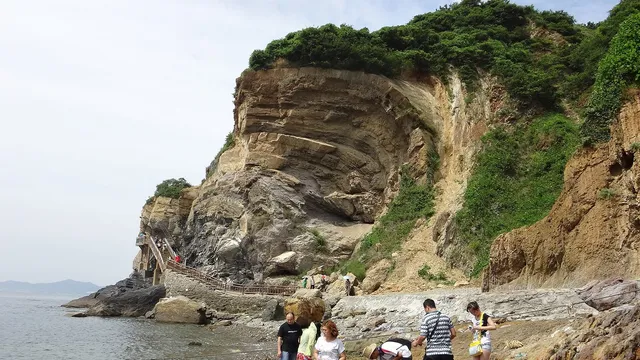
The 'Golden Pebble Beach,' an hour northeast of downtown, is where geology steals the show: a national geopark of sandstone and conglomerate sculpted by the sea into dragons, turtles and rose-colored walls from sediments hundreds of millions of years old, all viewable on a cliffside boardwalk. Around it sit a long swimming beach, resort hotels, golf and a large amusement park. It is Dalian's beach day and its rock-hammer day rolled into one excursion.
Good to know · Reachable on Metro Line 3 (the express 'kuaigui' line) to Jinshitan station, about an hour from downtown (as of September 2026). The Coastal Geopark charges around ¥60 in high season; the beach itself is free. Low tide reveals the best rock formations — check tide times locally — and summer weekends pack the sand.
No. 5
Zhongshan Square
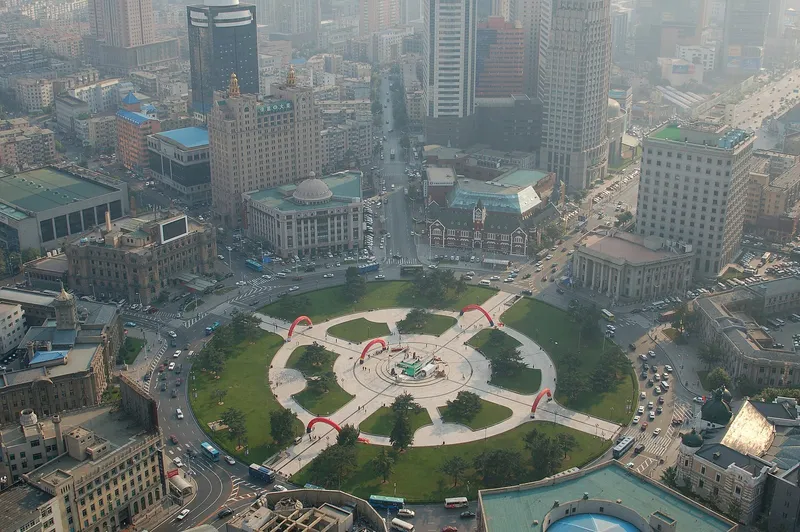
Dalian's history circulates around its roundabouts, and Zhongshan Square is the grandest: a circular plaza laid out in the Russian era as Nikolayevskaya Square, ringed by a dozen grand banks and offices built in Romanesque, Gothic and Renaissance revival styles under Russian then Japanese administration. Today the buildings still house financial institutions while the center hosts a fountain, chess players and dancers. Come at night, when the facades are floodlit and the brass-age architecture glows.
Good to know · Free and open at all times; evenings are best (as of September 2026). It sits ten minutes' walk from the railway station — pair it with the vintage tram 201, which rumbles past nearby. The nearby 'Russian Style Street' is a made-for-tourists rebuild; skip it in favor of the real colonial fabric around the square itself.
Dalian is northeast China’s exhale. The region’s cities are famous for smokestacks and sub-zero winters, but at the tip of the Liaodong Peninsula the geography changes the character: hills run down to a blue sea, the air moves, summer temperatures stay mild while the interior swelters, and the streets — arranged, uniquely in China, around dozens of circular squares — came from a Russian master plan and a Japanese colonial rebuild. That layered past is genuinely legible here, from the floodlit bank palaces of Zhongshan Square to the war forts of Lushun. And the water matters: a coast road you will want to walk all day, rock formations older than the dinosaurs, an aquarium empire, and a serious seafood table. Add a century-old tram and China’s biggest city square, and Dalian earns its nickname: the Northern Pearl.
A Bit of History
Dalian’s founding date is uncomfortably precise, and foreign. In 1898 the Russian Empire leased the southern Liaodong Peninsula — having pressured a weakened Qing court after China’s defeat in the first Sino-Japanese War — and began building its flagship warm-water port at Lushun (Port Arthur to the West) with a commercial twin city on Dalian Bay, named Dalny, “far away.” Two empires wanted exactly this harbor — and the harbor remains a working naval base today — which is the short version of what came next. Japan had seized Lushun bloodily in 1894 during that war, then been forced by Russia and its partners to hand it back; in 1904 Japan attacked again. The Russo-Japanese War — fought, astonishingly, entirely on Chinese soil between two foreign armies — hinge-turned here: the ten-month siege of Port Arthur, with its trench lines and hill forts, was one of the modern era’s first industrial wars, and Japan’s victory inaugurated four decades of colonial rule over the whole territory.
Japan ran its leased Kwantung Territory hard and built Dalian as a showpiece: planed boulevards, circular squares, the grand South Manchuria Railway headquarters, and a port that by the 1930s moved more cargo than any in East Asia. The squares’ banks, Yamato-era hotels and the 1937 colonial city hall survive as the city’s working center — architecture as annexation, preserved in daily use. In August 1945 Soviet forces took the city; in 1955 it finally returned to Chinese administration, closing a half-century in which Dalianites had changed rulers, currencies and street names three times without moving house.
The People’s Republic made Dalian the north’s shipyard and oil-refining port — the refitting yard where China’s first aircraft carrier took shape is here — and, from the 1990s, its certified liveable-city darling. That history explains the city’s odd, appealing texture: the squares and bank palaces are colonial, the seafood is borderless, the accent is northeastern, and the war memory, preserved at sites around Lushun, is presented in China with unambiguous bitterness. Reading that story on the ground — honestly told at the museums and forts — is one of the most affecting things a history-minded traveler can do in northeast Asia.
Culture & Daily Life
Dalian does not behave like the rest of the northeast, and locals know it. Winters are windier but milder than Harbin’s; summers are the region’s reward — July afternoons in the high 20s with sea haze instead of furnace heat — and the whole city reorganizes around the waterfront when they arrive. Beach kit, kites, squid skewers and evening strolls; the squares fill with dancers and the coastal boardwalk becomes a communal gymnasium. This is a hilly city built on circles rather than grids: traffic (and life) spirals around Zhongshan, Renmin, Olympia and a long list of other roundabouts, which gives street corners a plaza-like sociability that never quite turns off after dark.
The northeast’s fingerprint remains. Migration here came overwhelmingly by sea from Shandong in the great Chuang Guandong wave, so the dialect is Dongbei-flavored but the food is a bridge between the two coasts. Dalian is one of China’s most football-mad cities — veterans’ leagues and stadium culture run deep — and its beer festival each late July–early August at Xinghai Square pours for ten days.
Two pieces of living history to use, not just photograph. First, the trams: route 201 has run since 1909, and vintage-style cars still rattle from the railway station toward Haizhiyun Park — at a fare of one to two yuan, it is China’s cheapest heritage ride. Second, the ferry piers: this is a port city where overnight boats still cross to Shandong, and the terminal’s departures board is a working piece of geography. Daily rhythms are early by Chinese standards — markets peak in the morning, nightlife fades near midnight — and the tempo softens further on the coast. English is limited; a translation app plus a point at the aquarium works fine. Payment is Alipay and WeChat Pay everywhere, including tram conductors and beach vendors.
Nature & Day Trips
Dalian’s natural endowment is its coastline — nearly two thousand kilometers of it across the municipality, cliffs and coves wrapping the peninsula — and the city has engineered access to almost all of it. The spine is Binhai Road and its boardwalk (see Top Sights); the geology showpiece is Jinshitan’s sea-sculpted sedimentary coast; the swimmer’s belt runs through Fujiazhuang and Bangchuidao, where the water is cleanest. Watch for the local swimming-club culture: hardy residents take the sea from May to October, and winter swimmers cut through February ice for spectacle.
The essential day trip is Lushun (Port Arthur), at the peninsula’s western tip. The military logic of a century is visible in one panorama: the narrow harbor mouth, White Cloud Hill, the 203 Hill artillery position and the fort lines of the Russo-Japanese siege, plus the moving Russo-Japanese War sites, the 1917 Lushun Museum (free, closed Mondays) and the Soviet-era martyrs’ cemetery. Buses and the metro-connector rail run out; a taxi tour lets you stack the views.
Beyond the peninsula, the classic extensions run by sea and rail. The Bohai ferry crosses to Yantai and Weihai on the Shandong coast — daytime sailings take roughly six to seven hours, and overnight boats with berths run the same route — linking Dalian naturally to a Shandong loop. On land, the high-speed line puts Shenyang 1.5 hours away and Harbin about 3.5, so the city chains cleanly into a northeast itinerary.
Food & Drink
Seafood is the reason to be hungry in Dalian. The Yellow Sea and Bohai confluence delivers cold-water quality: sea urchin (eaten raw, spooned straight from the shell, or as a dense roe rice bowl), abalone grilled or congee-ed, oysters the size of a fist, mantis shrimp, blue crabs, clams and sea cucumber at celebratory prices. The local ordering style is market-fresh: pick your seafood at the counter or market, pay by weight, and a back-street kitchen steams or braises it to order. Spring through autumn is prime; early summer overlaps with the fishing closed season, when farmed and frozen product fills the gap — quality stays high, prices climb.
Then there is the snack canon. Menzi — braised starch jelly, cut into cubes and fried crisp, then sauced with sesame paste, garlic and chili — is Dalian’s street-food signature and costs pocket change. Try it once fried and once cold-dressed. Other institutions: salted fish with cornbread (xianyu bingzi), a fisherman’s plate of pan-fried small fish and coarse corn cakes; sea-intestine rice, a briny local delicacy over steamed rice; and dumplings stuffed with shrimp and leek, the region’s default comfort food. Barbecue stalls along the shore do squid and oysters late into summer evenings, and nowhere in town is far from one.
Drink like a local: this is beer-festival territory, and draft beer with seafood is the default dinner setting, though many classic seafood places keep things alcohol-light for family tables. Coffee culture is decent around the squares and along the Donggang waterfront. Budget realistic: a seafood market feast runs ¥80–150 per person depending on what you point at — urchin and abalone move the needle — while menzi-plus-skewers street dinners land under ¥40. Bring no cash whatsoever: Alipay and WeChat Pay work at every stall, and morning markets are the freshest (and cheapest) seafood classroom in the city.
Top Sights
Dalian sightseeing splits cleanly into coast, parks and history. Budget one day for the Binhai Road arc between Xinghai Square and Laohutan, one for Jinshitan or Lushun, and a couple of evening hours for the squares.
Xinghai Square & the Coast
Start at the postcard. Xinghai Square — “Sea of Stars” — is an exercise in scale: 110 hectares of reclaimed waterfront arranged around fountains, lawns and sculpture, generally credited as the world’s largest city square. The symbolic furniture is worth decoding: the open-book sculpture and the thousand bronze footprints (cast from real Dalian residents) commemorate the city’s 1999 centenary, and the cross-sea bridge arcs across the bay. Come at golden hour, stay for the musical fountain after dark, and finish on the adjacent beach as the bridge lights up.
Everything here is free and always open; the fountain and light shows run in the evening in season (as of September 2026). Metro Line 1 and tram 202 deliver you to the area, and late July brings the China International Beer Festival, when the square fills with tents, pours and bands — great fun, book lodging early. Sunset over the bridge is the photograph you came for.
Binhai Road
Dalian’s coastal road is the rare sightseeing artery that is itself the attraction. Cut into cliffs between forest and sea, Binhai Road strings together beaches, boardwalks, bridges and kiosk terraces for roughly thirty kilometers along the southern shore; a continuous wooden walkway lets you do the scenic middle sections on foot, and the whole route doubles as the course of the city’s international walking festival. The classic stretch links Xinghai Square through Fujiazhuang Beach to Laohutan — headlands, tidal rocks and rest platforms, a blend of exercise and panorama locals treat as a daily gym.
Logistics are easy. The circular coastal tourist bus (around ¥10) departs near the railway station and hits the main sights, roughly 8:00–16:00 in season (as of September 2026); taxis hop between trailheads for a few tens of yuan; and DiDi works along the whole route. Wear genuine walking shoes, carry water in summer, and start early — the middle-morning tour buses cluster after ten. Even a two-hour walk between beaches will reorder your impression of a Chinese city commute.
Laohutan Ocean Park
Families, this is your day. Laohutan Ocean Park gathers one of China’s biggest marine-park complexes onto a wooded southern-shore bay: the Polar Aquarium stars belugas, penguins, polar bears and performing dolphins in a 2,000-seat theater; adjacent halls cover coral, birds and sea mammals; and the outdoor centerpiece is the Tiger Sculpture plaza, where a row of enormous granite tigers strains toward the sea — the city’s signature photo op. Cable cars cross the bay overhead and sightseeing boats loop the coast.
Tickets run about ¥200 in the April–October high season (less in winter), with hours around 8:00–17:00 (as of September 2026); buy through official channels with Alipay or WeChat Pay and plan three to four hours minimum. Show schedules post at the entrance; arrive at opening, because the crowd curve steepens fast. Animal-welfare-minded travelers should know what they are buying: this is spectacle-first marine entertainment, popular and polished, not a rehabilitation center. If that sits poorly, the adjacent coastline gives you the same bay for free.
Jinshitan
Dalian’s beach-and-rocks excursion runs an hour northeast to Jinshitan, the Golden Pebble Beach national resort. The headline act is the Coastal National Geopark: a cliff boardwalk over sedimentary rock laid down hundreds of millions of years ago and since sculpted by tides into a gallery of natural sculpture — turtle heads, dragon silhouettes, rippled “rose garden” walls. Geology-averse companions get their payment at the wide, clean swimming beach next door, backed by resort hotels, seafood strips and, for the amusement-park contingent, Discoveryland next door.
Getting there is half the charm: Metro Line 3, the elevated express line, runs from downtown to Jinshitan station in about an hour for a few yuan (as of September 2026). The geopark ticket runs around ¥60 in high season with the beach free; hours run roughly 8:30–17:00 in summer (as of September 2026). Time your visit around low tide for the fullest rock exposure, bring sun protection — the boardwalk is exposed — and if the summer weekend crowds grate, the far end of the beach quiets down fast.
Zhongshan Square
History is Dalian’s second coastline, and Zhongshan Square is its best gallery. Laid out under Russian rule as Nikolayevskaya Square and refined in the Japanese era, this wide circular plaza is ringed by about ten buildings in Romanesque, Gothic and Renaissance revival dress — built as banks and institutions under two colonial administrations, many still operating as banks today. The ensemble reads like a northern financial street lifted whole into Liaoning, circling a green center where fountain, chess players and dance troupes share the afternoon.
Come after dark, when floodlights warm the facades and the circle fills with promenaders; the square is free and always open (as of September 2026). It sits ten minutes from the railway station, so pair it with arrival day and the heritage tram 201, whose rattling cars pass nearby. One honest warning: the “Russian Style Street” a few blocks north is a commercial rebuild aimed at tour groups — skippable without guilt. The squares’ real magic is comparative, so see Zhongshan at night and let the roundabout logic of the city sink in.
Getting There & Around
Dalian Zhoushuizi International Airport, ten kilometers northwest of downtown, flies dense domestic routes plus regional East Asian and Russian connections, and Metro Line 2 runs from the terminal into the center past Zhongshan Square — an unusually easy airport transfer (as of September 2026). The rail story is better still: Dalian anchors the Harbin–Dalian high-speed line, with bullet trains from Dalian North station reaching Shenyang in about 1.5 hours, Changchun in 2.5, and Harbin around 3.5 — a clean chain for a northeast itinerary — while classic overnight trains cover Beijing. The old Dalian station, right by Zhongshan Square, handles conventional services. Sea approach: passenger ferries run from the port terminal to Yantai, Weihai and Tianjin, the Shandong crossings taking roughly six to seven hours by day boat, with overnight berths available; book via official operator channels or at the terminal.
In town, metro Lines 1, 2, 3 and 12, trams 201 and 202, and a dense one-yuan bus network cover the sights cheaply; DiDi works normally and taxis are metered. The core squares, station and waterfront are walkable in a huffing, hilly way — that is part of the charm — and the coast sights chain naturally by tourist bus.
Where to Stay
Pick a base by mood. The Qingniwaqiao–Zhongshan Square zone, between the railway station and the harbor, is the default: walkable to the squares, tram 201 on the doorstep, mid-range chains and shopping malls all around, and the coastal tourist bus starting nearby — best for first-timers and rail arrivals. The Xinghai Bay area trades centrality for horizon: modern high-rise hotels facing the square and bridge, the beach and fountain show out front, and metro access downtown — the pick for families and sunset people. The Donggang waterfront, east of the harbor, is the sleek new option: conference-center architecture, a musical fountain of its own, boardwalk strolls and fresh-air mornings, with fewer budget choices. For a beach-base holiday, Jinshitan’s resort strip puts sand and the geopark within walking distance, a metro ride from town. Whatever the zone, summer weekends and beer-festival week surge — reserve as early as your train tickets, and keep your passport handy at check-in.
Sources & verification (10)
- https://en.wikipedia.org/wiki/Dalian
- https://en.wikipedia.org/wiki/Xinghai_Square
- https://www.travelchinaguide.com/attraction/liaoning/dalian/laohutan.htm
- https://www.travelchinaguide.com/attraction/liaoning/dalian/jinshitan.htm
- https://www.travelchinaguide.com/attraction/liaoning/dalian/square.htm
- https://www.travelchinaguide.com/attraction/liaoning/dalian/lushun.htm
- https://en.wikipedia.org/wiki/Trams_in_Dalian
- https://en.wikipedia.org/wiki/Bohai_Train_Ferry
- https://en.wikivoyage.org/wiki/Dalian
- https://www.travelchinaguide.com/cityguides/liaoning/dalian/getting-there.htm